Winter is here! Not only does winter mean a break from the cripplingly oppressive Hoedspruit heat, but it also means, Milky Way season! What better way to take advantage of the cloudless winter conditions than to capture your very own photo of our galaxy’s great spiralling arms reaching into the sky like a cosmic ladder to the heavens.
Look to the East an hour after sunset on a dark night, and you will see the distinctive glow of the centre of our galaxy. Its core dominates the constellation of Sagittarius, the Archer, and its current low position on the horizon offers some of the best photographic opportunities of the year.
Thanks to modern day technology, a relatively basic camera is capable of capturing awe-inspiring images of the Milky Way that will reveal glistening star clusters and areas of glowing nebulosity. However, getting your settings right is paramount.
Here are the top tips for stunning Milky Way photos this winter.
Composition
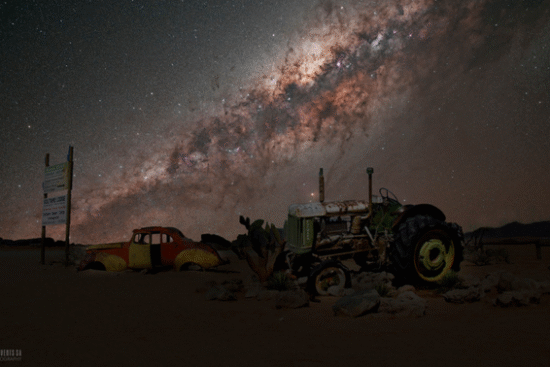
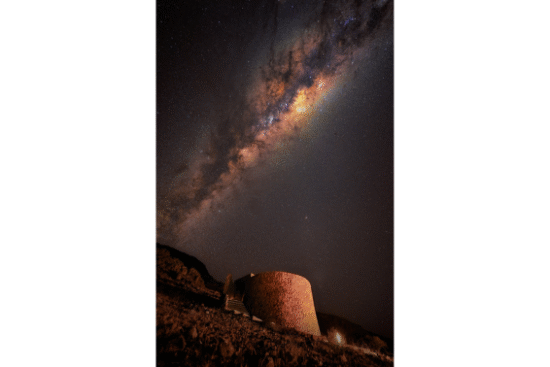
With the Milky Way stretching up from the eastern horizon, it is a great time to frame it against some interesting terrestrial features. Photography is art and thus there are endless options, but look for a dead tree, some interesting geology, a building, or even a burnt-out car as a foreground subject.
Equipment
Any DSLR or Mirrorless camera (and even some of today’s modern cell phones) can take amazing photos of the Milky Way. A good tripod is needed to keep the camera steady during long exposures, and a ball head mount will allow you to compose the shot. A remote trigger can also be beneficial, to minimize vibrations when the shutter is depressed. If you do not have one, the camera’s self-timer can also be used.
Camera Settings
In night photography, we are taking the camera out of its comfort zone, and we must tell it what it needs to do. Ensure that you are shooting on manual, in order or to give yourself full control over the settings.
Shutter Speed
We are asking our camera to capture distant and faint specs of light, so we need to give it ample opportunity to do so. However, the Earth is constantly turning and thus we cannot expose to too long, otherwise the stars will move, creating trails and not pin pricks of light. As a general rule, divide your focal length into 300 – this will give you your maximum exposure time before ‘worming’ in the stars becomes apparent. If you are shooting at 20mm, your maximum shutter speed should not exceed 15s (300/20). Remember to consider your crop factor if you are not shooting with a full frame sensor.
Aperture
Aperture refers to how much light the lens will gather. Since we are photographing faint objects, we need the lowest f-stop available. This will be dictated by your lens, but the lower the number the better. If you have a fast lens (f1.8 or f2) it is advisable to shoot one stop higher, in order to maximize quality.
ISO
For all photos, work off the premise of ‘as much as necessary and as little as possible’. Higher ISO settings make the camera sensor more sensitive to light, but also more prone to noise. Ultimately, the strength of your ISO will be dictated by your camera model but for many DSLRs, around ISO 2500 should be a good starting point.
Focus
Cameras cannot accurately auto-focus on a star, so put your camera on manual focus. Find a bright star on the screen and zoom in. Then adjust the focusing ring until the star is as small as possible. You could tape the focus ring to stop it shifting throughout the night.
Advanced Equipment
If you plan on taking longer exposures, then a star-tracking mount is essential. These are aligned to celestial south (the axis of Earth’s rotation) and allow for exposures of up 2 or 3 minutes if aligned accurately. This means the camera can capture lots of faint information and enables you to shoot at lower ISOs and thus have less noise in your photos. These are not cheap but are an essential item if you want to take your Milky Way photography to the next level!
Good luck and we would love to see your results!!
See Celestial Events SA advert for contact details.