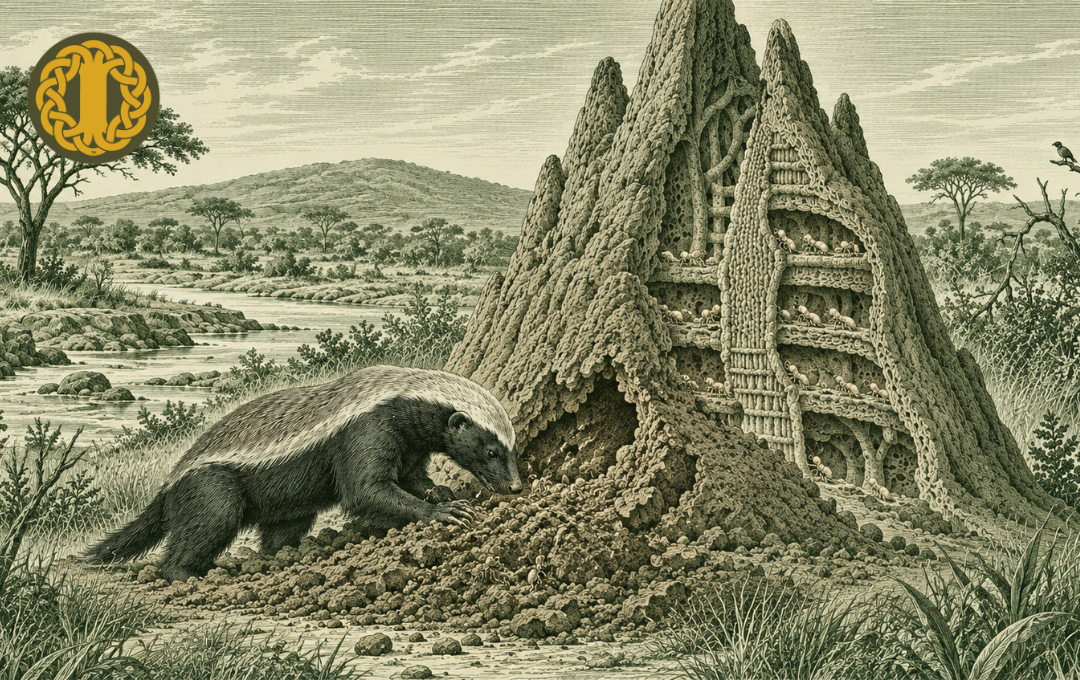
The termite mound had been breached by an African honey badger. The excavation bore the characteristic signature of its typically furious, single-minded digging, a cone of loose red soil fanned out across the surrounding ground. The mound itself, a two-metre column of compacted earth on the edge of a drainage line in the Sabi Sand, had a jagged opening at its base roughly the size of a football.
By the time we returned past the same mound three days later, the breach was sealed. Not patched – rebuilt and sealed. The new material was almost indistinguishable in colour and texture from the surrounding structure. Worker termites had assessed the damage, sourced material, and rebuilt to the original compressive strength – a feat of structural engineering that would challenge a human team equipped with laboratory analysis. They had done it in forty-eight hours, in darkness, without a plan, or management, and without any individual worker possessing more than a fragment of the information required to accomplish the whole.
What the colony had done was not merely repair. It had made an upgrade. The rebuilt section carried subtle structural modifications – denser packing at the breach point, a slightly altered internal channelling hinting at how the original structure failed. The system had not bounced back. It had learned, and in learning, changed.
This is innovation in the language of Social-Ecological Resilience: not invention for its own sake, but the adaptive updating of a system’s structure and behaviour in response to disturbance. It is Brian Walker’s seventh attribute, and perhaps the one most consistently misunderstood – because innovation in this context is not about being clever. It is about being honest enough, and flexible enough, to change when the evidence demands it.
What Innovation Means in Resilient Systems
Walker is precise about what innovation is not. It is not the relentless novelty of a system that can never settle – that is instability dressed in progressive language. Nor is it the rigid repetition of a system that responds to every new challenge by “bouncing back” to execute its established procedures more forcefully. Innovation, in Walker’s framework, is the capacity of a system to learn from disturbance and alter its behaviour accordingly: to experiment with locally developed responses, to reward approaches that work, and to discard those that don’t, even when discarding them is uncomfortable.
The ecological archive of the African savannah is full of this process. Species that proved unable to update their responses to shifting conditions – to novel predators, to altered rainfall patterns, to changed fire regimes – left their record in the fossil layer. Those that persist are those whose populations, over generations, tracked changing conditions with sufficient flexibility. The chacma baboon offers a living demonstration. Troops observed across decades show demonstrable behavioural innovation across generations: new foraging strategies, new responses to human presence, new social configurations that emerge in response to changes in group composition or food availability. What looks like individual intelligence is, at the population level, a resilient system continuously updating its operating parameters.
The critical condition Walker identifies is what happens after disturbance. Did the system change its practice in an appropriate manner? Did it learn? A system that experiences a severe drought, loses half its livestock, and then rebuilds to the identical configuration – same stocking density, same grazing strategy, same water management – has not innovated. It has recovered without learning. It has prepared itself, with considerable effort, for an identical failure at the next similar disturbance. A system that rebuilds differently – that uses the forced reorganisation of crisis as an opportunity to implement changes that normal conditions would never have permitted – has done something qualitatively more valuable.
The Sabie and The Fever Tree Corridor
There is a stretch of riverine forest along the Sabie River where fever trees – Acacia xanthophloea, the lime-green powdered, smooth-barked acacia of floodplain margins – were decimated across two successive droughts in the 1990s, compounded by heavy elephant pressure. The corridor that had defined that stretch of river for as long as anyone’s records extended was, within a decade, reduced to scattered survivors and dead standing timber.
The management response at the time was to experiment with restoration: some replanting, exclosure fencing, herbivore management to protect saplings. Some of this worked. But what was also observed – and initially viewed with ambivalence by managers working towards restoring the original vegetation – was that other species were moving into the gaps. Sycamore figs established along sections of bank. Native reeds colonised the water margins. Apple-leaf trees and Natal mahoganies appeared in the mid-storey. The riverine community was not returning to its prior state. It was reorganising around the conditions that now existed – different soil moisture profiles, different light regimes, different herbivore pressure – rather than the conditions that had existed before.
What emerged was not a degraded version of the original system. It was a different community with different characteristics, some of which proved more robust under the altered conditions than the original fever tree monoculture had been. The system had innovated around the disturbance. The managers who recognised this – who adjusted their intervention strategy to support the emerging community rather than insisting on the restoration of the prior one – were themselves practising Walker’s seventh attribute. Those who continued to fight for a return the original configuration were, in ecological terms, subsidising the past.
The Stoic philosophy of revision
Chrysippus of Soli (279–206 BC), the third head of the Stoic school of Athens and arguably the philosopher who gave Stoicism its systematic intellectual architecture, built his entire contribution on a practice of innovation that he never attempted to disguise. He read the work of his predecessors — Zeno, Cleanthes — and where he found the arguments wanting, he revised them. Openly, rigorously, and without rigid adherence to any unquestioned authority of the school’s founders.
This was not betrayal. It was, in Stoic terms, the only philosophically honest response to evidence. The Stoics grounded their ethics in a commitment to reason and to reality as it actually is — not as tradition describes it, nor as comfort prefers it. A position held out of loyalty to its source rather than confidence in its truth was, for the Stoics, a form of intellectual cowardice. Chrysippus revised because the arguments required revision. The school was stronger for it.
The Stoic concept most directly relevant to innovation is askesis — the rigorous self-discipline of testing one’s responses to conditions not yet encountered. Where premeditatio malorum (negative visualization) rehearses adversity to prepare the mind for endurance, askesis goes further: it creates the conditions for discovering that your current response strategy is inadequate, so that you can revise it before the real test arrives. It is, in systems terms, controlled experimentation. The Stoic who practises voluntary discomfort, who deliberately places themselves in unfamiliar circumstances, who seeks out the friction of ideas that challenge their own, is not merely toughening themselves. They are running trials. They are learning what breaks before it matters that it breaks.
Roman emperor Marcus Aurelius, applying this under the pressure of imperial governance, returned repeatedly to a question that is essentially an innovation prompt: What does this situation actually require of me? Not what have I done before. Not what does protocol dictate. What does this situation, in its particularity, require? It is the question of a system genuinely open to updating – one that has not pre-committed its response before reading the evidence.
Innovation in The Special Forces Operator
In small team operations, the institutional forces against innovation are formidable. Doctrine exists for good reasons – it encodes hard-won learning about what works under pressure. Standard operating procedures reduce cognitive load at precisely the moments when cognitive load is highest. The culture that rewards reliability and consistency over experimentation is not irrational; in many tactical contexts, reliability is survival.
But doctrine applied beyond the conditions that generated it becomes a trap. The team that executes a textbook response to a situation that has evolved beyond the textbook is not demonstrating competence. It is demonstrating rigidity – and in a genuinely novel environment, rigidity is the enemy of survival.
The most operationally effective teams cultivate a genuine learning loop alongside their execution capacity: an after-action culture that interrogates what the situation revealed about the plan’s assumptions, not merely what went according to plan. This requires something psychologically difficult in high-performance cultures – the willingness to treat failure and unexpected outcomes not as embarrassments to be managed but as data to be processed. The team that debriefs honestly, names what didn’t work, and updates its approach for the next contact is running the same process as the termite colony rebuilding the breached mound: not returning to the prior state but incorporating the information the disturbance provided.
At the individual level, this means maintaining cognitive porosity – genuine openness to new frameworks and new ways of reading a situation, even when those challenge established expertise. The operator who, a decade in, is still curious – who reads outside their box, seeks out friction with perspectives unlike their own, treats accumulated experience as a resource to draw on rather than a conclusion to defend – is practising Stoic askesis and ecological innovation simultaneously. They are keeping their system’s adaptive capacity alive.
Walk-On
The termite mound, two days on, gives nothing away. It looks as it always looked: ancient, purposeful, indifferent to the attention of passing primates. But it is not the same structure it was. It absorbed a serious disturbance and emerged having updated its own architecture.
There is no drama in this. There never is, with genuine learning. The drama belongs to the disturbance. What survives is stronger – the patient accumulation of better responses to a world that will keep presenting new ones.
Andrew Paterson
Philosafaris.com