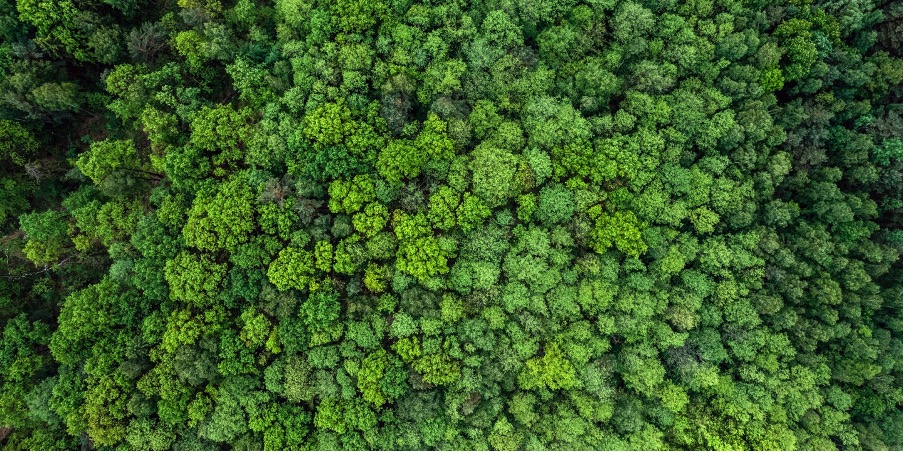
A new study, published in the journal Nature Communications, has identified land roughly equivalent to the combined area of South Africa, Namibia, Botswana and Zimbabwe where reforestation can deliver optimal climate benefits while supporting wildlife habitat, food production, and freshwater availability.
It identifies an area for reforestation that can net 2,225 TgCO₂e (teragrams of carbon dioxide equivalent) or roughly 2.2 billion tonnes of carbon dioxide per year total in net mitigation potential. That’s roughly five times South Africa’s annual emissions.
Though global in scope, the study has strong implications for Africa where natural grasslands and savannas are often misguidedly and inappropriately converted to forests, which can actually harm biodiversity and even exacerbate global warming.
It also holds the potential to better inform and operationalise the nature-based solution’s potential on the continent, which faces disproportionate climate impacts despite contributing very little to human-induced climate change.
The study, in part from the University of the Witwatersrand’s Future Ecosystems for Africa (Fefa) programme, saw the creation of what it described as “the most accurate maps” of 195 million hectares globally where tree restoration will deliver “maximum climate benefits”.
Professor Sally Archibald from Wits’ School of Animal, Plant and Environmental Science, who leads the Fefa programme, explains that “previous studies often failed to address how afforestation could have negative effects on biodiversity and human well-being, especially for poor people living in remote rural areas often targeted for reforestation”.
“The drop from previous estimates is due to layers that previous maps haven’t been able to incorporate, because the research was still nascent at the time.”
Archibald explains that the research “accounts for the albedo effect, for example, which means restoring tree cover can, in some locations, actively heat the Earth rather than cool it by affecting how much sunlight is absorbed or reflected. It also excludes native grasslands and other ecosystems where carpeting the land with trees would harm biodiversity and exacerbate fire regimes.”
This aspect of the research accords with the findings of another, earlier study, led in part by Emeritus professor of biological sciences at the University of Cape Town (UCT), William Bond.
Daily Maverick reported at the time that the Bond study bust the myth that planting trees everywhere is the silver bullet to slowing global warming, and explained why we need areas like open grasslands in the savannas.
Africa contains more grasses than any other continent. According to the South African National Biodiversity Institute, the savanna is the biggest biome in southern Africa, covering 46% of its area.
Bond explained at the time that savannas – characterised by grasslands – are an open habitat peppered with a handful of trees, and that in a healthy grassland ecosystem there is a very delicate balance between trees and grasses that needs to be maintained for the diversity of animal species that it supports to survive and thrive.
Tree-planting plans to offset carbon threaten the ancient grasslands and everything it supports, he said.
“What many don’t realise is that grasslands store carbon in their soils and reflect more sunlight back into space than forests, playing a very important part in cooling the Earth.”
Dr Susan Cook-Patton, at The Nature Conservancy (TNC) and a senior author of the latest study, told The Guardian that “reforestation is not a substitute for cutting fossil fuel emissions, but even if we were to drive down emissions tomorrow, we still need to remove excess CO₂ from the atmosphere.
“As the number of climate-fuelled disasters stack up worldwide, it’s increasingly obvious that we can’t waste time on well-meaning but hazily understood interventions,” Cook-Patton said.
“We must fast-track our focus toward the places with greatest benefits for people and nature and the fewest downsides, the places most likely to be win-win. This study will help leaders and investors do just that.”
This article was previously published in the Daily Maverick/Our Burning Planet/Trees of Life