The Currency That Cannot Be Printed
I have watched countless breeding herds of African elephant consisting of a senior cow, elder females and younger cows, all the way down to juveniles of both sexes – the young males are banished from their natal herd around their early teens – yet I’m ever fascinated by the quality of synchronised attention this matriarchal sisterhood constantly pay to one another.
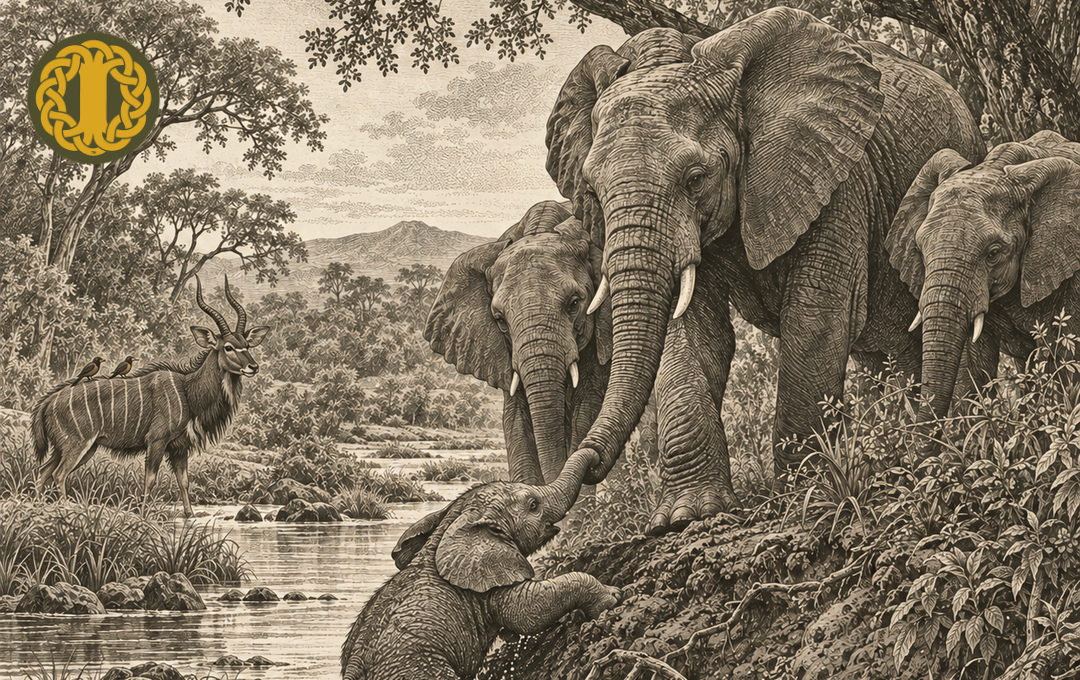
On a recent trail I observed a small calf stumbling up a steep bank of the Luvuvhu River in the far north of the Kruger National Park. Instantly, three of the nearest adult cows turned simultaneously – not in alarm, but in the unhurried, certain manner of those who have arranged themselves, over years, to know where the vulnerable members are. On roads, the matriarch usually positions herself between her extended family and a vehicle long before any signal that I can detect has passed between the animals. A young bull, nearing his teens and starting to push his social boundaries within the herd, tests a situation that the matriarch has already assessed and decided against. He reads her posture, pauses, and follows her better judgement.
There is nothing sentimental about what I am watching. It is a system operating through accumulated, embodied trust – decades of shared experience compressed into the instant legibility of posture and proximity. The herd does not deliberate. It knows. And what it knows has been built, slowly, through the most ordinary medium in ecology: relationship.
This is social capital. And in Brian Walker’s framework of Social-Ecological Resilience, it may be the attribute that, more than any other, determines whether a system survives the moments that cannot be planned for.
What Social Capital Is
Walker defines social capital as the trust, well-developed social networks, and effective leadership that allow communities – human or otherwise – to coordinate responses to disturbance. It is not the same as social contact, or even social cohesion. A crowd has neither trust nor effective leadership; it has proximity. Social capital is the functional infrastructure that makes collective action possible when conditions change rapidly and the cost of getting it wrong is high.
In social-ecological systems, this infrastructure operates at multiple levels. At the community level, it is the network of relationships through which information flows – who knows what is happening at the far end of the watershed, who can be trusted to report accurately, who has the credibility to call for collective restraint when restraint is needed. At the leadership level, it is the quality of judgement that allows one individual or council to act as a trusted node in that network – not because they hold authority by appointment, but because they have earned it through demonstrated reliability over time.
Walker is characteristically precise about leadership here. Sometimes resilience requires a strong visionary individual who can hold a course under pressure and absorb the uncertainty that would otherwise paralyse a group. At other times it requires what he calls shepherding – leading from behind, facilitating rather than directing, drawing out the distributed knowledge of the community rather than imposing a central view. The skill lies in knowing which one the moment demands. Misjudge that – apply a visionary’s forcefulness to a situation calling for distributed wisdom or offer facilitation when the situation demands decisive commitment – and the social capital that enables response erodes precisely when it is most needed.
The Luvuvhu River and the Oxpecker’s Contract
The floodplain forests along the Luvuvhu River support one of the highest densities of nyala in southern Africa, alongside leopard, bushbuck, waterbuck, and an extraordinary diversity of bird life. Walk there in the early morning and you are walking through a system dense with mutualist relationships – arrangements of mutual benefit refined across evolutionary time.
The yellow-billed oxpecker riding the back of an antelope is one example of this. The bird removes ticks and other parasites the buck cannot reach; the buck provides a mobile foraging platform with a predictable parasite load. But the relationship runs deeper than the transactional. Oxpeckers function as an alarm system. Their hissing call and sudden flight from an animal’s back is one of the earliest signals of a predator’s approach – often more reliable than the direct observations of the ever-alert host animal itself, because the bird’s elevation provides sightlines the ground-bound animal lacks.
The antelope does not consciously think: this bird serves my interests. But over evolutionary time, animals that tolerated and supported oxpecker presence survived at higher rates than those that didn’t. The relationship is a form of biological social capital – a built-in network of trust and mutual benefit that enhances each party’s resilience without costing either of them in any acute way.
What is instructive about mutualist, symbiotic relationships in ecology is precisely what Walker emphasises about social capital in human systems: it accumulates slowly, through consistency, and it is difficult to restore once broken. A host animal in the habit of chasing oxpeckers away – perhaps for being too irritating around wounds – does not easily re-establish the relationship. The trust infrastructure, once disrupted, requires time and repeated positive experience to rebuild. And during the period of disruption, the animal’s early-warning system is compromised.
The Stoic Conception of Community
The Ancient Greek Stoics approached social capital through the concept of oikeiosis – the natural affiliation and extension of care outward from the self to others. Human beings are naturally disposed to form connections: first with themselves, then with family, then with community, then – in the Stoic cosmopolitan vision – with all of humanity. This was not sentiment. It was a recognition that the individual in isolation is radically less capable than the individual embedded in a network of trust and mutual obligation.
For the Stoics, friendship – genuine friendship, not convenience or flattery – was among the most important investments a person could make. Roman Stoic Seneca’s letters to Lucilius are, among other things, a sustained commentary on this. He distinguishes sharply between those who collect associates for instrumental reasons and those who cultivate genuine friends: people who know your actual character, who will tell you what you need to hear rather than what you want to hear, and whom you trust enough to be known by. Such friendships, he argues, are not a luxury. They are a structural component of a life capable of absorbing serious disturbance.
Stoicism is so often misread as a hard philosophy of solitary self-sufficiency. It isn’t. Epictetus taught in a school. The Roman emperor, Marcus Aurelius names, in his private Meditations, the specific people from whom he learned specific virtues – his grandfather, his father, his teachers. His list is not incidental. It is a record of the social capital that made him who he was.
Social Capital in the Special Forces Team
In Small Team tactics, social capital is not a desirable addition to operational capability. It is, in conditions of genuine stress, the primary determinant of whether the team functions – and survives – at all.
The reason is straightforward: in a high-stakes, rapidly evolving situation, there is no time to verify. The operator receiving a report from a teammate cannot pause to assess whether that teammate is accurate, honest, and competent. They act on the information communicated. If the social capital in the team is high – if the track record of that teammate’s judgement has been built through shared experience, through challenges navigated together, through the thousand small acts of reliability that constitute trust – then the team acts as a coordinated machine. If the social capital is low, an operator either hesitates at a moment that doesn’t permit hesitation or acts on information he has no basis to trust.
Walker’s observation about leadership applies here, particularly. The team leader who defaults to command-and-control in every situation – who cannot shift to distributed authority when the situation demands it, when the soldier closest to the ground has information that the leader lacks – is burning social capital with every such decision. Over time, teammates stop volunteering judgement they expect to be overridden. The network of distributed intelligence that is the team’s greatest adaptive asset quietly atrophies. Then, the leader has a compliant team, not a resilient one.
Conversely, the team that has built genuine social capital – through the mundane, unglamorous work of showing up reliably, delivering on commitments, sharing discomfort without complaint, and extending trust before it is strictly necessary – possesses something that no training programme can manufacture in a hurry. It possesses the functional infrastructure for effective collective action under conditions that no plan has anticipated.
This is the irreducible truth about social capital that Walker identifies, and that the elephant matriarch embodies as second nature: it cannot be improvised at the point of need. It must be built before the need arrives, through the patient, unspectacular investment of constant practice.
Walk-On
Moving back through the riverine vegetation as the light thickens, a herd of buffalo moves through the Fever-tree forest ahead of us, unhurried. An oxpecker lifts momentarily from the shoulder of the lead animal, wheels in flight and settles again. A transaction invisible to the casual eye. A relationship ancient beyond reckoning.
The bush is not a collection of individuals competing in isolation. It is a web of obligations, debts, and mutual dependencies – most of them invisible, all of them load-bearing. Strip them away in the name of simplicity or efficiency, and you don’t get a cleaner system. You get a more fragile one.
Andrew Paterson
Philosafaris.com