At a place called Lone Tree in the central Kalahari, a band of San hunters picked a young kudu bull out of the herd and started running it down. Louis Liebenberg, then a young South African researcher with no distance-running background, wasn’t meant to be part of that – the hunters told him the heat made the chase too dangerous for someone untrained. He talked his way into staying anyway.
A running mammal generates heat it has to shed somehow. Humans do it by sweating – a system that works at any pace, without stopping. Kudu cool down by panting instead, and panting barely works at a gallop; a running kudu can only really recover once it slows down and rests in shade. So the hunters’ job wasn’t to outrun the kudu. It was to deny it that rest – closing the distance every time it stopped, before its panting had done its work, and pushing it running again. Do that for hours in 39-42°C heat and the animal’s core temperature climbs until it simply can’t run anymore.
Liebenberg’s own body was starting to fail by then. By the time the hunters closed on the exhausted animal, he’d stopped sweating himself – a warning sign, not relief, and proof he was now as dangerously overheated as the kudu, even if his body was failing for the opposite reason: too much fluid lost, rather than too little chance to cool. The only moisture anywhere near the kill was inside the animal’s stomach, and it wasn’t safe – kudu feed on a plant that turns toxic once digested, so the hunters kept him away from it. What actually got him through the rest of that afternoon was one of the hunters running back to fetch water. He has said since that he might not have survived without that.
That afternoon is why CyberTracker exists. Liebenberg came away from it convinced that what he’d watched – reading sign, predicting an animal’s next move from a half-print in loose sand – was a rigorous cognitive skill, not something to admire from a distance. The tracker certification system, the evaluation protocols and later the CyberTracker software all grew out of that conviction. The point was to write the skill down properly, and give the credit to the trackers who actually had it.
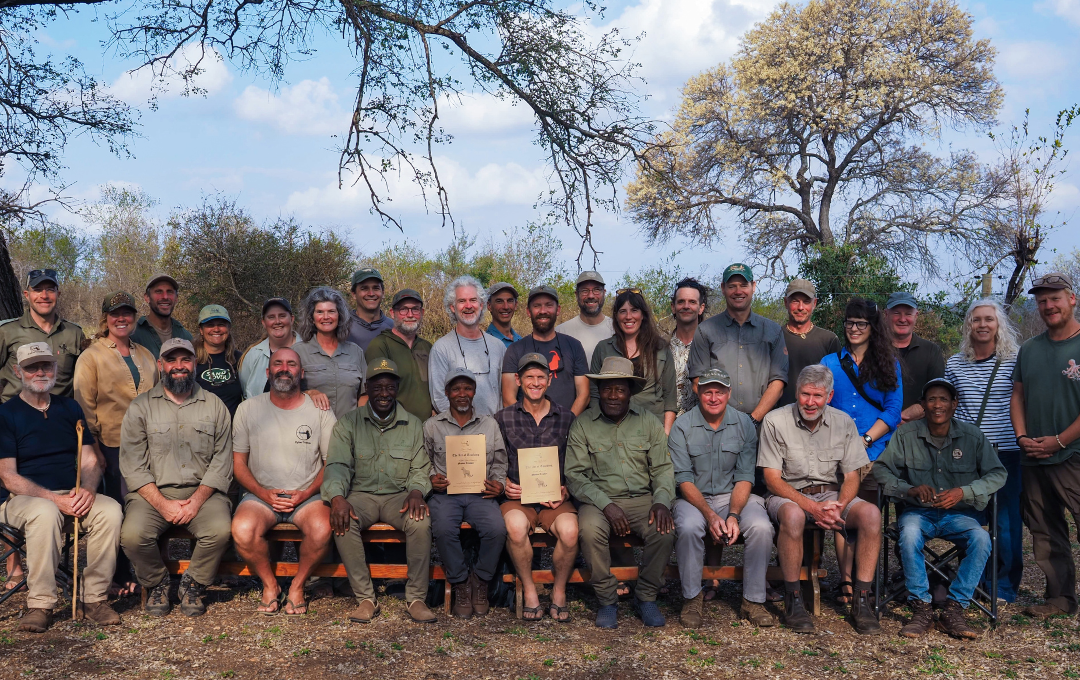
The first International CyberTracker Meeting – the first of its kind – organised by Dr Kersey Lawrence and Lee Gutteridge, has just wrapped up in the central Kruger Lowveld. There its wild bush – elephant bulls and cow-calf herds moved past the camp, with lion, hyena, owl and nightjar filling the nights. It was the largest and most varied CyberTracker gathering to date: 24 evaluators and partners, five board members and administrators, two Ju/hoansi San Master Trackers, two Shangaan Master Trackers. The Tracker Empowerment Foundation, backed by sponsors Justin Douglas, Landan Cheney and Arianne Cheney-Lewis, covered travel and accommodation for those who couldn’t otherwise have made the week.
Lawrence and Gutteridge say the real value showed up around the programme’s edges, not inside it. Trackers who’d known each other only by reputation tracked together for the first time – starting with reading individual signs, ending in the actual test: following a trail to the animal. Much of the substantive work happened around a daytime campfire, in loose conversation about tracking philosophy with Liebenberg, and in small working groups rather than formal sessions, with evaluators who rarely speak up in plenary pushing through the certification system’s harder protocol questions toward something close to consensus. Nobody expected every open question closed in a week; the point was getting people from very different assessment contexts into one room, for the first time in the organisation’s history.
Two of the evaluators who made that trip put it in their own words. John Rhyder, who introduced CyberTracker to Europe in 2012 and has evaluated for the organisation since 2018, runs a nature-based education school in Sussex and has written books on tracking and bushcraft. His highlight of the week was trailing a rhino behind one of the Shangaan trackers, Lucas – and learning only that afternoon that Lucas had grown up in the same village as Wilson Masia, the tracker credited alongside Liebenberg with starting the whole system. “The complexity of the trail he was following and the way he searched it… the speed he was doing it in such difficult terrain – it gave me a lot of things I can work on in my own practice,” Rhyder said. Pressed on what he’s taking home, he set the protocol work to one side. “It’s more about the people, I think.” He’s also unwilling to accept that this kind of tracking belongs only to Africa – Europe, in his view, is wrongly written off as too degraded a landscape for it. “It’s doable, you just have to adapt it a bit.”
Jonathan Poppele made the trip from St Paul, Minnesota, where he writes nature guidebooks on wildlife tracking and stargazing for a living. He first met Liebenberg in 2002, as a graduate student interviewing him for his own research, years before he returned to CyberTracker and began working toward Track and Sign evaluator status. For Poppele, the highlight and the takeaway were the same thing: finding out how little separates trackers working on opposite sides of the planet. “We’re doing the same things… in a completely different landscape,” he said, “but it’s so clear that we’re doing the same thing. We’re doing it in the same way. We have the same kinds of questions.” Part of the meeting’s purpose, he said, was confirming exactly that – “to make sure we were all on the same page. And we really are.”
The Ju/hoansi and Shangaan Master Trackers meeting was its own highlight. The two traditions developed hundreds of kilometres apart, with no prior contact, yet each recognised the other’s standing on sight. They asked to track together, and did – Shangaan trackers mentoring their Ju/hoansi counterparts through unfamiliar terrain and with unfamiliar species.
Two new Master Trackers were certified during the week: Casey McFarland (US) and Dam Debe (Namibia), both visibly moved receiving their certificates before the full group. Senior Tracker is the highest testable qualification, held only by those who’ve passed both Track and Sign Specialist and Trailing Specialist. Master Tracker isn’t a test at all – it’s an honour, awarded by existing Master Trackers to a Senior Tracker of at least ten years’ standing who has made a significant contribution to the field.
The most emotional moment of the week came on the final afternoon, on a riverbank, with the whole group present. The Master Trackers read the certification criteria aloud together and evaluated their own cofounder against it, then unanimously awarded Louis Liebenberg a Master Tracker certificate. Several accounts mention evaluators in tears: decades inside a system whose cofounder had never, by the field’s own standard, formally held the title it’s built around.
Liebenberg is often called CyberTracker’s founder. He corrects that: cofounder, alongside the indigenous trackers who taught him and whose knowledge the system exists to recognise. He named the master trackers who shaped it — among them the late !Nam!kabe Molote, !Nate Brahman and Horekhwe (Karoha) Langwane, of Lone Tree, Botswana; Quasha (/Uase) Xhukwe of Lone Tree, Botswana, !Namka and /Xantsue of Bere; /Dzau /Dzaku and Xa//nau of Groot Laagte; Tso!oma, Ganamasi and Mutsabapu of Old Xade in the Central Kalahari; !Nani //Kxao, Ghau ≠Oma and TsisabaDebe of Nyae Nyae, Namibia; the late Karel Kleinman (Vet Piet) of Kalahari Gemsbok National Park; the late Dawid Bester of West Coast National Park; the late Wilson Masia of Thornybush Game Reserve, and Nxjouklau Kashe of Bere – alongside Juan Pinto, Adriaan Louw, Mark Elbroch and every tracker and evaluator who has carried the work into new regions since.
Liebenberg and Pinto, both present since CyberTracker’s earliest days, told that origin story – the Kalahari, the kudu, the near-fatal thirst – to a generation of evaluators who’d grown up inside the system without hearing it firsthand. Liebenberg also laid out how the organisation’s separate strands – Tracker Certification, tracking philosophy and the origin of science, the Master Tracker Project, ongoing research, and the CyberTracker software – form one deliberate whole, not a loose collection sharing a name.
Evaluators singled out the host organisation’s entry-level guides for particular praise, their appetite for the tracking and ecological knowledge on display striking several as its own highlight. At the closing circle, the guides were called in to join it, not left standing outside. One evaluator told them: “When I was here in South Africa with Kersey and Lee ten years ago on a programme, I never envisioned that I’d be an evaluator in this organisation when I came back. So, I want to say to these young people, you could be the future of our organisation, of tracking. The opportunity is here for you to take.”
The week didn’t settle every open question in the certification protocol, and organisers never expected it to. What was evident was that CyberTracker as an organisation is one that even holds its own cofounder to the same standard as everyone else, and it shows: no one here got their title on reputation.
What was settled was something harder to legislate: whether a system run independently across four continents for years was still, underneath the regional variations, one system. Rhyder said as much from Sussex. Poppele said the same thing from Minnesota, almost word for word, without either man comparing notes first. For an organisation that exists because one man nearly died proving that tracking deserved to be taken as seriously as any laboratory science, that kind of agreement – being arrived at independently, by people who’d never worked together before this week – is the resounding proof of the inherent success and strength of the system.