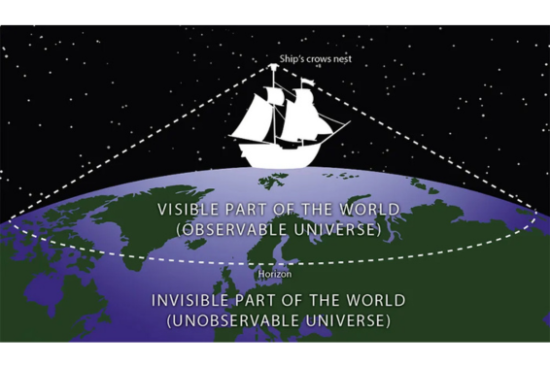
Space is big …. maybe not infinite, but definitely big. The observable universe is thought to be a mind-boggling 90 billion light years in diameter, but likely only forms a part of a larger whole. The universe is 13.8 billion years old. With our understanding of the expansion rate of the universe, the distance to the furthest detectable objects has been calculated to around 45 billion light years away. Any light beyond that boundary simply has not had enough time to reach us since the universe began. Imagine being on a boat in the ocean; you can only see as far as the horizon in all directions, but the ocean is far greater. The same is true of our universe.
Despite the scale of this ocean of cosmic history laid out before us, we can extract a huge amount of information from its inky depths thanks to our understanding of light. Although incomprehensibly far away, these objects give off massive amounts of energy, right across the electromagnetic spectrum, meaning that we can see them. And if we can see them, we can capture their photons. However, there was one uncleanable greasy fingerprint on our cosmic lens: our atmosphere.

Our atmosphere does so much for us every second of every day, but its protective bubble both blocks and distorts the information being sent from the stars. In 1977, an ambitious joint project between NASA and the European Space Agency (ESA) sought to eradicate this problem. They started work on a giant space telescope that would orbit the Earth, high above its atmosphere, allowing astronomers to probe the darkness unhampered. Thirteen years later, the Hubble Space Telescope was launched. Thanks to various technical problems, it would take a further three years before it became operational, but when it did, the metaphorical heavens opened!
Hubble has changed the way we understand our universe, and thanks to the unprecedented rise of visual media, its spectacular images have wowed billions of people, sparking a global interest in astronomy and cosmology. Throughout its lifetime (estimated to be until 2030) Hubble’s 2,4m diameter mirror will record everything from the birth of stars to the collisions of galaxies, in unimaginable detail and beauty. It has aged the universe to 13,8 billion years and mapped its distribution of dark matter. But Hubble was about more than pretty pictures and science, it represented the discovery of the unknown.
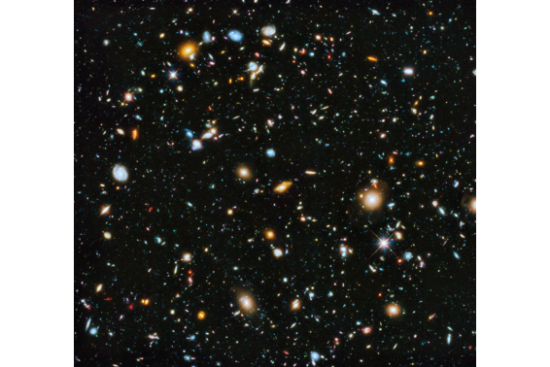
In 2014, NASA and the ESA released what is possibly the most humbling and thought-provoking space image ever taken. Combining ten years of data and over one million seconds of exposure, the Hubble Ultra Deep Field photo gave us our most profound look into the universe, and our past. Within an area of seemingly featureless black sky (about the size of a grain of sand at arm’s length) Hubble revealed over 10 000 galaxies, their diversity in size, shape and form matched only by their sheer abundance. Combined with our mathematical models of the distribution of matter throughout the universe, this information suggests we could share our existence with over 2 trillion other galaxies, each containing 100’s of billions of stars, and almost infinite possibilities.
Not only did the Ultra Deep Field expand our horizons, but it also allowed us to see back in time. Hubble was able to spot galaxies 13,5 billion light years away, meaning it saw what they looked like 13,5 billion years ago, only moments (cosmically speaking) after the Big Bang! By examining these images, astronomers have been able to literally see what the universe looked like soon after the first galaxies started to form, gaining a great understanding of the process of galactic evolution.
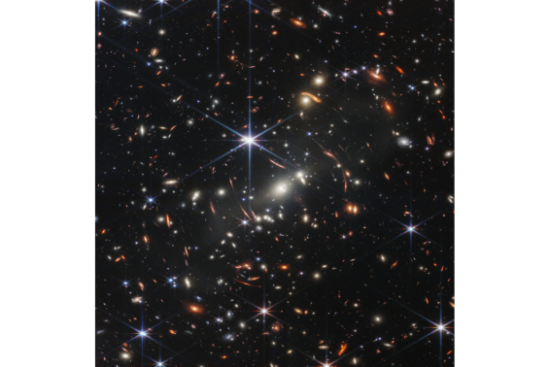
Then in 2022, the James Webb Space Telescope tried its hand at its first deep field image. Its enormous 6m diameter mirror and infra-red capabilities allowed it to see even further back than Hubble, shining yet more light into space’s shadowy depths. Its more accurate data has already caused us to refine much of what we had learned in the past two decades, and this trend is set to continue.
The technological advances of these, and other telescopes, have grown our cosmic neighbourhood to such a size that it seems highly improbable (to this writer at least) that we are alone. Despite the challenges of creating and sustaining life, there are thought to be as many as 1 000 000 000 000 000 000 000 000 (1 septillion) stars in the universe (more than ten times the number of cups of water in all the oceans of the world!), many of which harbour multiple planetary systems and moons. Whilst definitive evidence continues to elude us, we have but scratched the surface as to what might be out there, and who knows what else we will find as the eyes in the sky continue to peer into infinity and beyond.
See Celestial Events SA advert for contact details