I have been involved in astrotourism for more than five years, and delivered hundreds of astronomy-based events. During this time, one of the most common questions asked is ‘How do we know how far away objects are?’, and ‘How do we measure these distances?’.
For most of us, it is almost impossible to truly comprehend the vastness of space. The distances involved are, quite literally, astronomical. Our brains are programmed to think on a human, earth-bound distance scale, whereby a long-haul flight is considered ‘far’. Having just returned from doing some work in New Zealand, I can certainly attest to this!
But travelling from one side of the Earth to the other does not even register on a cosmic scale. When appreciating the distances between planets, stars and galaxies, we need new units of measurement to make the numbers more manageable.
There are various units of distance used in space but by far the most common, (and well known thanks to sci-fi movies), is the ‘light year’. Despite using the word ‘year’, the first thing to remember is that a light year is a measure of distance and not a measure of time. Simply put, it is the distance that light travels in one year.
This figure should not be scoffed at however. Light is the fastest thing in the Universe – a pretty bold claim! It travels at a mind-boggling 300 000kms per second. Just think about that for a minute …. If you were travelling at the speed of light, you could travel around the world 7,5 times in just 1 second! So, if light can travel 300 000kms in 1 second, imagine how far it could travel in a year. The answer is far; very far – a whopping 9,5 trillion kilometres!
Already we are entering the realm where these figures do not mean much to us, so let us put it in more relatable terms – if you travelled 1 light year in an Airbus passenger plane, it would take you 1,2 million years!
Many of you may have heard of the Voyager space probes that were launched in 1977 and have been sending back information about space for nearly half a century. Despite hurtling through space at around 60 000km/h, they have not yet travelled 1 light DAY!
The table shows how long it would take to reach some of the well-known objects in the sky by an Airbus passenger plane:
Object | Description | Distance (Light Years) | Approx. Time (Years) |
The Sun | Our parent star | 8 mins | 13 |
Alpha Centauri | Our closest star after the Sun | 4,3 | 4 000,000 |
Betelgeuse | Red supergiant star in Orion | 650 | 600 000 000 |
Omega Centauri | Brightest globular cluster | 17 000 | 15 000 000 000 |
Large Magellanic Cloud | Dwarf galaxy | 170 000 | 150 000 000 000 |
Andromeda Galaxy | Closest large galaxy | 3 000 000 | 3 000 000 000 000 |
How then do we actually measure these vast distances? To objects in our solar system, we can use radar imaging. We can bounce radio waves off these objects and measure how long it takes for the signal to return. This method is effective up to around 1 billion kilometres. Despite the magnitude of this number, a billion kilometres is a mere stone’s throw in the abyss of space. Beyond this, astronomers use slightly more mathematical based techniques:
Paralax

Parallax uses the same basic trigonometry that many of us studied at school – and many school children wonder where this sort of mathematics could be used! Our eyes do it for us every day and allow us depth perception. Hold out your hand, close one eye and place it over a distant object. Now close that eye and open the other. What you will notice, is that the object appears to shift against the background. The further away the object is, the bigger the difference. Our brain knows the distance between our eyes, and combined with how much the object moves, calculates the distance!
So how does this work in space? Astronomers look at a star at six month intervals, when the Earth is on opposite sides of the Sun, and measure its movement against the background stars. From this information, trigonometry can tell us the distance to the star. Europe’s Gaia satellite has used parallax to measure the distance to over a billion stars to date. The movement is small, but our equipment is so sensitive, it is effective up to around 500 light years.
Standard candles
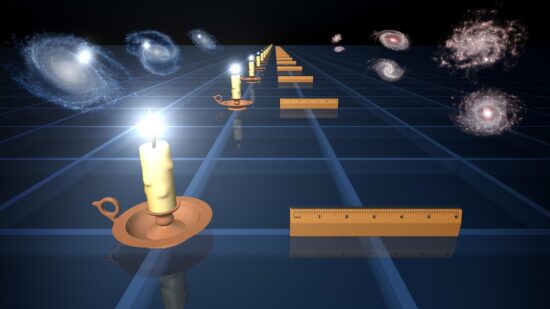
Certain objects in space are always the same brightness. If we know the intrinsic brightness of an object, we can compare how bright it appears from Earth, and then work out how far away it must be.
Imagine standing at one end of a 1 km runway at night time, and at the other end is someone holding a 100 watt lightbulb. The light will be barely visible to you, but because you know how bright it is, some simple maths can work out how far away it must be to look so faint. Examples of objects used by astronomers include Type 1a Supernovae (white dwarf stars that always explode when they reach a specific mass) and a class of star known as Cepheid Variables that pulse at very specific rates based on their brightness.
Red shift

But what about distant objects that do not possess any standard candles? The Universe is expanding, and as it expands, it ‘stretches’ light. Because we know this rate of expansion, we can measure how far an object’s light has been stretched and calculate how far it therefore must be. Every element produces a very specific pattern of light, or spectra, that looks a little bit like a barcode on a rainbow. Distant objects are expanding away from us and thus have their lines shifted towards the red end of the spectra. The further the object, the more the ‘redshift’, and the more the lines have moved. The gaps between the lines remain the same, but the pattern has moved. By measuring this movement, its distance can be calculated.
Perhaps the coolest thing about looking into space is that you are also looking back in time! Light takes so long to reach us that we are not seeing the stars in real-time. This is how telescopes like Hubble and James Webb can see some of the earliest stars in the Universe. They can see objects billions of light years away and are therefore seeing what they looked like billions of years ago. Knowing this is allowing us to recreate the origins of the Universe and trace the steps of the earliest stars that formed after the Big Bang, some 13.8 billion years ago!
Scientists tell us that time travel is not possible (yet anyway!) but it is available to each and every one of us, every night. Many of the stars in the sky may not be there anymore… They may have blinked out of existence or exploded, hundreds, thousands, or even millions of years ago – but we will only know when the information arrives. Not only is Space beautiful and mysterious, it is ‘Back to the Future’s cosmic DeLorean: the ultimate time machine’!