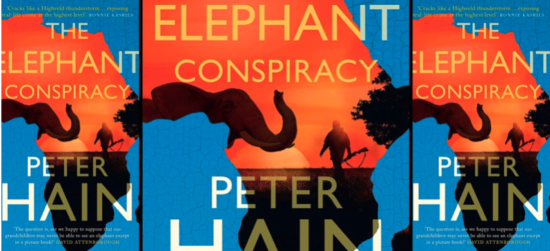
Lord Peter Hain’s ‘The Elephant Conspiracy’ may be fiction but many of its scenes mimic real-life poaching realities and monstrous criminal acts.
Chilling, horrifying, shocking and based on the realities of wildlife poaching. The Elephant Conspiracy brings an element of truth to fiction, and lays out the connection between corruption, crime and conservation.
This is according to Assistant Editor Marianne Thamm, host of Daily Maverick’s ‘The Elephant Conspiracy’ webinar, with author Peter Hain on Thursday 8 December 2022.
In this sequel to his 2020 novel, The Rhino Conspiracy, Hain explains that he worked with wildlife experts to craft a novel that describes with grizzly detail what happens as elephants are poached and traded illicitly.
“It’s not packed with facts that people find hard to absorb, but you’ve picked them up as you go along,” says Hain, adding that the realities of what has happened and what is happening cannot be ignored.
Truth of the matter
“In 1800, there were 25 million elephants on the African continent. A century later, at the beginning of 1900, there were two million,” explains Hains.
This rapid decrease from 25 million to two million elephants in one century was predominantly driven by trophy hunting in the era. But, currently the numbers are down to 400,000 – and still dropping, as a hundreds more are killed daily, explains Hain.
“The projection is that by 2040, they will be extinct,” says Hain, “These are real wildlife realities that we are having to grapple with.”
Hain says that’s the point of his book, to get people not to think of politics and wildlife as separate but connected.
“Our very future as humankind is dependent on our ecosystem and biodiversity and these precious animals that we’re killing off,” says Hain. “It’s all connected.”
Ivory links
The book discusses the links between politics, organised crime and wildlife that are seen today. “The problem is there’s a legalised trade in wildlife and then there’s the illegal criminal underworld linked to political corruption, and they blur into each other,” says Hain.
Elephants are poached across Africa for their tusks, which contain ivory, explains Hain. The ivory is seen as a status symbol, or ground down into powder and used as an aphrodisiac in areas of Asia, he adds.
Hain says rich elites believe in its properties and potency as an aphrodisiac, despite scientific proof that this is not the case, and instead it “sells like gold dust”. “This is big business. It’s a big crime.”
Brutal poaching of elephants and ripping out of their tusks is a big source of income for criminals as low as local poachers, to big city gangsters and “right through to international criminal syndicates” according to Hain.
This reason, maximising profit, is why horrifying methods of killing elephants may be adopted. One of the worst might be cyanide poisoning of entire herds, as described in the book, based on research and consultation with wildlife experts.
“The cyanide enables [poachers] to pull the tusks out without having to hack them out,” says Hain. “It’s pretty awful.”
Fight back
For Hain, readers should learn from the book but also feel empowered to fight back.
“It’s not a bleak read,” says Thamm. The characters Hain created “understand they need to fight back and do fight back, as we’ve actually seen them in South Africa”.
“Wildlife is central to Africa’s heritage, to its culture, and I tried to convey that,” says Hain.
“This is not an issue for white tourists, wildlife funds, wildlife parks, or safari holidays, this is about us. This is about who we are, as Africans, and where we come from.”
This article was previously published by the Daily Maverick
Watch this webinar ‘The Elephant Conspiracy” on YouTube
Feature image: A family of African elephants drink at a waterhole in Addo Elephant National Park. (Photo: EPA / Jon Hrusa)