The main rocks in the Hoedspruit area are ancient granitic gneisses, which we looked at last month. Long after their formation, when many other deposits were piled on top of them, these basement rocks were intruded by magma – hot liquid rock – that was forced up from far below the surface and squeezed through along lines of weakness. This would have formed outpourings of lava on a surface far above Hoedspruit, which has now vanished. Deep below, the magma that remained in the basement rocks formed Dolerite. Lines of intrusive rock like this are called sills, when their orientation is more horizontal, and dykes, when the orientation is more vertical.
Dolerite dykes are so numerous in this part of South Africa that they form what is called a dyke swarm; the Hoedspruit area is full of places where these hard dark rocks are visible and, in some places, form small hills. Collectively, they are part of what is known as the Black Hills Dyke Swarm. Seen from high above, and on geological maps, the dykes all run in a similar direction. Recent research suggests the area they cover may be 75 km across, or more. They are evidence of a series of vast outpourings of magma onto an ancient land surface that was far above us, but has now been eroded away.

Dolerite is very high in iron, oxidises easily, and forms rusty red clayey soils. Dolerite hills therefore host communities of plants and animals that can be quite different to those found in the sandy granite-gneiss soils nearby.
The same magma from which Dolerite originates forms three different types of igneous rock, depending on how slowly the magma cooled. Deep down and very slow-cooling is Gabbro; intruded and cooling more rapidly is Dolerite; extruded and very quick-cooling is Basalt. The only difference is in the crystal size – the larger the crystals the slower the cooling.
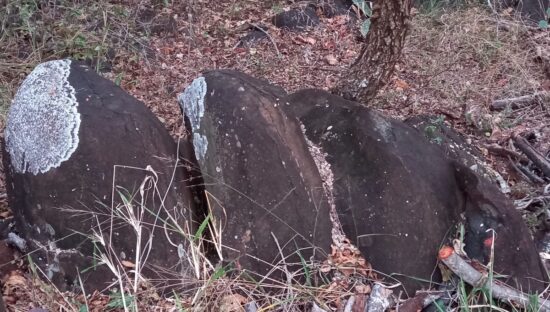
The single most significant and widespread Dolerite event in South Africa, is probably the huge surging forth of enough magma to cover most of the sub-continent with sheets of Basalt up to a kilometre thick! Magma that didn’t reach the surface formed Dolerite – now exposed over large parts of the country, and particularly visible in the Karoo. This heralded the breakup of Gondwana, around 180 million years ago. In comparison, the Black Hills Dyke Swarm was emplaced about 1800 million years ago – 10 times further back in time!
A few more facts about Dolerite: it is composed mainly of the minerals Feldspar and Pyroxene. Using a magnifying glass, you can usually see crystals of these minerals in a piece of Dolerite. It is used as road and railway gravel, so you’ve probably travelled over some in the last week or two.
Don’t confuse it with Dolomite, which is derived from Limestone – that’s a story for next month.
John has a continuous curiosity and an abiding passion for sharing the stories of South Africa’s remarkable biodiversity, rocks and landscapes. Based in KZN, he offers geological learning adventures throughout South Africa. Check out www.johnroff.co.za.