On 8 November 2025, the community of Phalaubeni in Limpopo marked a milestone many thought impossible just a few years ago: the official launch of its community-led Eco-Tourism Office and newly established hiking trails. But the true story is not about buildings or trails – it is about a profound shift in identity and mindset.
For decades, Phalaubeni was known as a Human-Wildlife Conflict hotspot bordering Kruger National Park, Letaba Ranch and Mthimkhulu Game Reserve. With broken fences, limited livelihoods and conservation tainted by the sense of exclusion, the landscape was viewed mainly as a place from which to extract to sustain livelihoods – firewood, grazing and in many cases, bushmeat. Illegal wildlife trade and unmanaged access became symptoms of the deeper socio-economic pressure on the community. But something remarkable has unfolded here.
A quiet transformation takes root
The turning point began in early 2024 when the community engaged in a Safe Systems assessment, facilitated through the WWF South Africa Khetha Programme and supported by the K2C Biosphere Region. Over three days, residents, leaders and partners confronted hard questions about their relationship with wildlife, land, safety and each other.
For the first time, the community mapped out the challenges and the possibilities. They identified seven priorities that could fundamentally reshape daily life: securing fences, strengthening communication, improving grazing, building skills, and critically, exploring eco-tourism as a new livelihood pathway.
This was the moment Phalaubeni began to see its landscape not as something to be survived, but as something of value – an asset with the power to generate income, pride and protection.
The celebration of a new era
That shift was on full display at the launch. Community members arrived in large numbers, filling the courtyard of what is now the Eco-Tourism Office – a once-abandoned structure refurbished through collective effort and partner support.
With Headman Million Mabunda and the Community Development Forum leadership at the helm, the ribbon cutting symbolised far more than a project opening. It represented a reclaiming of identity: Phalaubeni as custodians of nature, not victims of it.
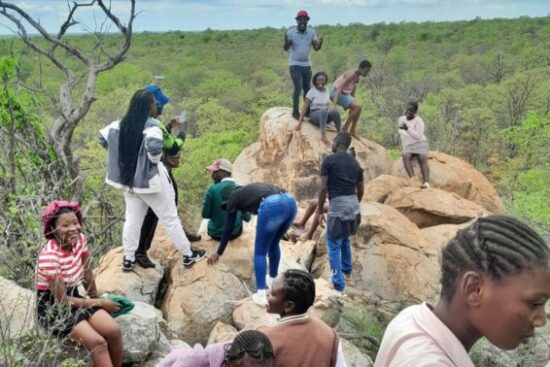
From there, the community moved to the Phalaubeni Dam, which is the newly established trailhead, to experience their landscape anew. Five trained nature-based tour guides led guests along a 5km route, sharing stories of termite mounds, ecological processes, sacred baobab trees and the history embedded in every ridge and rock.
For many of the residents, it was a moment of revelation. “It doesn’t feel like we are still in my community,” one resident said. “It feels like a place far from here.”
That sense of rediscovery and wonder captured what words could not. This was not simply a new tourism product – it was pride returning home.
Elders remember while the youth reimagine
One of the most impactful events unfolded when elderly residents were transported to the “koppie” viewpoint – some had not visited these places in decades. Childhood stories resurfaced. Landmarks were remembered. A sense of belonging, long overshadowed by conflict and fear, found its voice again.
The day ended in a joyful colour-splash celebration, where children, youth, elders, guides and partners painted themselves onto the canvas of a shared, hopeful future. A community marking an inspiring new beginning.

A model for community-led conservation
Phalaubeni’s transformation demonstrates what becomes possible when communities unpack their own challenges, leadership unites around a shared vision, partners listen and support rather than impose, and nature is repositioned as a source of livelihood that should be protected, rather than harvested unchecked for survival.
Today, five local guides have been upskilled. Trails are open. The office is functional. Partnerships with organisations such as Elephant Alive, Global Conservation Corps, SAEON, Octopus Horse Riding, and the K2C Biosphere Region have supported this process thus far and continue to strengthen Phalaubeni’s capacity and confidence.
But the greatest achievement is intangible: a mindset shift at community level.
Phalaubeni, once known for poaching, harvesting and breaching fences, now speaks openly about protecting wildlife, maintaining boundaries and welcoming visitors to experience its natural heritage. This shift did not happen overnight. It is the product of brave conversations, honest reflection and the courage to imagine something different.
Looking ahead
Over the coming months, the Eco-Tourism Office aims to develop booking systems, expand guide training, improve trail infrastructure and market the product to regional networks. Longer-term plans include cultural tours, overnight experiences and deeper integration of tourism with conservation monitoring.
The vision is clear: a thriving community that benefits from safeguarding the ecosystem it calls home.
A story of hope for the Greater Kruger
Phalaubeni’s journey is an inspiring reminder that transformation is possible, even in places long defined by conflict. When communities are given tools, trust, and the space to lead, they demonstrate resilience and creativity far beyond what external actors alone can achieve.
The people of Phalaubeni deserve recognition for this extraordinary shift. Their story offers hope for other communities across the Greater Kruger landscape, showing that coexistence is not a distant ideal, but a practical, achievable, community-driven reality.