Look to the east soon after sunset and you will notice a bright object nestled between the zodiacal constellations of Aquarius and Pisces. Further inspection with a pair of binoculars will reveal that this luminous stellar object is not a pinprick of light, but rather a slight oval. You are looking at the great gas giant, Saturn.
Of all the cosmic gems in the night sky, no one object has inspired more excitement and wonder. Saturn, and its iconic ring system, remain the jewel in the crown of our solar system. Through a telescope, the view is simply awe-inspiring, revealing a glowing yellow sphere encircled by a glistening thin disc. Many of the famous telescopic objects require some knowledge, or an explanation at least, to fully appreciate what you are looking at, but no such embellishment is required for Saturn. It is the highlight of any evening and people’s first views are normally accompanied by exclamations of amazement and disbelief. It truly speaks for itself and has turned many a casual stargazer into an avid astronomer!
We are set to enjoy great views of Saturn for the next 5 months as it slowly ebbs from east to west across our night sky, so here are some mind-bending facts about the mighty ‘Lord of the Rings’.

Saturn is Jupiter’s father in Roman mythology but in Greek, Saturn is Cronos (Jupiter is Zeus). In Greek mythology, Cronus was told of a prophesy that he would be overthrown by his own children. To ensure his long reign, Cronus had a habit of swallowing his children, including Demeter, goddess of agriculture, Poseidon and Hades. When his wife bore his sixth and final son, Zeus, she tricked Cronus into swallowing a rock. Zeus was raised in secret and once fully grown, fed Cronus an emetic, causing him to disgorge his brother and sisters. Together they waged war on the Titans, eventually securing the rule of the gods.
Saturn (and Jupiter) are giant balls of hydrogen that contain sufficient mass for gravity to have sculpted them into a sphere. Beneath the gaseous cloud tops that we can view through a telescope, the hydrogen behaves more like a liquid thanks to the immense pressure. Right at the planet’s centre, we think there is likely a small rocky core. Despite Saturn’s huge size, it is light enough that should there be an ocean big enough (its diameter is about nine times that of our Earth), it would float!
Saturn’s rings were first viewed the Italian astronomer Galileo, but he was unable to resolve their features. He thought that Saturn may be a triple planetary system and described Saturn as having ‘ears’ jutting out from its sides. It was Christopher Huygens who first noted their true nature and described them as a disc of material around the planet. As equipment improved, Giovanni Cassini discovered that the system is made up multiple concentric rings with gaps in between. The largest of the gaps is now called the ‘Cassini Division’ and can easily be seen in long exposure photography.
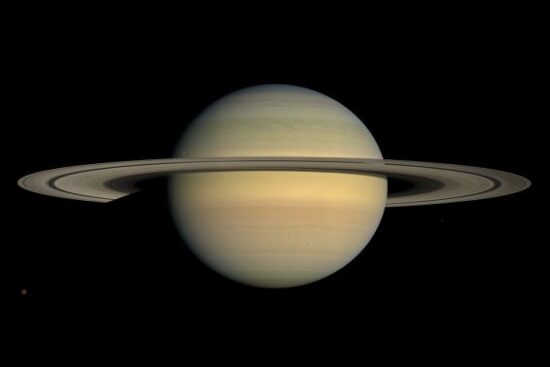
Saturn’s famous ring system was formed when an icy moon ventured too close to the planet, and the tidal forces tore it to shreds, the debris collecting as a thin disc orbiting the planet. The majority of the rings are made from ice, interspersed with dust and rocks, and span the width of six Earths! Despite their huge diameter, the rings are incredibly thin. Believe or not, at their thickest point, the rings are no more than one kilometre thick and average only about 10 – 100m! It is estimated that there is more ice in the Antarctic ice sheet than in the entire ring system. It is amazing to think we can view such a delicate structure from 1,5 billion kms away, but ice has a high albedo and thus the rings reflect a huge proportion of the Sun’s light.
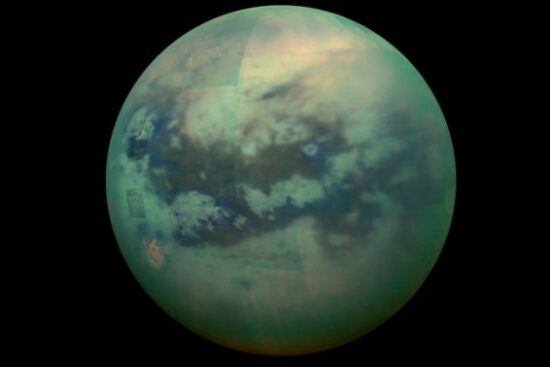
Saturn’s largest moon is called Titan and is unique amongst the solar system as being the only moon with an atmosphere. Like Earth, Titan has a nitrogen rich atmosphere but contains no oxygen or water vapour. Instead, it has clouds of methane above its surface and there are hundreds of seas and lakes filled with liquid hydrocarbons such as methane and ethane. This makes it the only other known body with liquid on its surface. Titan is of great interest to astronomers and astrobiologists since it offers a glimpse into Earth’s atmospheric evolution and more importantly, its chemistry could possibly harbour life. NASA’s dragonfly mission is scheduled to launch in 2029 and will be equipped with a helicopter that will scour the surface for more information on this unique world.
See Celestial Events SA advert for contact details