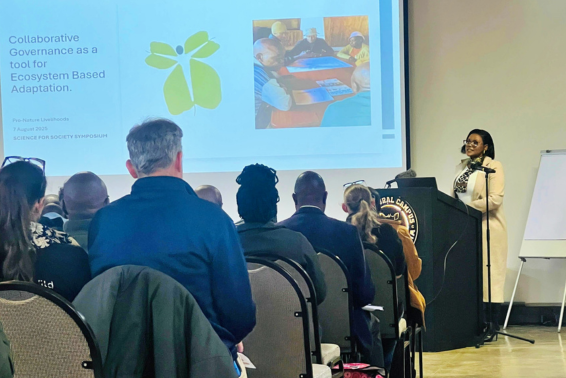
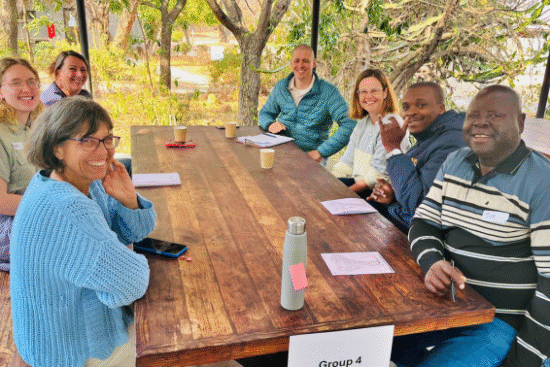
Moments of connection like this one captured the spirit of the third annual Science for Society (S4S) Symposium, hosted by the Kruger to Canyons Biosphere Region (K2C BR), the Wits Rural Knowledge Hub (WiRKH), and the South African Environmental Observation Network (SAEON). Bringing together 90 participants from 50 diverse organisations, the event was a rare chance for researchers, traditional leaders, community groups, government officials, NGOs and private partners to share knowledge and spark progressive collaboration. The room reflected the rich tapestry of voices dedicated to shaping the future of the K2C region.
As Anthony Fry from WiRKH reflected “The coming together of role-players from different domains is so useful for gaining an integrated perspective of the region.”
Shared challenges, co-creating solutions
Among the pressing issues discussed, waste management emerged as a critical concern. Studies led by Prof. Schenck from the University of the Western Cape revealed widespread illegal dumping and burning in rural communities like Moremela and Matibidi – practices that pose serious risks to both environmental and human health. Building on this, K2C and its partners conducted studies to assess the current waste management, assess the needs of the communities and possible potential solutions, including the concept of waste beneficiation centres. These initiatives aim to transform litter into valuable products contributing to circular economies and new opportunities.
Water security was another urgent focus. Sediment accumulation has reduced the Blyderivierspoort Dam’s capacity by 20% since 1999, threatening water quality and availability for agriculture, domestic use, and wildlife alike. This alarming decline is linked to upstream activities such as illegal mining, spurring both government and community responses to protect this vital resource.
Researchers and restoration managers shared hopeful insights on the resilience of local grasslands and the sustainability of livestock farming. Long-term studies show grasslands can recover from drought even under heavy grazing. However, farmers do face complex social and economic challenges, including disease control, compensation disputes and strained relationships with conservation areas that deeply affect their livelihoods and well-being.
Conservation through collaboration
Conservation related presentation topics focused on invasive alien plant management, forest restoration, and supporting predator movement through fragmented landscapes. Presentations also highlighted participatory decision support systems, community and student involvement in habitat restoration, and the use of umbrella species like the Cape Parrot to guide forest conservation. An “umbrella species” is a plant or animal whose conservation helps protect many other species and the wider ecosystem they share. By focusing efforts on preserving the habitat and needs of the umbrella species in this case, the Cape Parrot, conservationists can protect entire forests and countless other plants and animals that rely on the same environment. These initiatives underscore the power of collaborative governance and capacity building as foundations for lasting success.
Across all these issues, one theme emerged: the need for solutions that are practical, community-driven and informed by science. “The S4S Symposium isn’t just about sharing data – it’s about building trust and understanding between people who often work in adjacent worlds and finding common ground,” said Romy Antrobus-Wuth, K2C BR organiser. “When science is made accessible to the public, we open doors to real-world solutions that benefit both our communities and our natural heritage.”
From discussion to action
Breakaway sessions sparked lively conversations around gaps in current knowledge and action, from waste and water to economic development and local resilience. Across discussions, a common thread emerged: empowering local people with skills and governance tools is key to lasting change. Group discussions at the end of the day deepened these interactions, and the more casual setting allowed participants to continue conversations and build on ideas sparked earlier in the day, forging connections that could support sustained learning and real-world problem-solving.
“The symposium is helping to consolidate the emerging network of local actors interested in learning together to improve our region.” said Fry. “We feel that this process is boosted by the strong NGO presence in the region, whose agility allows them to respond quickly to opportunities.”
Looking ahead
Looking ahead to 2026, the team hopes to build on this platform, creating complementary sessions focusing on service delivery and research inside the protected areas as well. And as the veranda conversations showed – when unlikely allies sit together and listen, what begins as talk about trash can grow into plans that change the future of our region.