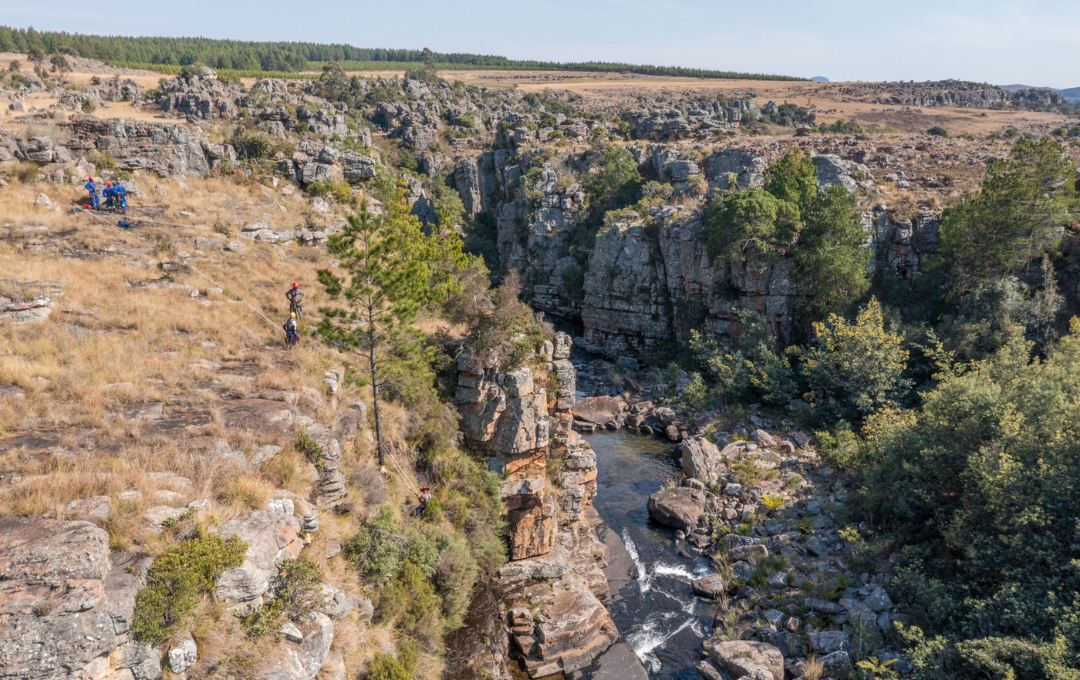
On the Blyde catchment’s steep slopes, a pine tree left beyond the reach of a clearing team can continue spreading seeds into the surrounding landscape. Restoring this important water source means reaching those trees too, and investing in the people who can do so safely.
The catchment covers approximately 200,000 hectares. Its history of forestry has left a legacy of invasive alien plants, predominantly pines, which have spread into surrounding grasslands and mountain slopes. These invasions threaten biodiversity and are estimated to reduce streamflow by 13.7 million cubic metres of water a year.
Reaching trees on cliffs and in remote valleys requires specialist rope access skills, careful preparation and teams who can rely on one another. This work forms part of the Catchment Investment Programme (CIP) being implemented by Kruger to Canyons Biosphere (K2C) in partnership with Nature for Water through its GO Fund programme, and The Nature Conservancy South Africa. It aims to improve water availability and long-term security for downstream users while creating local jobs and livelihood opportunities and protecting biodiversity.
Over the past two years, an estimated 22,000 hectares have been cleared of invasive alien plants through the programme, which has employed up to 100 people at a time, including a core of 31 people with specialised skills.
The same principle – investing in catchment restoration to protect water supplies – underpins the Greater Cape Town Water Fund (GCTWF). The recently launched Cape Water Performance-based Bond is helping to finance the expansion of that work, and the K2C team is collaborating with the GCTWF role-players to learn from their model.
Building Confidence Together
The Cape Town connection also offers K2C an opportunity to learn from people with years of experience in the field, restoring difficult mountain terrain. Following high altitude technical training in 2025, K2C team members were joined in August 2026 by experienced rope technicians from Likhona Lethu Services, a contractor working with the GCTWF, for a ten-day learning exchange in the Upper Blyde, combining workshops, site planning and practical fieldwork.
For the K2C team, this meant time alongside experienced colleagues: watching how they approached a task, asking questions and receiving guidance while putting their own training into practice. It created space to revisit techniques and work through uncertainties with someone who understood the demands of the job from years of practice.
The learning went beyond handling ropes. Together, the teams checked equipment, assessed hazards and discussed emergency plans. These preparations also meant learning how to work together: understanding each person’s responsibilities, communicating clearly and looking after one another.
Participants’ reflections highlighted growing confidence, better equipment handling and stronger teamwork. They also recognised the need for continued practice. The value of the exchange lay in having time and support to develop these skills together.
“Working as a team is the most important thing to ensure safety. We appreciated the respect that the K2C and Likhona Lethu teams had for each other and we also loved the biodiversity of the landscape in the nature reserve,” said Likhona Lethu team lead Ayabonga Velem.
Mentoring others was a new experience for Likhona Lethu Services, while working in the Blyde introduced them to different conditions and approaches. The teams also compared the tools they use. Likhona Lethu recommended herbicide applicators designed to reduce blockages and spills, while K2C shared its use of tree poppers – hand tools that grip small invasive trees and pull them out with their roots.


Seeing a path into specialist work
For K2C, identifying barriers to women’s progression and supporting equal access to learning and development are part of its commitment to gender mainstreaming. K2C’s Lower Blyde Restoration Project Manager, Dimakatso Nonyane, arranged for women from the general clearing teams to meet the two women in the visiting Likhona Lethu Services team. Most participants had previously regarded high altitude work as a role only for men. Meeting women already performing these roles gave them an opportunity to ask questions and imagine a different path for themselves.
For Angel Mapheule, seeing women with specialist skills was a source of encouragement. “Some ladies know how to use a chainsaw and that encourages me!” she said. The opportunity to learn directly from the visiting team was also impactful.
Lesedi Malope expressed an interest in learning more about rope technician work and appreciated the time taken to explain it. “The Cape Town teams are very good at teaching and explaining to us, they made sure we understood,” she said.
Several women expressed interest in further training. Turning that interest into a career opportunity will require training, practical experience and continued support, but the encounter helped to lay a foundation by challenging assumptions about who could pursue the work and encouraging women to consider developing these skills themselves.


Preparing for the difficult terrain ahead
As K2C works to scale up the CIP, its investment in people and developing skills will remain closely tied to its restoration ambitions. “Ensuring that the teams operate safely is crucial and this learning exchange provided an opportunity for our teams to gain confidence and clearly understand safety requirements,” said Nicholas Theron, K2C’s Senior Programme Manager. “This training will enable our teams to tackle some of the most challenging terrain safely into the future, with planned operations focussed on the Three Rondawels, an iconic landmark currently being overrun by alien plants.”
Reaching such a remote site will require helicopter drop-offs and extended stays camping on the mountain. In those conditions, the exchange’s lessons in planning, equipment checks, communication and looking after one another will be particularly important.
As the CIP looks to upscale, continued mentorship and learning will help the teams to prepare to take on more challenging terrain, while opening opportunities for individuals to develop their skills and careers.
Lauren Booth
K2C Biosphere Communications Manager