According to the UN, Earth’s 8 billionth person was born in mid-November. It is an arbitrary number insofar as there is no immediate change to our daily lives – but it is a significant marker for our increasing impact on the world. Those who are in touch with nature are more likely to value it, appreciate our dependence on it, and be cognisant of our impact on it. Southern Cross Schools is ideally positioned to establish an awareness of our critical link with nature.
In the past 50 years, the global population has more than doubled. This rapid increase has resulted in worldwide sustainability challenges – our growth has out-paced our rate of adaptation to more sustainable living practices, and as our population burgeons, so competition for land and resources increases, and habitats are lost to the detriment of all – humanity and the natural world.
Human-wildlife conflict (the competition for land and resources, and the threat that both humans and wildlife pose to one another when forced into contact), is an increasingly salient topic if we are to preserve the natural world while sustainably accommodating our immense population. Our growing population and subsequent concrete development, destroys habitats and squeezes wild animals into human contact, intensifying human-wildlife conflict. Sustainably managing our population and environmental impact requires us to learn to live with wild animals.
Because Southern Cross Schools is located in Hoedspruit, on a wildlife estate on the boundary of the Greater Kruger, the interaction between people and wild animals is part of our everyday lives. It is something that makes SCS so special; we are positioned to be at the forefront of learning how to accommodate the natural environment around us, while still developing a modern school.
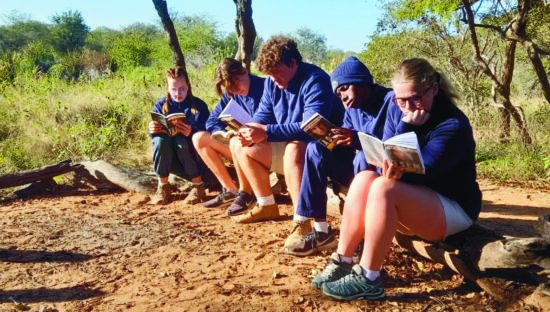
Since opening 20 years ago, a common conversation and memory of past learners are the wild dogs that run past the school during morning meetings, or leopards spotted walking through the school in the evenings. In the latter part of 2022, a leopard has been frequenting the school property. Of course there is concern for safety, but the solution is not simple. Relocating the leopard only opens the territory up to another leopard to take its place, and there is already limited space for wildlife. Moving the leopard will likely only place it in another leopard’s territory. Then, there is an ethical consideration over whether we have the right to move animals when and where we please, not to mention killing them because they pose a threat. If we adopt the mentality of killing dangerous animals when they come into regular contact with us, an expanding human population would call for increased killing and therefore increased threat to wildlife. Sadly, this has been the case throughout history worldwide, and the threat is exponential with our exponential growth.
Thus, the SCS solution has been to set up camera traps around the school to monitor the movement of the leopard and other animals, which then guides our activities and movement around the school. Learners are taught how to behave around wild animals and how to respect them. Furthermore, sightings and discussion of wildlife, foster an interest and often a passion for nature. Such passion is essential if we are to preserve the world we live in for our mutual benefit.
Engagement with nature fosters a respect for nature, and this respect naturally leads to the adoption of sustainable practices. SCS is a ‘bush school’ – we have the wilderness on our doorstep – and part of its niche relies on driving an environmental agenda. In addition to learning amongst wildlife, SCS has a number of activities and lessons that are focused on the environment as a whole and with what is on our doorstep. Every child at the school, from toddlers in the pre-school through to matrics in the college, have a weekly Bush Lore or Enviro lesson, where they get out of the classroom and into nature, learning about and engaging with their natural surroundings. An effort is also made to have lessons outdoors as often as possible.
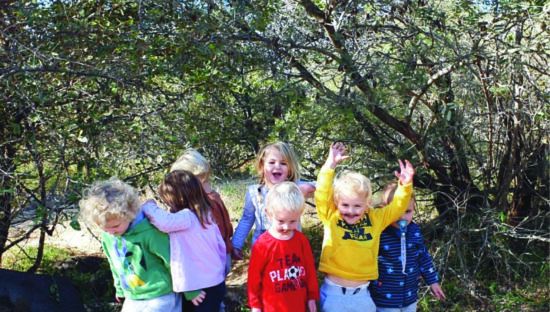
More formally, in the college, there is an Eco-Club that meets twice a week to discuss ecological issues and learn about the bush, by attending talks given by experts in various environmental fields, going on walks on the wildlife estate, and attending courses and field experiences with those working with wildlife. The College also has an Environmental Committee which aims to arrange events and activities that raise awareness of environmental issues. These range from quizzes and movie nights, to talks for the school about environmental issues, or interesting nature-based projects happening in our community, such as the use of contraception for elephants in Selati Game Reserve, to manage the reserve’s elephant population humanely.
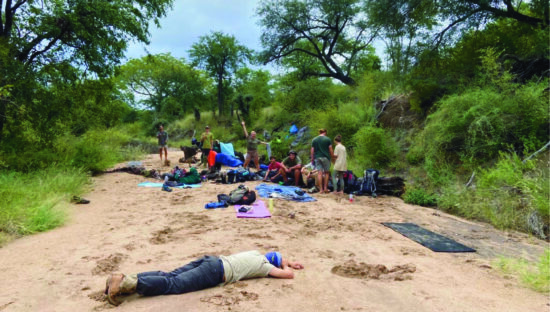
For those learners who are passionate about nature, and enjoy immersing themselves in the wilderness, SCS through EcoTraining, has started arranging an annual 4-night/5-day primitive trail, where learners carry all their supplies on their back, sleep under a canopy of stars, encounter big game on foot, and are taught to read the bush. It is on these trips that the magnificence of our African wilderness is fully appreciated, and a love and respect for the wild truly seeps into our hearts. The memories forged and experiences change one’s perspective of the world and our place in it. Despite our ability to shape the world, we are a very small part of something much greater than ourselves. In April 2022, eight SCS learners went to the Makuleke Contractual Concession in the Pafuri region of the Kruger National Park. It was an exceptional experience. Next year’s group will go on a trail in Tuli, Botswana.
All schools can have lessons about climate change, the impact of population growth, and living sustainably, and some no doubt do so very well. But those schools in the cities will always have these lessons with the environment at arm’s length. SCS is able to remove the disconnect between humanity and nature. By doing so, the natural world is valued and appreciated for its own sake. This creates intrinsic motivation to protect it and an awareness of our place on Earth. We have a right to be here, but so does the rest of nature. We are part of nature and depend on it more than we realise. We should not exercise our right at the expense of everything else.