November 23 is considered to be Fibonacci Day. Many around the world celebrate this day, that honours one of the most influential and talented mathematicians of the Middle Ages (and maybe of all time) – Leonardo Bonacci. Leonardo was an Italian, from the Republic of Pisa. He was born in 1170 in modern day Algeria. His father was an Italian merchant, and Leonardo travelled around the Mediterranean extensively as a child. He was educated in Bugia (Algeria) where he learnt about the Hindu-Arabic numeral system.

In his travels, and whilst speaking to merchants and traders, he soon realised the advantages of the Hindu-Arabic numeral system over the Roman numerals that were in use at that time. It was later in 1202, that he completed the Liber Abaci (Book of Abacus or The Book of Calculation), a Latin publication on arithmetic, which basically popularized the Hindu–Arabic system in Europe. He illustrated its practical use and value in applications such as bookkeeping, weights and measures, calculation of interest, money-changing, and others. The book was so well-received that it had a profound impact on European thought and processes. Replacing the old numeric system and utilising the abacus was an advance in making business calculations easier and faster. The book explained different uses in business, from converting different currencies, to calculating profit and interest. This contributed to the growth of banking and accounting in Europe at the time.
However, although the Liber Abaci contained the earliest known description of the (now known as) Fibonacci sequence (named after Leonardo) outside of India, the sequence had in fact already been described by Indian mathematicians as early as the sixth century!
Leonardo is thought to have died in the 1240’s, and later in the 19th century a statue in his honour was erected in Pisa.
Back to November 23. The reason why this day is celebrated is because if one writes the date out as 11/23, the digits form the four of the first five digits in the sequence – 0,1,1,2,3. The Fibonacci sequence is simply a series of numbers, where a number is the sum of the two numbers before it. So in the sequence, 2 is the sum of the two numbers before it (1+1), and 3 is the sum of (1+2), and so on. Leonardo carried his calculation up to the thirteenth place with a value of 233.
Leonardo came upon this sequence whilst investigating a simple puzzle about a rabbit population. The question that was posed was, that if there were a pair of newly born rabbits – male and female – in a field, and if they were able to produce another pair of rabbits in their second month of life, how many pairs of rabbits would there be after a year? Was there nothing else to think about? But then again that’s what made him famous.
The solution, generation by generation, was the sequence of numbers later to be known as the Fibonacci numbers.

Amazingly the ratio of two successive numbers in the Fibonacci sequence (especially as one gets closer to infinity) is very close to what is called the ‘Golden Ratio’. This ratio is approximately equal to 1,6 – a ratio, it is believed, that suggests that objects that exhibit this ratio in length to breadth, are the most pleasing to the eye. It is thought that this is because the Golden Ratio can be processed faster by the human eye, and as a result it causes our brain to feel ‘pleased’. The two are intricately interwoven and connected in a way to the golden spiral.
The amazing thing about the Fibonacci sequence of numbers, the Golden Ratio, and the golden spiral is that you find these all over the natural world. There is evidence that the Fibonacci numbers and the Golden Ratio occur from microscopic structure proportions in living beings, to relationships of gravitational forces, distances between bodies in the universe. And even the stock market!
Fascinatingly, the logarithmic spiral, that we are talking about, is equiangular; so, if you draw a straight line from the center of the spiral to any point on the spiral curve, the line always cuts the curve at exactly the same angle.

Botany
These numbers and ratio are often demonstrated in the structural symmetry of plants. Many flowering plants exhibit petal symmetry, and often illustrate the sequence in their seed sections, or in the spirals that are formed as new parts and branches grow.
Examples of flowers whose petals exhibit the Fibonacci sequence are the euphorbia, iris, hibiscus, Black Eyed Susan, plantain, sunflowers, and daisies.
Interestingly the bumps and hexagonal scales on the surface of most pineapples form either 3,5,8,13 or 21 distinct spirals in increasing steepness. This creates a recognizable pattern of Fibonacci numbers. The Romanesco broccoli has a shape with florets organized in spirals in both directions around the center point. Fruits that are common to us, that exhibit this series in the seeds’ sectional arrangements are the banana, cantaloupe, cucumber, Kiwi fruit, watermelon and apple. The sequence is also found in pinecones, ginger plants, artichokes and others, including numerous cacti. Palm leaves are also arranged in Fibonacci sequence spiral formation.
Insects
The honeybee is a famous example of an insect that exhibits a Fibonacci sequence, which can be seen in the numbers of ancestors of each generation.

Animals
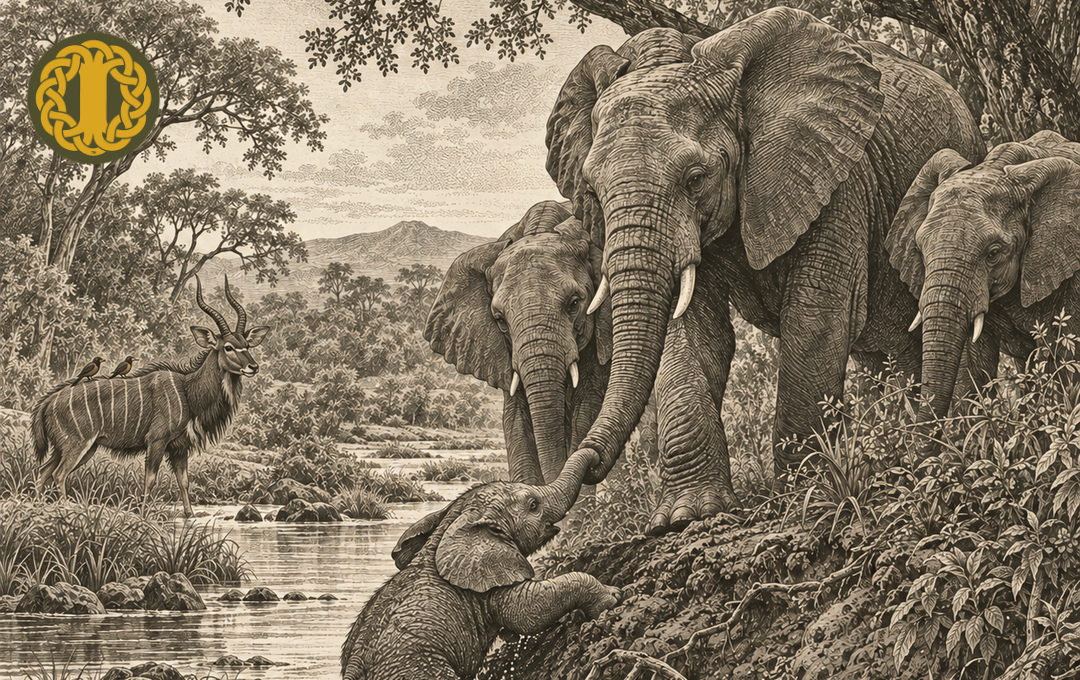
Microtubules (making up the cytoskeleton) of an animal cell, exhibit Fibonacci numbers. Some researchers have even seen the golden ratio in the shape of horns of both Rams and kudu, and in the curvature of elephant tusks. Many sea creatures exhibit the golden ratio in one form or another. A wide variety of sea creatures exhibit symmetry, for example the sea star and starfish. In addition, growth patterns of natural shells like that of the moon snail shell, the conch shell and the Atlantic Sundial shell, all show patterns of the golden spiral.
Curled up pangolins, millipedes, and the chameleon’s tail, all exhibit a golden spiral.

Birds
Research has shown that some Falcons keep a slightly curved diving trajectory whilst hunting prey. They do not dive in a straight line, and in fact follow this logarithmic spiral down to intercept their prey. Hawks have also been observed to follow the same pattern.
The universe and geography
The Milky Way Galaxy and other spiral galaxies in our universe, all resemble the golden spiral formation. Some scientists have even suggested that the distribution of planets, moons, asteroids, and rings in the solar system conform to the golden ratio properties.
Fibonacci sequenced numbers, and the relationships between them, have been observed in sea wave curves and tributary patterns of streams, drainage patterns and in weather patterns. Even the shape of whirlpools and hurricanes closely match the golden spiral.

The human body
Our human body structure really brings to the fore, the Fibonacci sequence or numbers.
One, is represented by our trunk, head and heart; two, is represented by our arms, legs, eyes and ears; three, by the number of bones in each leg and arm, and the main parts of the hand. Five, are the limbs and head attached to our torso; two arms, two legs, and a head.
We also have five fingers, five toes and five openings on the face. With all these, our five senses allow us to interact through sight, sound, touch, taste, and smell. The human arm together with fingers consists of eight parts. All the numbers in the base column of human structure are in the Fibonacci series.
The cochlear of the ear is also a Fibonacci spiral as is the spiral of the umbilical cord. Even our DNA has Fibonacci proportions as do our fingerprints!
And there is so much more to delve into within the human body and its peculiar relationship with the Fibonacci sequence, the Golden Ratio and the golden spiral – do yourself a favour and look this up – you will be amazed.
The Fibonacci sequence has even been shown to exist on the stock market – but that is another story. It does, however, not occur everywhere, but it is just one simple example of the resilient and persevering quality of nature. How amazing nature is.