The vast majority of species lack colour vision. Mammal eyes have two principal types of cells as follows:
Rod cells – these are tubular cells that can function in low light conditions and are sensitive to shape and movement at the expense of detail and colour. They are perfect for animals that are mostly nocturnal and for species that have no need for colour vision. They are common in most prey and predator species.
Cone cells – Each contains a photo-pigment sensitive to one of three parts of the spectrum; response to wavelength of 419 nanometers (billionths of a metre) = blue/violet; response to 531 nanometers = green; response to 559 nanometers = green to red. This is called trichromacy. the cones receive an electromagnetic impulse, pass it along to the nerves and a colour message is sent to the brain. By comparing these light messages, the mind identifies colour and images. Some birds will in addition use light filters to see in more spectral bands and a greater variety of colours than mammals.
New research has revealed that all but the most nocturnal of mammal species are not totally colour blind as was once thought.
Cats and dogs probably see in pale shades of colour for parts of the spectrum. Colour vision impairment – having only one or two types of cones – can infer advantages for survival because it makes camouflage more readily detectable (hiding predators or prey). these conical cells need good light conditions to function adequately and they are sensitive to colour and detection of fine detail while lacking sensitivity to shape, movement and low light acuity. They are found in species that use colour for communication and those that find their food by colour (ripe fruit), and are common in birds and primates.
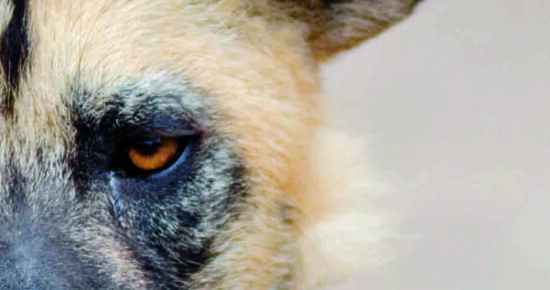
Why do the eyes of some animals shine at night?
This phenomenon is caused by a reflective, mirror-like layer of crystals called the tapetum lucidum at the back of the eye that helps to improve the vision of these animals at night. It primarily occurs in nocturnal species wear acute sight in dim light is a prerequisite for survival.
Light passing into the cells of the retina hits this layer and is effectively enhanced to optimise activation of the cells and interpretation of the image by the brain. This reflected light is what we interpret as the shining of the animals’ eyes. The tapetum lucidum may be situated within the retina (eg: Hoofed animals, carnivores, rodents, dolphins) or behind the retina (eg: crocodile, fruit bats, marsupials).
Regardless of the location, all serve to increase retinal sensitivity. Tapetums may also serve to enhance contrast, allowing nocturnal species to see better. The mineral guanine is found in many (but not all) tapetums and has a phosphorescent quality, being more sensitive to light, improving the eyes’ ability to detect light. Guanine is a white, reflective compound found in the scales of fish, The skin of some amphibians and reptiles and the guano of sea birds. It is interesting that tapetums tend to occupy the top half of the retinal area to collect and enhance visual cues from the darker ground. The lower half of the retina is occupied by a layer of darkly pigmented cells (tapetum nigrum) That subdues light from the brighter sky.
Excerpts from ‘Beat about the Bush – Mammals and Birds’ by Trevor Carnaby, Published by Jacana Media, Second Edition reprint 2018.