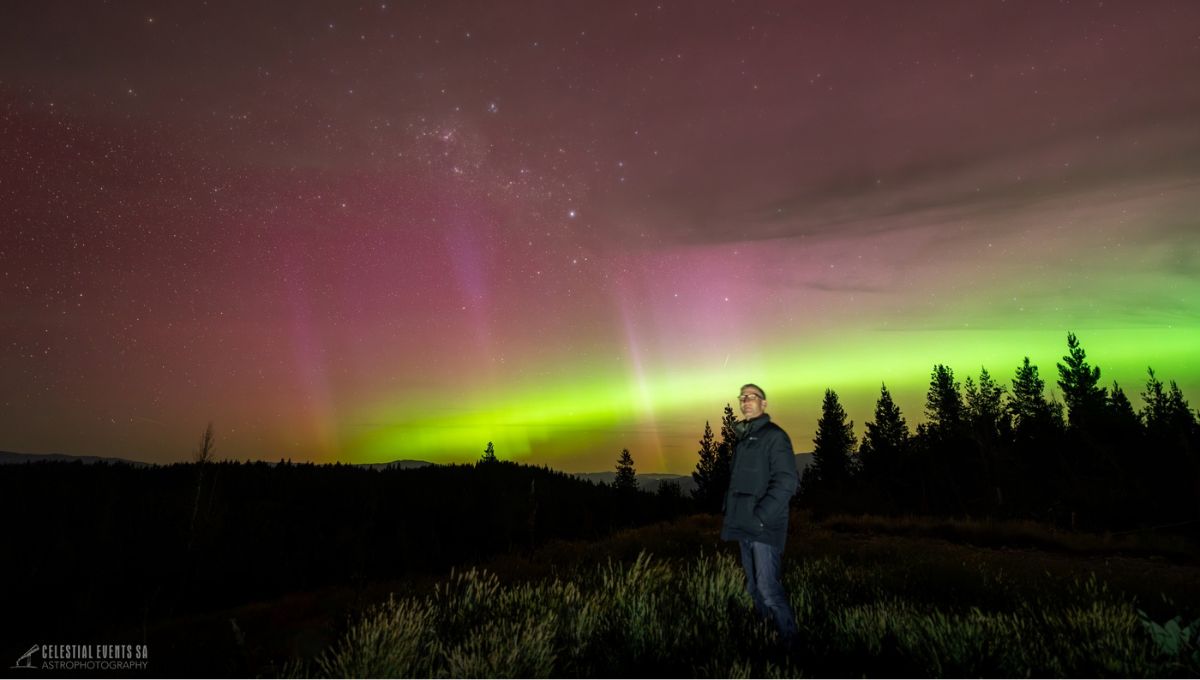
Christmas has always been synonymous with celebration and fanciful decorations such as tinsel and fairy lights. We are used to living rooms and public areas being lit up by these twinkling displays, but this December, the Sun delivered a very rare gift to Earth. A gift that did more than just bring light and joy to a single family, or small community. In early December a stream of supercharged particles erupted form the Sun and slammed into our atmosphere giving us a Christmas light show that literally lit up the skies for most of the globe!
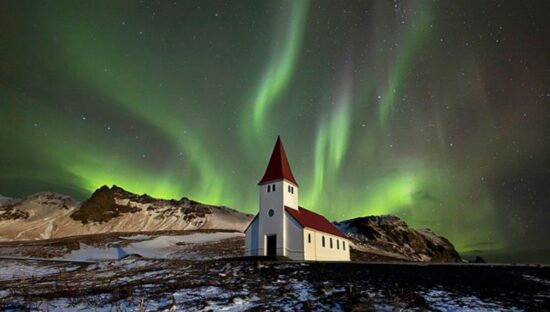
The aurora, also known as the northern and southern lights depending on its locale, is one of nature’s most beautiful and awe-inspiring sights. People travel thousands of kilometres for the chance to witness and photograph this mysterious, spectacular display of light dancing across the skies. Green ribbons seem to waltz through the atmosphere as if conducted by some great unseen force and, depending on the location and conditions, other colours such as pinks, reds and blues are sometimes invited to join this cosmic shimmering ballet. Similar to the solar eclipse a few months ago, to witness the aurora is a once in a lifetime, and often life-changing experience.
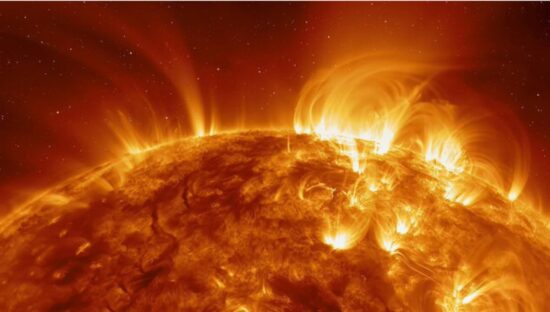
This vibrant cacophony of colour owes its existence to violent geomagnetic storms within the Sun that shoot out streams of highly charged particles across the solar system. These particles crash into Earth’s protective bubble, its electro-magnetic field, and are funnelled towards the poles where they interact with the gases in the atmosphere and produce the mesmerising ethereal glimmers that light up the darkness.
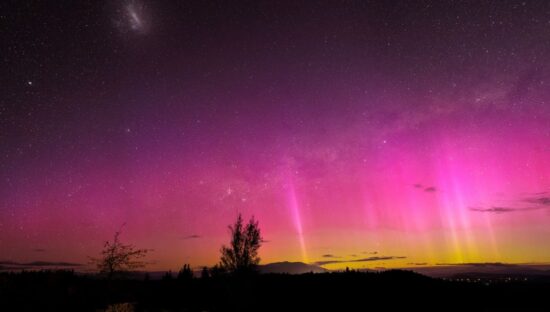
Since they emanate from the poles, auroras are normally restricted to locations such as Greenland, Iceland, Canada and Scandinavia in the north, and Antarctica, New Zealand, and the southern tip of South America, in the south. However, like all things in nature, the Sun also goes through cycles at around 11-year intervals, with peaks and troughs in its activity levels. The end of 2023 has marked the beginning of the solar maximum, which has brought with it a large increase in the Sun’s energy being released and increasing the amount of ‘space weather’ that we are experiencing. The aurora seen in early December was so strong that it was captured on cameras as far south as Nevada in the USA!
But what causes this cycle? As strange as it may sound, the Sun’s magnetic poles flip 180° every 11 years. Yes, that means that if you had a compass on the Sun, the north pole would become the south pole and south pole will become the north pole. Even more strangely, the poles on Earth do the same, albeit on a much longer time scale. On average, this has happened once every 300 000 years in Earth’s history, although the last occurrence was 720 000 years ago. We know this from magnetic patterns in ancient volcanic rocks.
Those of you that monitor such oddities may know that the north pole is currently moving much faster than in previously recorded history, covering an average distance of 48 kms per year since 2020. This recent acceleration has caused some scientists to wonder whether the next flip on Earth has begun.
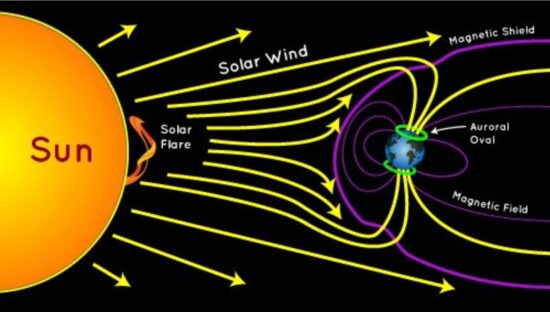
When the Sun’s magnetic field lines perform this flip, they begin to twist and cause cooler areas on the surface known as sunspots. Monitoring sunspot numbers, frequency and location is one of the ways that allow astronomers to track the solar cycle. Sometimes these entangled magnetic fields suddenly release their energy, a bit like a spring uncoiling. This massive burst of electro-magnetic force is known as a coronal mass ejection, or CME, and it is these escaping particles, along with other surface phenomena like solar flares, that arrive at Earth and interact with our atmosphere to produce the aurorae.
These particles do not only interact with our oxygen, however. Sometimes their effect can be much more serious. The arriving geomagnetic energy can affect power grids, telecommunication networks, orbiting satellites and even expose astronauts to dangerous doses of radiation. In 1859 a huge CME slammed into Earth causing auroral displays in equatorial regions such as Cuba and the Bahamas. Known as the Carrington event, it also caused a worldwide telegraph system failure, causing some operators to receive electric shocks and generated sparks that set papers ablaze.
In 1989 a similar CME plunged the entire province of Quebec, Canada, into an electrical blackout that lasted 12 hours.
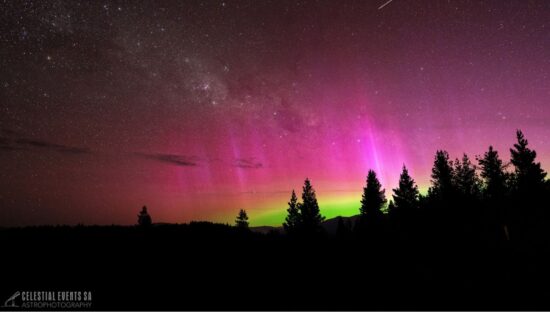
Despite the rather apocalyptic possibilities, the aurora remains one of the most sought-after natural wonders of the world. There are few things that can rival its magical appearance and one cannot help but watch dumbstruck at its beauty. For anyone hoping to tick off this bucket list experience, it is best to head north, since there are more easily accessible land masses closer to the north pole than to the south. This will allow you to be ‘under’ the lights and to witness the fanciful dancing display that they are so famous for, as opposed to only seeing them on the horizon, which is the case for the southern lights – unless you fancy a trip to Antarctica!