With Christmas fast approaching, we thought we would look at some festive objects in the night sky. There are not a great deal of official, Christmas-related constellations, but historians suggest that the famous Star of Bethlehem, that guided the three wise men the Jesus’s birthplace, could have been a conjunction (two objects appearing close together in the sky) of two planets or perhaps a comet.
Around the time of Jesus’s birth, there was a conjunction of Jupiter and Saturn in Aries, and Halley’s comet was visible in the sky around 11 BC. Whilst neither of the dates align perfectly to history, these remain the most likely culprits.
Regardless, there are a few Christmas-themed deep sky objects that are visible this time of year, all of which can easily be seen with a pair of binoculars or small telescope:
The Christmas Tree Cluster (NGC 2264), MONOCEROS
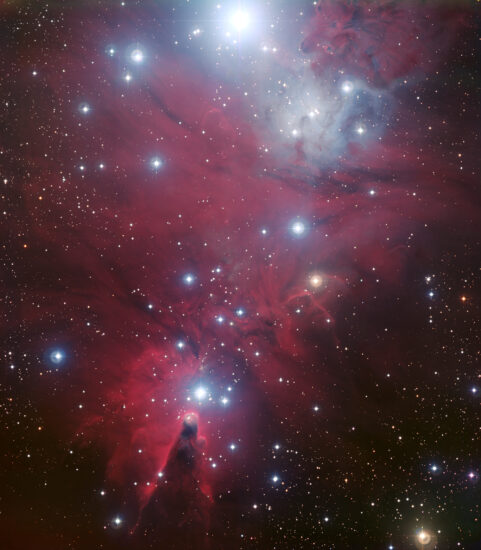
Residing over 2500 light years away, this group of young stars forms the characteristic, triangular shape of a Christmas tree – although it appears upside down from southern latitudes. Situated in the faint constellation of Monoceros, the Unicorn (sandwiched between Orion and his two hunting dogs), the cluster contains around 600 young, recently formed stars, many of which can be seen through binoculars. At the apex of the tree, lies a dark patch of dust and gas known as the Cone Nebula.
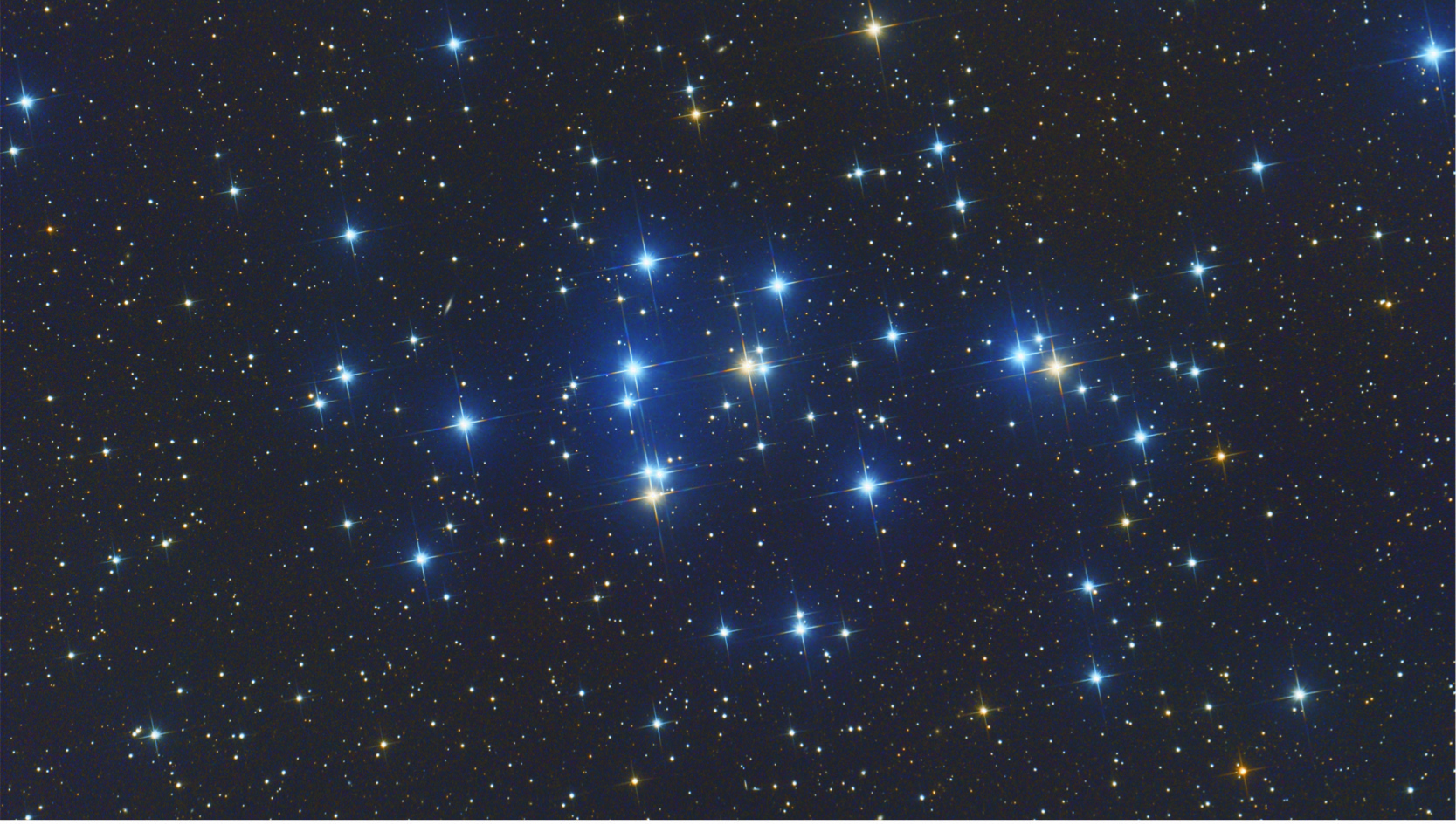
Praesepe, the Manger (M44), CANCER
Cancer is a faint constellation, but contains one of the brightest and most magnificent open clusters in the sky. M44 is more commonly known as the Beehive Cluster, but its Roman name, Praesepe, comes from the word ‘manger’. Like the Christmas Tree cluster, the manger is a community of young stars, only around half a million years old, embarking on their stellar journey. The object is easily visible with the naked eye and a pair of binoculars will resolve many of its 1000 or so members.
Blue Snowball Nebula (NGC 7662), ANDROMEDA
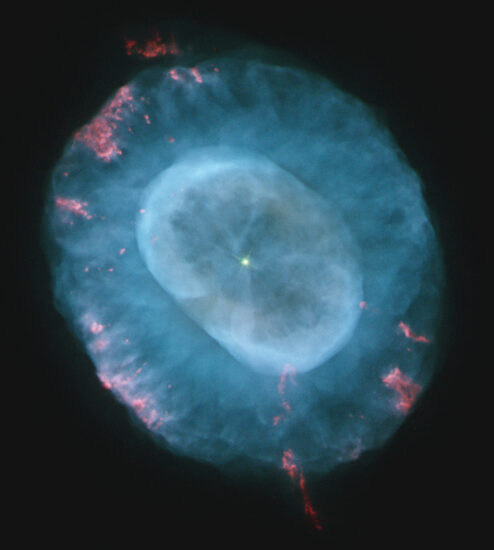
Planetary nebulas are the remnants of dying, small stars. As they expire, they release their atmosphere into space in a gentle ‘puff’ rather than an explosion. Left at the centre is a white dwarf, the core of the now deceased star. The Blue Snowball is a part of the Andromeda constellation and can found west of the Andromeda galaxy, below the body of neighbouring Pegasus. Although small, a backyard telescope will reveal a central star surrounded by a slight haze, but larger instruments will pick up some blue colouration.
See Celestial Events SA
[Image Credits:
Blue Snowball: NASA
Christmas Tree Cluster: ESO
M44: Wikipedia]
advert for contact details