![Squirty Adult[99]](https://kruger2canyon.co.za/wp-content/uploads/2022/10/Squirty-Adult99.jpg)
In the September you were introduced to the Caterpillar Rearing Group (CRG). The context was historic and high-lighted the origins of the group as it stands today.
Having been participatory to the CRG since its inception, my daughter Allison and I have experienced very interesting findings while searching for and rearing the larvae of many different Lepidoptera species. Between us we have attempted in excess of 3000 rearings, with some unusual discoveries.
The forests of Franklyn Park are one of our favorite places to go ‘caterpillar hunting’ along with the many other delights that are on offer while walking the trails. A particular tree of constant interest is the forest knobwood (Zanthoxylum davyi), but more from a butterfly perspective. Our largest butterfly species, the Emperor Swallowtail (Papilio ophidicephalus ayresi), has the knobwood species as a larval host plant.
On one of our excursions along the trails of Franklyn Park, to a spot high up the, we found an interesting larva that was later to be given the name of ‘squirty’, due to a pair of tubular appendages extending off the last segment. It has been indicated that these appendages are a defense mechanism, as the larvae are able to squirt an acidic deterrent when approached by predators.
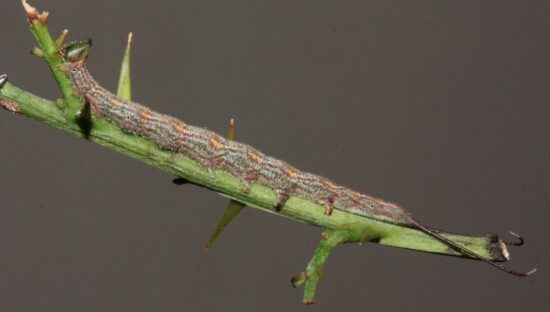
The first specimen found created much interest and discussion. Unfortunately, the quest to rear a ‘squirty’ was filled with many disappointments. On returning home with our latest discovery, it was noted that the container had a gaping hole in it, and that our newly found specimen had escaped. This incident increased our resolve to rear this little ‘Houdini’ and, therefore, many more trips to Franklyn Park were undertaken with differing levels of success.
Finding more specimens was not always easy and there were other issues to contend with. Parasitoids are always problematic – most disappointing was when an almost fully grown larva that was being reared was found to be suspended over a bed of parasitoid cocoons. Furthermore, having a fresh supply of plant material to feed the larvae, was a critical issue. The food could only be kept in the refrigerator for so long before wilting. Poor food quality also leads to the demise of any larvae being reared. Heat and humidity are factors affecting rearing success as mould thrives under such conditions.
After a number of seasons of failure, Allison discovered a batch of squirty larvae on a young knobwood tree at the lower end of the forest. These larvae were treated like royalty from the Lepidoptera world and successfully reared to pupation. Some weeks later the adult moths started to eclose. Having expected a spectacular moth from this weird larva, there was discernible disappointment when a typically drab moth emerged.
Another specimen that created much interest was a day-flying moth from the top of the Mariepskop Mountain. Siting on the tip of a dry twig, above a batch of dozens of eggs was a beautiful day-flying moth. Collecting eggs is always high-risk as sometimes the eggs are not deposited on the actual larval host plant. In this case, samples of surrounding vegetation were collected to provide a range of choices to the hatching larvae with the hope of one hitting the jackpot.
Enquiries were made about this moth species, to determine what the larvae may feed on. As far as the species is concerned, experts could only provide a genus and the species remained a mystery. However, some critical information on this particular genus was provided. On emergence from the egg, the larvae of this group must find some swampy water to drink as they need of the bacteria present in such water, to assist with digestion.
When the larvae started to hatch, we realized that all the plant material we had harvested was of no benefit. My wife Tertia suggested we try something from our fishpond. Hastily a variety of plants from the pond were sampled, put in containers, and the hatched larvae, now christened ‘swamp-monsters’, placed on the plant material.
![Swamp Monster Hatchlings[48]](https://kruger2canyon.co.za/wp-content/uploads/2022/10/Swamp-Monster-Hatchlings48-550x312.jpg)
There was great excitement when some fras was noted on the leaf material from the water lilies. On closer inspection, clear evidence of foraging activity was found on the underside of the lily leaf material.
What appeared to be an issue, was totally mitigated by the water lily availability and obvious palatability. The larvae grew strongly, passing through their instars successfully, and finally pupating. Many did die for some unknown reason, but when the first adult eclosed, there were smiles all round. An bonus was that that some females even produced batches of eggs! A second generation of larvae hatched, and more adults were reared – a complete success story.
![Swamp Monster Adult with Eggs[25]](https://kruger2canyon.co.za/wp-content/uploads/2022/10/Swamp-Monster-Adult-with-Eggs25-550x312.jpg)
Only one question remained – what is the species? That may be another story to write about at a later date.
This is but a tiny glimpse into the amazing world of caterpillar rearing, and the incredible experiences we have had in rearing Lepidoptera larvae. The learning curve is unbelievably steep, but worth every effort.