It is the beginning of the bite and sting season. At this time of year as the weather begins to warm up, we start to see a marked increase in snake, insect and arachnid activity. Below are some helpful tips on reducing your chances of a painful encounter or worse.
Spiders
Spiders are typically portrayed in a negative light by society and popular media, in reality the majority of spiders are in fact completely harmless to humans and play a crucial role in maintaining healthy ecosystems. That being said, there are a handful of species in the area which are potentially medically significant. Most notably are the button spiders, violin spiders and sac spiders. There is even some debate as to whether sac spiders should even be considered medically significant as there appears to be little hard evidence to support this claim.
Legitimate spider bites, in other words bite cases where the bite has been physically felt and the offending spider seen and correctly identified are rare. Generally speaking, their fangs are relatively small and consequently it is virtually impossible for them to even penetrate human skin. Most bites occur when the spider is accidently squashed against the skin. Shaking out bedding, clothing, shoes and being mindful as to where you place your hands will greatly reduce your chances of a bite.
Ticks
What may be surprising to some is the fact that ticks are arachnids, as adults they have eight legs. They are well known as significant vectors for transmitting various diseases to both humans and animals.
Exposure to these external parasites typically occurs when walking through grass and other vegetation, or when interacting with animals. Wearing long pants, closed shoes and spraying insect repellent on your legs and feet will help to limit this exposure. It is also advisable to conduct a physical examination of your clothing and body after being out in the bush, to remove any ticks which may be on your person.
Scorpions
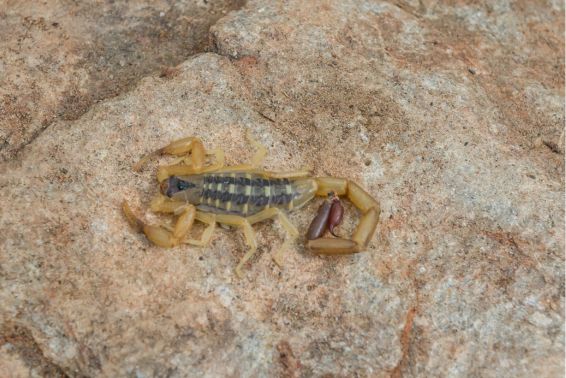
Most scorpion species are not dangerous to people. As a rule of thumb scorpions with thick, fat tails and small pincers are more venomous than those with thin tails and large pincers. The Transvaal thick-tail scorpion (Parabuthus transvaalicus) is highly venomous species commonly found in the Hoedspruit area.
Scorpions are predominately nocturnal so keep screen doors closed at night. There are often gaps under doors and it is beneficial to fit aluminium door seals (draft stoppers) with the rubber strip, to prevent scorpions and snakes from entering under the door. Use a torch at night so you can see where you are placing your feet, and wear closed shoes. Be sure to check clothing, bedding and shoes before use. And be careful when grabbing that piece of firewood for your weekend braai.
Wasps
Solitary wasp species tend to be rather docile, however the social species such as the paper wasps can be very defensive around their nests. Typically, they build their distinctive nests in sheltered locations, for example under the eaves of a roof, under carport roofs, in pipes or under decks. Pay attention to your surroundings when working in and around your home to avoid disturbing a nest.
Other invertebrates
There are many insects and other invertebrates which have the capability of either delivering a painful bite, sting or releasing a noxious chemical in defence. Soldier ants of many species can bite and sting. Centipedes have a modified pair of front legs that look like fangs which they use to inject venom. Assassin bugs have a curved piercing mouthpart called a rostrum which they use to inject their venom. Of course we are all familiar with the honey bee which can be very defensive of their hives. All the above mentioned bite and sting precautionary/preventative measures are applicable for reducing chances of a painful encounter
Snakes
Hoedspruit is home to many snake species, including seven highly venomous species. Never attempt to capture, handle or kill any snakes, just leave them alone. Never handle any dead snakes that you may come across. Always wear long pants and closed shoes when walking in the bush. Avoid walking in long grass and thick vegetation. Keeping doors and windows closed, when possible, will help to prevent snakes from entering your home. Always pay attention to your surroundings and be careful where you place your hands and feet. Use a torch when walking at night and stay on paths or walkways. Keep your gardens neat and tidy to avoid attracting snakes and their prey.
For more information on venomous animals, awareness training and talks, as well as a professional 24hrs problem snake rescue service, contact the author at Wildlife Safety Solutions: 073 934 6156; info@wildlifesafetysolutions.co.za; www.wildlifesafetysolutions.co.za, FB Wildlife Safety Solutions, Instagram wildlife_safety_solutions