With a welcome to warmer times, so far this month, we have seen relatively stable rain free conditions, dominated by high pressure, and offering some welcome stability. The trees and grasses have dried, the remnant flowers have withered, and vegetation everywhere has shrunken into shrivelled, decaying forms.
Mornings are refreshingly mild, lacking the crisp nip of a fortnight or so ago, and which rapidly build after brunch to the heat of midday. Afternoons are now notably hot, but cool quickly at the first hint of twilight, offering fresh and radiant evenings. Despite the occasional gust of berg wind, we have already been through the worst and now see signs of spring everywhere, if we look closely enough.
Blackthorns and the other “Acacias of ancient history” are blooming, with each species already starting in earnest with their spike and ball shaped flowers. In a way, these are almost the African equivalent of Japanese cherry blossom. Their off-white to yellow tones wash over the landscape, and thus offer wisps of colour and fragrance which contrast starkly with the still, largely leafless and barren looking terrain.
Other signs of “new life” in action include other flowering trees, such as the nectar and activity-rich, Weeping Boer-bean, which are suddenly buzzing with pollinators like bees, flies and others. Insect life, both diurnal and nocturnal is starting to emerge again, building to their crescendo as we go forward.
Even in many of our local birds, we can note some changes. Behaviours like courtship displays, display flights and nuptial rituals are in full effect for some, as is pair-bond formation. The tone and intensity of singing is audibly increasing day by day.
As conditions improve, there are still remnants of winter out there, but the turn of the tide is undoubtedly upon us. Birds remain loosely associated within bird parties, but there is an extra energy in the air as mating hormones flurry through each species and birds become more vocal. This is alongside a flush of migrants arriving back, the first intra-Africans who quickly reclaim regions left only about one hundred days ago.
These and all birds are simply taking advantage of the good conditions expected ahead. One of the major aspects that make birds so successful is their mastery of self-propelled, self-reliant, aerial flight. Because of this, they are able to tap into optimal conditions on a local, international, intercontinental, and sometimes, even global scale.
Flight, as mentioned last month was a completely accidental benefit from the fundamental design of the scales that feathers evolved from. Nonetheless this “plunder of fortune” has allowed birds to radiate out into the vast, varied, highly specialised and rapidly-evolving group of vertebrates we see today.
The major reason that feathers can generate flight is because of their individual shape. More specifically, flight results from what that shape does to the air that is split around it while moving forwards. Fundamentally all feathers used for flight have the same shape, known as an aerofoil. When looked at, side on, the one side is heavier and it trails to a fine tip, the upper surface is curved and the lower surface is flat.
This is the same shape that airplane wings and helicopter blades look like in their cross sections. In fact, the inspiration for the design of these parts came from birds and feathers themselves.
Feathers are each individual little aerofoils but the wings of birds, by no coincidence, have overall exactly the same structure too.
The physics of what happens next is quite intricate, but essentially the most simple way to explain it, is that as feathers move forward they are sucked into the sky.
An easy way to experience this principle, is to create an aerofoil shape with a hand, which can then be held a short distance out of a window of a moving car. When the right shape is created the hand rises of its own volition. Thus all that flapping does is generate forward momentum, not lift. It may sound strange, but how it works can be simplified.
As a feather or wing pushes through the air, the air particles are separated. The particles that are pushed beneath the wing travel in a straight line, thus these have less distance to travel before meeting up again, on the other side of the wing with those that were pushed above.
Those that go along the curved upper edge of the wing travel farther in the same amount of time, and thus stretch out to get to meet the lower particles. This stretching out creates lower pressure. Air always moves from an area of high pressure to low pressure. Because there is low pressure on the upper side of the wing and relatively high pressure beneath it by comparison, the air simply moves up and takes the wing, or feather with it. Thus simply by moving forward, bird wings, comprised of feathers themselves, passively generate lift.
There are many adaptations, important to mention, that almost all birds share, out of which aerofoil design is only one. Each are vital for the ability to keep a body from succumbing to the pull of gravity, not to mention atmospheric challenges, for long periods of time.
Hollow bones allow for a light weight framework for the attachment of huge pectoral and other muscles. The airspaces in the bones themselves, as well as a number of air sacs that extend from the lungs, give birds an alien but highly efficient respiratory system. Having these, means that birds of all shapes and sizes, have a constant supply of high octane oxygen to fuel the sportscar-like efficiency that huge muscles, like the pectorals, achieve.
Bills are another flight saving gadget which have developed over time. These, alongside the well-developed gizzards in many seed-eating species, arose as a result of having a lack of teeth. The density of teeth in terms of weight, alongside their placement on the body, would have rendered flight comically impossible.
Thus, with unessential weight jettisoned, a good blood supply, and the right-shaped equipment for flight, birds have literally spanned, and in their own ways, conquered the earth. Today birds have radiated out across the globe in their myriad of forms almost entirely due to their flying and thus dispersal capabilities.
Due to the great variety of habitats birds are able to access, there have been many adaptations in wing shape. Different designs offer their bearers the opportunity to manipulate and bend the boundaries of what is possible within the environments they inhabit. There are a four broad categories of wing shape, each type offers a range of features that are both advantageous and in some cases limiting.
Those species with short-and-broad wings have the ability to explode into the air dramatically from an absolutely static position, no run-up required. These wings are found in many prey species that spend a lot of time on the ground, families such as Spurfowls, Francolins and Doves have incredible lift capabilities but lack endurance or agility. Thus, there are some costs to bare for the benefit of instant flight.
Species that have broad wings which are also long, are those that are best suited to soaring. Soaring is the act of using wings, spread out, to passively fly and climb in altitude, often while catching rising thermal air currents. The wide surface area of this shape provides a large parasail and therefore allows these birds to take advantage of the uplift of air. Many of these species have specialised, and spread out, primary finger and alula feathers which act to limit turbulence at the wing tip. This means that individuals can soar more peacefully without too much turbulence.
Examples of groups with this broad-and-long wing-type include large raptors, Storks, Cranes, Bustards and others. Many of these are migratory over vast areas, but are restricted to travelling over land where rising thermal air currents can be found. Thermals are not found over cool surfaces like water. One of the major downsides for this kind-of design is that flapping flight becomes energetically extremely expensive. Therefore, when cold, wet or overcast conditions prevail, these species largely remain grounded. Even though they are able to fly, they choose not to, as it would be too inefficient over all but short distances.
Short-and-pointed wings are the go-to of choice for small, usually arboreal species including many passerines, like seed-eaters, and small raptors, like Accipiters (birds of prey). Overall, this type of design is the best all-rounder in terms of flight capability, compact design and ability in the air. This alongside great agility to dive between spaces with many obstacles, like branches and other vegetation.
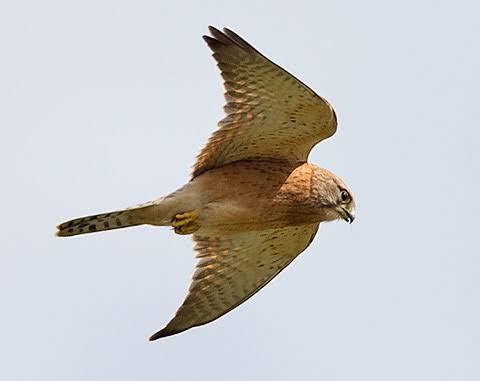
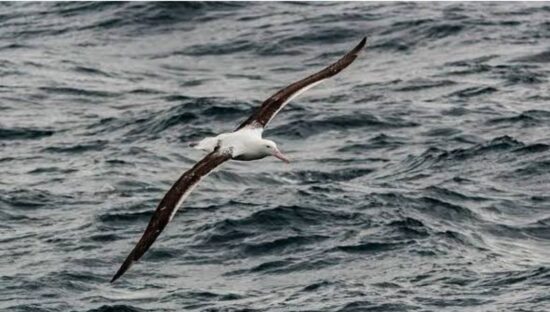
The final group of basic wing types are those that are both long-and-pointed. In some cases, a similar design shared by a number of unrelated families for a variety of reasons. In raptors like falcons and kestrels, this design cuts through the air, offering highly streamlined flight, best illustrated when stooping in a predatory dive or hovering above a grassland. This wing shape is also found in seabirds which “bank” and “glide” effortlessly, just above the height of waves, using almost no energy at all. They do this for hundreds and thousands of kilometres at a time, as they traverse the oceans of the globe.
Despite these basic designs, when using flight for identification purposes, something incredible happens within the brain of the birder. Because we are hard-wired for picking up small, even minute differences, we are often able to discern a huge amount by observing how various species fly.
Constant factors like dipping action, patterns of movement, flapping rate, length and strength of flight, landing habitat and more can affect a birds flight pattern. All features combine to give a consistent impression which can reliably help separate one far away dot moving across the sky, from another. It sounds difficult, but it is surprisingly not.
No matter what their shape, functionalities or hindrances, wings and feathers of any kind remain a design and facet of the avian world to be admired and revered. They have allowed birds, as well as us, humanity, to dominate not just Africa, but the entire planet! This is a claim that very few groups of organisms can make, and is yet one more of the fundamental principles that fascinate about the class, Aves.
This month, while out with the binoculars, take a look at some local specialities and keep an eye to the skies for any birds. Especially if in flight, observe aspects like how each species mixes flapping with gliding. Ask questions like, do they have long flights or short ones, and where do they land, on the ground, in trees, reeds, bushes or in grass. Even those only seen in flight, if seen well, can be identified visually the old fashioned way, but this time having gleaned a little bit about the way each bird moves through the air as it does.
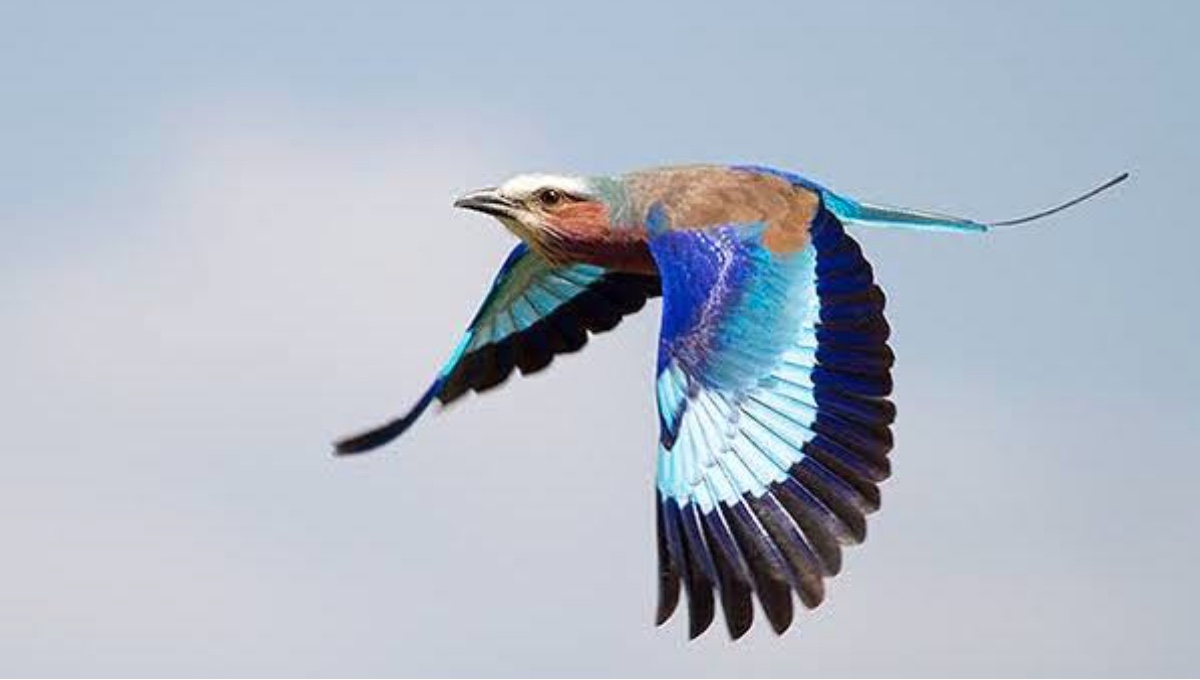
Feature image: Lilac-breasted Roller – John Edwards