How do you tell the difference between insect and fruit bats?
This is relatively easy, even with the very great diversity of species in southern Africa. The fruit eating bats are also called megabits because they tend to be larger in size and eat larger food items, we are generally smaller insect eating bats that eat smaller food items or descriptively referred to as micro bats. As the name implies, fruit bats eat fruit of all descriptions (generally berries and figs) and find the ripest of these by smell, hence they have a well-developed, dog-like snout and nose.
Site is also important, not to see the colour of ripe fruit, because at night there is no colour visible, but rather because they have to see where they are flying in among the branches to land at the right fruit. They therefore have a large pair of eyes. Their ears are small because they do not use echo-location and can see their enemies.
Insect eaters, on the other hand, catch their prey out in the open while flying so do not have to see well. They rather rely on a more sensitive mechanism to find their small prey items in total darkness. Echo-location is used with the sounds emanating from the tongue and voice box being bounced back off prey to the large ears. Many species also have convoluted folds of skin on the face that help to produce high frequency sound used in echo-location. The eyes and nose are unimportant for food acquisition and predator detection and are therefore very small in most species.
Why do bats not fall when hanging?
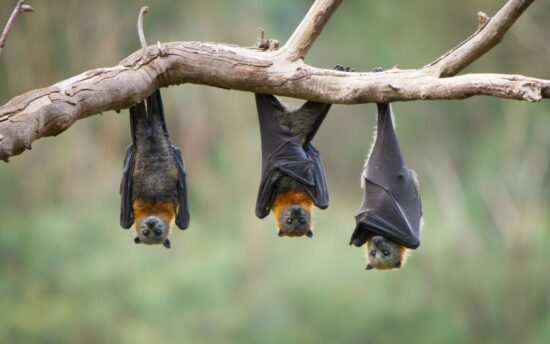
Bats have special mechanisms in the legs that actually allow them to grab and hold on by relaxing. An effort is needed to release themselves so they can, therefore, even sleep without the fear of falling. Normally in animals (there are a few exceptions) the tendons of voluntarily or consciously used, under tension, to close or open a joint, eg: a claw or talon. In bats, however, the tendon connections for the clause on the toes are in voluntary, being activated by the body weight when hanging upside down. Gravity, therefore, does all the work, the body relaxes, and the claws close – and stay closed, so that even if the bat died while hanging, it would stay there until bumped off by another bat or until it rotted off. To fly, the bat needs consciously to ‘raise itself’ to overcome gravitational tension. It then releases its grip, enabling it to drop and fly. I have often seen bats swaying in the breeze while attached to boots or foliage, some of them not even waking. Bats that use dark, cave like roosts (mostly insect eaters) have small command sharp claws to grip little indentations in the roof surface. This ability to hang upside down without concentration enables females to tend their young (which cling to the body, covered by the wing) without worrying about falling off.
The legs of bats are too weak to hold their body weight because they have become reduced to save weight as an adaption to flying. Most birds have hollow bones, but have minimal reduction (in most species) of the legs as they need them for perching and walking about in search of food. Bats have followed a different route altogether. Rather than having feathers (which are modified scales that hint at birds’ reptilian ancestors), they have developed extensive, but light, membranous wings, have kept the solid bones, but have reduced on the one thing that was not of prime importance- their legs! ‘Cause most bats of feeders of aerial insects that they catch on the wing, they can afford not to have strong legs, and so have adapted their wings (forelimbs) to have claws (hooks). Because birds have occupied most of the niches for flying, Mets compete by hunting at night (when most birds are in active) and use their foot claws to hang rather than perch. The legs in insect eating varieties are, therefore, rudimentary and not capable of holding the animal’s weight if attempting to stand (cumbersome shuffling being the only movement of these limbs). Fruit-eating bats still need some locomotive ability of the legs to aid in clambering around for fruit – but they are nowhere near as agile as birds.
When giving birth, the female pulls herself into more of a horizontal position by means of grabbing the substrate (cave roof or tree) with the claws on the thumb and index finger (in fruit bats) and only the thumb claw (in insect bats). With the heads thought lower than the tail, she gives birth and as the baby slowly falls, it is captured safely by a catch-net of soft skin wing-membranes – principally the large membrane between the 5th finger (‘pinkie’) and the hind leg, and assisted by those between the other fingers as well. These membranes, as part of the wing, are usually wrapped around the body at rest. The female now wraps the baby, and protects and holds it close to her body where the baby clings to her fur and pectoral nipples by means of the well-developed foot and wing claws and small hooks on the end of the milk teeth. The female will protect and hold the baby in this manner for a number of weeks until it is weaned. She may carry it around with her while foraging – the baby effectively clinging to her without assistance, or it is left in a nursery roost with other babies.
Excerpts from ‘Beat about the Bush – Mammals and Birds’ by Trevor Carnaby, Published by Jacana Media, Second Edition reprint 2018.