![Ludwig_s Bustard - an inhabitant of the deep karoo moving between bushmanland and namaqualand through the year. Birdlife SA [56]](https://kruger2canyon.co.za/wp-content/uploads/2023/07/Ludwig_s-Bustard-an-inhabitant-of-the-deep-karoo-moving-between-bushmanland-and-namaqualand-through-the-year.-Birdlife-SA-56.jpg)
As the winter enters its phase of chilled mornings and warm afternoons, many of us in the Lowveld appreciate the higher temperatures that rise through the middle of most June or July days. For us, it is a season of starkness and strife, as the bush and its component inhabitants make the most of late rains, a good food reserve, and for now, water sources that seem like they might last. For those in the highveld there is often a biting wind and nights are genuinely frigid, with nipping frost and clear blue skies.
None, however, have it worse at this time of year, than those who dwell in the mother city. With squalls, depressions, coastal lows and drenching fog, interspersed by gaps of several tempting ‘good days’ as the norm, time spent outdoors can be intermittent.
Despite this seemingly glum nature, this is a good time to be out and about in this region. Summer is also an excellent time to visit, as many resident species are still possible, the chance of a vagrant or scarcity exists, and the weather is much more stable.
A quick flip to Cape Town is often on the cards for many South African’s, many of whom either originate from the realm or who have family unduly caught in the vortex of ‘the Cape’, its sodium-rich air, and it’s aquarian allure.
The first thing to hit home, for those of us that live back east, is the late arrival of dawn. Hypothetically in a different time zone, the nature of the sun is definitely different to the one in the subtropical lowveld. During winter it only crests the horizon at a punishing 07h30 and sets below the opposite one at 17h30 sharp.
This naturally means the days are short, and oddly, distances between sites can be surprisingly long, so time available must be planned to some degree. If based in the urban hub itself, it is worth considering a night or two away and then back, therefore catching a few sites each day and making the most of each. Thus is it best, if thinking to explore the area properly for its top quality, world famous specials, to try stretch out from Cape Town itself in one of two loops, each of which lasting two to three days.

Birding in the city itself can be excellent with Kirstenbosch Botanical Gardens offering beauties like orange-breasted sunbird, Cape sugarbird, Cape spurfowl, bokmakerie, Cape bulbul, Karoo prinia and more. Rondebsoch Common is a great spot for the scarce rufous-breasted sparrowhawk with locals and even gate guards keeping tabs on the birds’ movements. Simonstown has the infamous African penguin colony, but it is also one of two starting points for the famous Cape birding pelagics. These pelagic trips run from 07h00 to 14h00 on one day of several weekends a month, and are weather dependant.

They are not very expensive for what they offer, which is one of the greatest spectacles in the natural world. If lucky enough to find an active trawler pulling in nets, there can be tens of thousands of birds behind a single vessel. A visual smorgasbord that doesn’t need to be all-identified to be appreciated. The money made from these Simonstown ventures goes directly back into seabird conservation and these boats are run as a non-profit exercise.
The boats that leave from Hout Bay are run by a private company which has more flexibility in terms of time out on the water. Both options offer a wealth of species and experience, each one is its own unique blend of variety and expanse. Species on offer include five or more species of albatross that can include the scarce wandering albatross and other rarities alongside the more common white-capped (shy), black-browed, Indian and Atlantic yellow-nosed albatross. Common ‘smaller’ birds include white-chinned petrel, northern and southern giant petrel, large numbers of Cape petrel in winter, and steady numbers of great-winged petrel, plus several shearwaters in summer. Wilson’s storm petrel and more, can all regularly be seen on these day trips.
These boat trips are often laden with cetacean sightings, it is not uncommon to see common Atlantic dolphin, southern right whale (in winter) and Bryde’s whale, while the fortunate catch a glimpse of the rare killer whale or orca.
Back on land a venture just west of town towards the hub of Sir Lowry’s Pass, Rooi Els and Betty’s Bay, with an experienced local bird guide, can offer Victorin’s warbler, Cape rockjumper, Cape siskin, forest canary, fynbos buttonquail and Cape eagle owl. A night at one of the many guest houses here offers a welcome respite from the hustle and bustle, transporting travellers into the quaint and refreshing ambiance of a small seaside town.

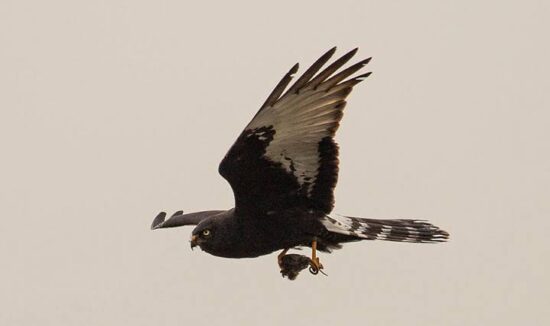
Moving further and further east, within a half a days drive of Muizenberg lies the De Hoop and De Mond Nature Reserves, as well as the Agulhas farmlands that lie between them and Betty’s Bay. The farmland routes can yield wonderful quiet roadside birding with white-throated canary, Cape clapper lark, Cape long-billed lark, black harrier, blue crane, Denham’s bustard, grey-winged francolin and more.
At De Hoop, time spent in its car park flanked by tall alien trees and in particular, its scramble-patch vegetated thickets, is often rewarded with the scarce Knysna woodpecker, here at the westerly fringe of its range, as well as the sometimes-tricky southern tchagra. From here, in summer, De Mond holds the world’s most southern breeding Damara terns as well as the chance of a vagrant or two, while in winter Antarctic terns can be found. All of this amidst fantastic scenery, whales in the right season and excellent easy birding. From here it is a days drive past Hermanus to get back to the home-base of the city.
Another option is to venture swiftly and arduous northwards. Away from the relative succulence of the fynbos and into the aridity, solitude, tranquillity, and relative isolation that one finds within the succulent Karoo.
First port of call is the Langebaan area ranging from its small but significant neighbouring West Coast National Park which holds great birds like southern black korhaan, black harrier, grey-backed cisticola, Eurasian curlew and others. Southern grey tit is locally common in scrublands around Langebaan itself, especially the last rocky outcrop towards the national park gate. Out of town, farmlands offer the unique Cape long-billed lark as well as other regular Cape species like capped wheatear, blue crane, bokmakerie and thick-billed lark.
The salt pans at Kliphoek Salt Works offer the delightful chestnut-banded plover as well as Cape teal, great white pelican, lesser flamingo, Caspian tern (the world’s largest of its kind), pied avocet and many other waders which are joined in summer by the Scandinavian breeding red-necked phalarope. From here the rest of the day can be spent in the shaded, semi-lush gullies and brittle rocky ridges that surround the Clanwilliam area to the north, which offers another chance at Cape siskin and Cape sugarbird as well as the top prize of the rare protea seedeater (canary).
From Clanwilliam or Garies, there is always the option of heading back for the city and its creature comforts. If the adventure lends towards a second, third or fourth night, then simply pushing on from Clanwilliam, on a two-hour highway journey, sets one nicely in Garies for the evening, amidst its undulating boulder-dashed hillsides. The trees, having turned to scrub kilometres ago, are a distant memory in this Martian landscape, an evening spent in these areas offers the slim chance at the rare and secretive Cape eagle owl. A dawn scramble in the jumble of rocks, before a hearty farmers breakfast, might yield dusky sunbird, jackal buzzard, cinnamon-breasted and Layard’s warblers and Karoo prinia amongst others.
After breakfast, a mid-morning digestive drive towards Springbok will take a couple of hours, where legs can be stretched and supplies for lunch acquired. Moving from here takes an hour and a half to the remote village of Alexander Bay and the chance to find the highly restricted Barlow’s lark.
This isolated ‘LBJ’ is a pilgrimage bird for many South African birders, and is remarkably easy to get to, the good road conditions and open terrain offer pleasant driving as kilometres drift past at a good steady pace. Potholed sections are not very common while the Anenous Pass offers challenging but beautiful corners for the few minutes it takes to descend, as it winds to the desert-like and coastal plain below. A picnic lunch along the coast and a search along the roadsides near the town for the lark can also yield other great birds like chat flycatcher, yellow canary, Cape long-billed lark, tractrac chat, Karoo chat, pale chanting goshawk and black-chested prinia to mention a few species found in the white sand, knee high vegetation.
Many of these that are individuals of more widespread species, curiously have adapted paler plumage than many of their more easterly living brethren. This is most likely to match the terrain assisting in camouflage when out in exposed areas, while possibly also assisting with thermal regulation during the blisteringly hot days this area receives; being firmly within South Africa’s tiny sliver of the true desert biome. Returning after lunch to Springbok, an early night is a good idea in order to make the most of tomorrow.
If on a significant venture, and hoping to see and do it all, in terms of the Karoo and its birding, then a long loop of driving and one more night away from the big city is needed. Despite the distance, the entire route is very achievable due to the excellent tarred roads along, pretty much, the entire route.
First stop from Springbok lies an hour and a half away at the mirage-like Koa Dune Field which lies 12km or so south of the highway and offers the best chance at birds like red lark, Stark’s lark, Ludwig’s bustard, the black-eared sparrow-lark (keep an eye out for small flocks of this scarce nomad as they float past), sociable weaver and more. A rough introduction to the grass-tufted red sands that inhabit this part of the Nama karoo yields yet another arid, but unique, landscape through which the N14 dutifully cuts.
Continuing eastwards you arrive at the one-horse cliché that is Pofadder, a conurbation of little consequence but the bustling metropolis of the region, and a great place to fill up on fuel and some of the country’s best homemade, farm-raised and expertly cooked roadside pies.
From here straight east for another few hours, through Kakamas and Keimoes to the equally sprawling ville-de-jour, Kenhardt. Here some roadside birding offers gems like the shrike-like, canary-sized African pygmy falcon, Namaqua sandgrouse, Karoo korhaan, Ludwig’s bustard, Karoo lark and others. Sociable weaver nests perch atop telegraph poles, that baffle the brain and defy all manner of engineering or logic, some even seem to break nature’s physical laws concerning gravity and density.
From Kenhardt towards the central-to-nowhere hamlet that is Brandvlei, there are fair chances of the rare Sclater’s lark and Burchell’s courser, both of which inhabit stony plains, and with the seed-eating lark, drinking often during the midday at metal farm tanks that have some water in their overflow systems. These are very difficult birds indeed, but the entire drive is filled with epic scenery, a feeling of open remoteness and once again surprisingly good roads and travel conditions.
From Kenhardt to Brandvlei the journey is a mere couple of hours and a night here offers much in terms of spotlighting along the same road at night, or any of the side roads of the area. During nocturnal forays, sightings of aardvaark, caracal, striped polecat, aardwolf and other nocturnal mammals are all possible in this fantastically dry, and accessible wonderland – as well as both spotted and the rare mountain-loving, Cape eagle owl.
As dawn breaks over the vast cool plains, the drive back to the lush green fields of the Western Cape would take most of the day, if taken slowly and stopping here and there along the way. It runs through Calvinia and on to the N7 highway running between Cape Town and Namibia. From here it is on to familiar ground with the next stop south being Clanwilliam and back to the Cape several hours later.
All in all, Cape Town and its greater surroundings offer much in terms of birding, diversity, adventure and comfort. When next in the region, it is worth considering dedicating a day or two to birding. Whether following the nose to some of the most well-known sites, or under the expert hand of some of the local areas bird guides, it is worthwhile unlocking some of the fantastic avian and other treasures on offer.