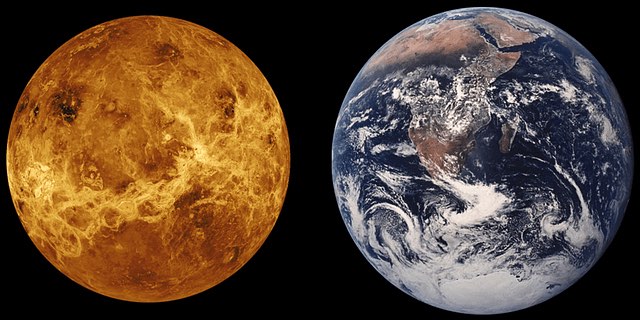
Look to the west just after sunset and it is easy to see the planet Venus shining brilliantly in the twilight. Lighting up the night like a great celestial beacon, Venus is the brightest object in the sky after the Sun and the Moon, and its prominent visibility ultimately led to it being named after the Roman goddess of beauty. As it is a planet, and not a star, Venus does not produce its own light, but rather reflects sunlight, and does not twinkle like its stellar cousins. It is very similar to Earth in terms of size and physical properties, but there is where the similarities end.
Currently, Venus is the ‘evening star’, dominating the western horizon for the first few hours of darkness. However, due to it residing in an orbit inside our own (it is closer to the Sun than we are) its position and visibility changes over the months in response to its position. Venus will remain visible as the evening star for around 263 days, and then disappear for about a week. After that, it will re-emerge in the eastern sky before sunrise for a further 263 days, where it becomes known as the ‘morning star’. Thereafter it will disappear again for 50 days before ultimately returning to the evening skies, as it completes its trip around the Sun.

For early astronomers, this was a hard concept to grasp, especially since the Earth was considered to be the centre of everything. It was not until the early 1600’s that Galileo gave us the first empirical evidence that the Earth and other planets orbited the Sun. Galileo trained his telescope on Venus and discovered that it exhibited phases (full, gibbous, half and crescent), just like our Moon. He deduced that the only way this was possible was if Venus was closer to the Sun than we were. This, along with many other discoveries by Galileo, ended the belief in the Geocentric solar system, in favour of the heliocentric one that we know today (the Sun at the centre). Ironically, Venus is at its brightest during its crescent phase. Despite much less area being illuminated, it is very close to Earth at ‘only’ 40 million kms, making it the closest approach of any planet.
But what makes Venus most interesting is that despite being so similar to Earth in size and composition, it has vastly deviated from the evolutionary path of our own planet. Venus was named after the goddess of beauty on account of its radiance. People thought that something so bright must be beautiful – but appearances can be deceptive. In reality, Venus is possibly the most inhospitable place in the entire solar system.

The Venusian atmosphere contains around 96% of carbon dioxide, a toxic and virulent greenhouse gas. Compare that to the Earth’s concentration of 0.04% and it is no wonder that Venus will not be on top of anyone’s holiday list. The thick gas enshrouds the planet, reflecting a huge amount of sunlight off its cloud tops, contributing to Venus’s apparent brightness. However, the gas also traps huge amounts of infrared light (heat) and has caused a runaway greenhouse effect on the planet’s surface. Day or night, summer or winter, the average surface temperature is a sweltering 460°C. That is hot enough to melt lead!
If the oppressive heat was not enough, the stifling atmosphere pushes down on the surface with a force of nearly 100x that on Earth, roughly the same as being 1km under the ocean. Modern day naval submarines cannot handle those pressures! Even if we could survive under those conditions, Venus’s clouds are predominantly made up of sulphuric acid from volcanic activity. This leads to concentrated acid rain circulating in the clouds, although the surface is far too hot for the rain to reach the ground.
In light of these impossible conditions, it is unlikely that any life can survive on Venus. We have been able to study Venus in detail, thanks to radar images from orbiting probes like the Mariner and Venera programs. We have even been able to touch down on its surface and record data, but the longest any probe has survived is a mere 2 hours thanks to the horrific conditions. Future missions include joint ventures with NASA and the ESA (European Space Agency) and are planned over the next decade with the hope of gathering more precise information on our hellish neighbour.
Venus’s last unusual trait is its rotation. All the other planets rotate anticlockwise (although Uranus is tilted at about 98%), preserving the angular momentum of their creation from a spinning disc of debris from the Sun. Venus however rotates backwards. The upshot of this is that, from a Venusian perspective, the Sun seems to rise in the west and set in the east. What caused this phenomenon remains unknown, but it was mostly likely due to a tremendous blow from a small planetary body during its youth. Either Venus was knocked upside down, or it received a glancing impact that stopped its original rotation and caused it’s reverse direction.
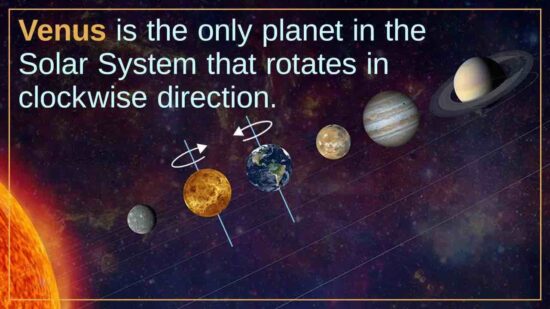
Not only does it rotate backwards, but it takes an age for a full rotation to occur. A day on Earth is measured by how long it takes the Earth to complete one revolution, and a year by how long it takes to orbit the Sun. Such is the snail-pace of Venus’s rotation, it travels around the Sun faster that it turns on its own axis, so in effect, a Venusian day is longer than a year!
Ultimately then, Venus could be seen as a portent of what might happen on Earth if we do not protect or fragile atmosphere. It is thought that billions of years ago, Venus had liquid water such as Earth before its runaway greenhouse effect slowly cooked the surface.
Global warming is a real, and potentially fatal problem for our own planet. Our atmosphere is only around 100kms thick, a paper-thin protective bubble that shields us from the harsh conditions of space, and if we do not look after it, our fate could well follow that of Venus. Whilst we do predict any life, studying its geological and climatic history may prove invaluable in understanding our own planet, and helping us to avoid such a catastrophic turn of events. There is so much to learn about ourselves by studying our solar neighbours and as technology improves, so too do our chances of understanding our future plights.
See Celestial Events SA advert for contact details