BirdLife South Africa’s Vulture Project
There are few sights in the African sky to rival a vulture on the wing. Barely a feather moves as it carves a slow arc on a rising thermal, holding altitude on a two-and-a-half-metre wingspan while scanning the ground far below. Vultures can soar vast distances each day, ignoring property and country borders, navigating an ever-changing landscape in search of food.
For all that grandeur, vultures are one of the most threatened bird groups. In South Africa, five species are listed as Critically Endangered, one step away from extinct in the wild. Populations of some species have fallen by as much as 90% over the past 50 years.
Vultures are the landscape’s clean-up crew, stripping a carcass in a matter of hours and removing carrion before it becomes a problem. In doing so they suppress the spread of diseases such as anthrax, botulism and rabies, and limit the build-up of other scavenger populations that carry disease into livestock herds and human settlements. A recent study on the economic value of vultures from ecosystem services provided in Botswana, Zambia and Zimbabwe was estimated to be over USD 250 million per year.
Vultures face a multitude of threats. Mass poisoning events, in which a single laced carcass can kill hundreds of birds at once, have devastated populations within the greater Kruger region. Targeted harvesting for the traditional medicine trade, or to hide the actions of poaching, have killed over 2000 vultures in the wider Limpopo Transfrontier Conservation Area since 2015. Collisions and electrocutions with energy infrastructure and loss of habitat compound the problem for these slow-breeding birds that typically lay a single egg each year.
There is one more threat, less visible than the rest and only recently understood, caused by lead-core ammunition.
An invisible problem
In 2016, BirdLife South Africa began investigating lead levels in vultures and other raptors. Blood sampling soon showed that lead exposure was not an isolated occurrence, with both White-backed and Cape Vultures showing elevated levels. Subsequent research, including a PhD by Dr Linda van den Heever, traced the source of this exposure to spent lead-based ammunition.
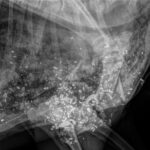
Upon impact with its target, a lead-core bullet fragments extensively, leaving numerous particles, often microscopic, within the carcass and surrounding tissue. Vultures are exposed to toxic lead fragments when they feed on discarded gut piles and carcass waste. Their highly acidic digestive systems facilitate the absorption of lead into the bloodstream, where it can be distributed throughout the body.
The impacts of lead poisoning are complex and severe. Acute poisoning can be fatal, while sub-lethal exposure can impair haemoglobin production, causing anaemia, and affect neurological function. Vultures suffering from lead poisoning are often weak, uncoordinated and emaciated, making these normally feisty birds much easier to catch and bring to a wildlife veterinarian for treatment. The risk is particularly concerning for chicks, which can be unknowingly fed contaminated carrion by their parents. At this critical stage of development, exposure to lead results in chicks fledge with compromised health as they develop flight muscles and learn to navigate their aerial landscape.
Blood sampling of White-backed Vultures in the Northern Cape since 2016 reveals that elevated lead levels remain a persistent threat within the population, with similar trends observed in KwaZulu-Natal. A study by Swart et al (2026) found that over one-third of the samples had above background exposure.
Vultures are not the only wildlife at risk. Southern Ground Hornbills have been documented suffering acute lead poisoning, with spent ammunition found in the gizzard, requiring intensive treatment. There is evidence of exposure in large carnivores too. In a case reported by Hauw et al. (2025), a cheetah held in a boma in Namibia developed acute lead poisoning after being fed game meat harvested using lead-core ammunition. The cheetah subsequently suffered a seizure and died, and spent ammunition was recovered from its stomach.
These cases highlight that the pathway from ammunition to wildlife extends well beyond vultures. Wherever animals consume carcasses, gut piles or game meat containing fragments of lead ammunition, there is potential for exposure. In a landscape where wildlife relocations are routine, lead exposure in bomas can be a source of unintentional poisoning.
A landscape-scale response
The encouraging news is that a solution already exists, and it is increasingly a local one. Lead-free ammunition, typically copper-alloy or brass monolithic bullets are made of non-toxic metals that do not fragment in the same way as lead-core bullets. South Africa has a growing domestic manufacturing sector with over a dozen manufacturers producing factory rounds in most of the common calibres, and bullets for handloaders in all diameters, and uptake is rising steadily.
BirdLife South Africa’s Vulture Project is working to accelerate that shift across the hunting, culling, ecotourism, and game management sectors. Our work includes ballistic testing, with a particular focus on locally produced lead-free ammunition, and gathering data on real-world field performance in partnership with the hunting and game management sectors. The aim is to collect evidence and produce best-practice guidelines that lead-free ammunition performs, is available, and that switching costs the shooter very little while returning a great deal to the landscape.
In a region defined by its shared boundaries, that is a change we can make together. Providing safe food is crucial to assisting the highly threatened vulture populations within the Kruger to Canyons Biosphere Reserve and beyond. Landscape conservation efforts involving all stakeholders are required to reduce the impacts from lead poisoning.


An Industry that Can Make a Difference
A particular group of professionals with a unique opportunity to make an impact is safari guides. Inherently seen as custodians of nature, they occupy a unique position to reduce the use, and by implication the impact, of lead-based ammunition on vultures and the wider environment. As professionals who spend considerable time in the field, guides are often able to influence the practices and purchasing decisions of the operations they work for, as well as engage with influential, high-net-worth tourists.
Where a firearm is required for walking trails, bush walks, or other legitimate safety purposes, guides can advocate for the use of lead-free ammunition as a standard operational requirement. This is a relatively simple change that can be made on the part of an employer, but one that can meaningfully reduce the risk of lead entering the environment and subsequently affecting wildlife and the surrounding ecosystem.
Just as importantly, guides can – and should – do their best to lead by example. Carrying lead-free ammunition whenever a rifle is required demonstrates that responsible guiding extends beyond the guest experience and includes a much deeper, broader understanding and respect for our impact on the environment and the associated ecological consequences of our actions. As storytellers, it can turn a simple coffee stop with guests into a deeper interpretation of the composition of the rounds on a guide’s hip, and how it’s not just the impact of a bullet that can be considered deadly.
By encouraging employers to adopt lead-free ammunition policies, explaining how they can justify the change to link to a broader impact narrative, and by making responsible choices themselves, safari guides can help ensure that the places in which they work remain safe not only for people but also for wildlife.
Conclusion
Shifting to lead-free ammunition in hunting, guiding and game management reduces lead exposure for threatened wildlife and people. It is a small change with big consequences, helping safeguard species beyond any boundary.
Justin Henry – Vulture Project Manager, BirdLife South Africa
John Kinghorn – Avitourism Project Manager, BirdLife South Africa