
Whilst James Webb (and Hubble) both do their work from the cold darkness of space itself, high above the refractive effects of our atmosphere, the Vera Ruben Observatory will aim its mighty gaze at the mysteries of the Universe from Earth. Despite this handicap, thanks to some incredible engineering and technological know-how, it promises to unlock the very fabric of space and time.
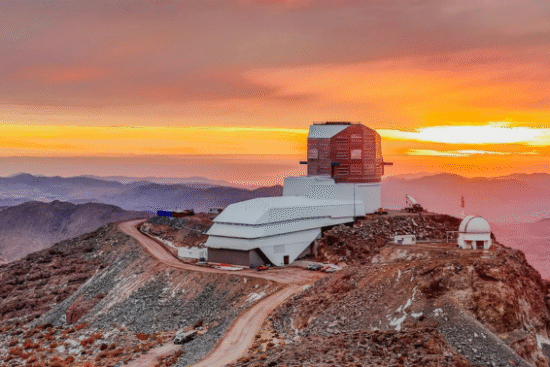
So, what makes Vera Ruben so special? For one, it has an 8.4m mirror. But other observatories boast similar mirrors – the South African Large Telescope (SALT) that is housed in Sutherland, has a 10m mirror! However, SALT, and other facilities, concentrate on very specific areas of sky, producing intricate details of deep space. With a field of view equating to the size of around 45 full moons, Ruben is designed to monitor large fields of sky at once. In fact, it will be capable of capturing the entire southern hemisphere sky, in exquisite detail, every few days.

This is possible thanks to its incredible digital camera, the largest ever built by mankind. A top of the range, full frame mirrorless camera records photos on its 35mm sensor at a resolution of 45 mega pixels. Ruben’s camera sensor is 64cms and has 3200 mega pixels! To be able to display this image in full, it would require around 400 UHD 4K TVs!! To achieve this, the camera measures 3 metres in length, is 1.65m in diameter, and weighs in at a little under 3 tons. In order to reduce noise, and ensure a ‘clean’ image, the sensor is cooled to a teeth-chatteringly cold -100°C.
This ground-breaking technology will allow Ruben to capture great swathes of space in a very short time, allowing astronomers to attain a time-lapse of the heavens spanning more than a decade. The implications of this are legion, but at the forefront of its research will be unlocking the secrets of dark matter, monitoring objects like supernovae and pulsars in real-time as they change, and tracking ‘Near-Earth Objects’.
NEOs are objects that could pose a danger to Earth, delivering an extinction-level-event with little to no warning. Earlier this year, social media was awash with hysteria that a recently discovered NEO had a chance of striking the Earth in 2032. Further observations of its orbital path have now seen the risk reduced to zero, but it was a timely reminder that this type of event is a real possibility, albeit unlikely. One just has to look at the surface of the Moon, or ask the dinosaurs, to realise their devastating potential.
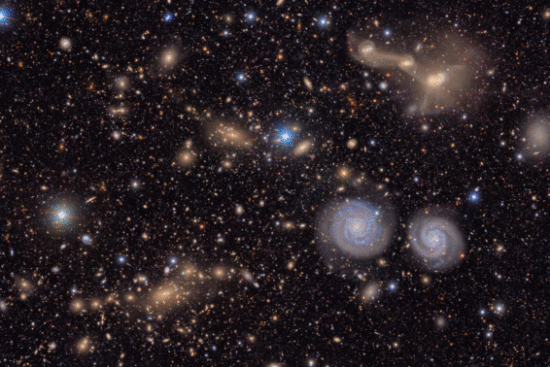
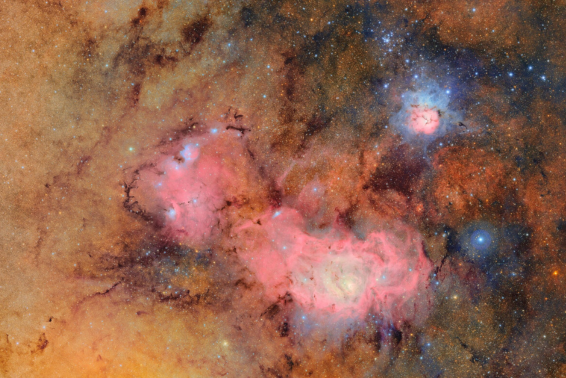
On June 23rd, Vera Ruben released its first images. And they did not disappoint. The 65 million light year distant Virgo Cluster contains over 2000 gravitationally-bound galaxies and gave Ruben the chance to showcase its potential. The published images are only portions of its full field of view, but its capabilities are there for all to see. Ruben also captured the Lagoon and Trifid Nebulae, great stellar nurseries in the constellation of Sagittarius that are visible to the naked eye as a small faint cloud. The image gives an almost 3-dimensional feel, revealing vast swathes of glowing gas and countless glistening stars and clusters.
Even to those who may not fully appreciate the scientific data hidden within, the images are still breathtaking and do at least some justice to the unfathomable beauty and scale of the Universe.
Who knows what the future of space observation will bring, but with the Nancy Grace Roman telescope scheduled for first light in 2027, the Extremely Large Telescope (with its 39m mirror) in 2028, and NASA’s future plans to put a 1km radio telescope in a crater on the Moon, we are truly living in a great age of discovery. The universe is under no obligation to make sense to us, but in trying to decode its chaos, we find the clearest reflections of ourselves.
See Celestial Events SA advert for contact details.


