The Kruger to Canyons Biosphere Region NPC (K2C) has released its 2024-2025 Impact Report, and the message is clear: through strategic partnerships, innovative projects, and strong community collaboration, real change is taking root across the landscape. From land restoration and job creation, to data-driven conservation and circular economies, K2C is a leading force in building a sustainable future for both people and nature.
At the heart of the K2C’s work is a mission to balance sustainable development and natural resource use with biodiversity conservation. This is done through implementing projects with strategic partners. This year’s report offers inspiring evidence of that mission and collective action.
A landscape of change: Measurable impacts cross the region
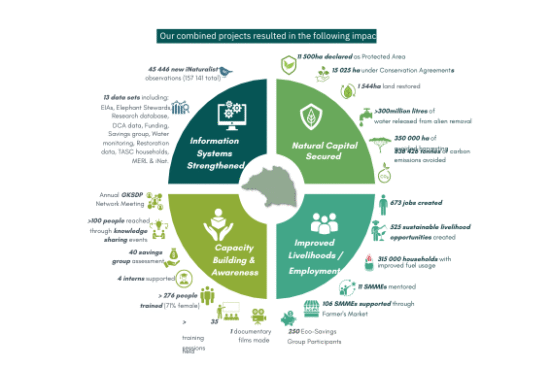
Amongst a host of positive outcomes, some of the most impressive from the past year include:
- 1,544 hectares of land restored, securing vital ecosystems.
- 15,025 hectares brought under conservation agreements.
- 838,426 tonnes of carbon emissions avoided.
- Over 300 million litres of water released through alien plant removal.
- 673 sustainable jobs and 525 livelihood opportunities created.
- 315,000 households with improved fuel usage through clean cookstoves.
- 106 SMMEs supported, including 11 mentored intensively.
- 45,446 new iNaturalist observations feeding into 13 different conservation datasets.
“We are dedicated to creating a region where people have a sense of pride and belonging, feel empowered to take action and are inspired by the natural world around them every day,” says Romy Antrobus-Wuth, K2C’s Conservation Science and Data Manager. “Producing the Impact Report each year is an important tool for us to share the results of collective action on the ground.”
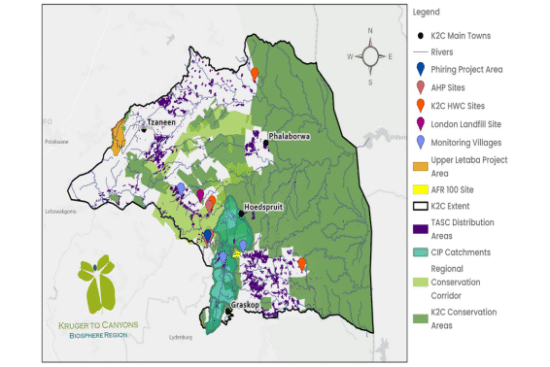
Mapping the Movement: Where the Work is Happening
The K2C Biosphere extends from the Letaba River to the Sabie River, and between the Blyde Escarpment and the Mozambique border. With a huge landscape to work in, K2C’s specific project nodes focus on water and catchment investment, declaring new protected areas to secure conservation corridors, waste management, climate resilience and human wildlife conflict.
Key projects being undertaken
K2C is involved in the financing and implementation of a Catchment Investment Programme to protect the state of the Blyde and other key river catchments through invasive plant clearing, sustainable rangeland management and protected area expansion. Strategic partners involved are Conservation South Africa and The Nature Conservancy.
Securing and improving the management of key biodiversity and water corridors linking the Greater Kruger to the escarpment and Blyde River Canyon Nature Reserve, to secure habitats that provide breeding grounds and migratory routes for threatened species.
The African Forest Landscape Restoration Initiative involves clearing invasive species to restore degraded land and promote indigenous vegetation establishment, as well as investigating the use of off-cuts (e.g.: biochar) to support local SMMEs in the areas adjacent to protected areas. This partners with Conservation South Africa and the Sabi Sand Pfunanani Trust.
BeResilient is a citizen science project for freshwater health and Indigenous knowledge systems for climate risk adaptation. Here the K2C together with UNESCO, has established a citizen science freshwater health monitoring programme in the biosphere landscape, documenting Indigenous knowledge systems aimed at building climate resilience and feeding into early warning systems.
Another project showcases sustainable land-use practices (climate-smart farming, tourism, eco-savings) that improve ecosystem services and build community resilience. This is part of the Phiring Demonstration Site, in partnership with Conservation South Africa and the Hoedspruit Hub.
The Upper Letaba Vegetation Clearing project focuses on removing alien invasive trees around the town of Haenertsburg in the upper Letaba catchment, to offset water used in the catchment by Coca-Cola. This has been made possible through the partnership with The Nature Conservancy and Coca-Cola.
The London Landfill Community Recycling project is a waste management beneficiation centre at the London landfill site. It stimulates a waste circular economy for waste reclaimers and entrepreneurs within the K2C landscape, made possible by the partnering with TASC and the Maruleng Municipality.
With the Human-Wildlife Conflict in the Greater Kruger Landscape project, k2C is looking to develop mitigation strategies to reduce conflict and support coexistence between communities and wildlife near adjacent to protected areas. This project is in partnership with WWF-Khetha.
Then there is The Absorbent Hygiene Products project where k2C is piloting a co-governance model for responsible diaper waste management through multi-stakeholder collaboration in two communities. The University of the Western Cape is the partner in this project.
The Cookstove Project is a carbon project distributing more than 450 000 improved cookstoves across the K2C region to help reduce fuel loads and as a result carbon emissions across the landscape. This is in partnership with TASC.
People power: building skills, knowledge and networks
Beyond the environmental outcomes, K2C continues to invest in people and sustainable livelihoods in the region. Over 276 individuals were trained in various technical and community skills, four interns were supported, and thirty-five training sessions were held. These activities ensure that the region and its custodians survive environmental pressures, but are also positioned to thrive in the face of them.
Looking ahead: A long-term vision
True impact is a long-term, iteractive process and the K2C team welcomes feedback, engagement and questions from stakeholders across all sectors.
“Meaningful change requires long-term positive transformations, with the goal of making a lasting difference to the lives of people and the species that occur in the region, as well as to address systemic issues. Thus our impact reporting is not the end of the story – it’s a measure of where we are in achieving long-term goals, as well as an invitation to collaborate,” says Marie Tinka Uys, K2C COO.
If something in the report inspires you, get in touch with the K2C Biosphere team or share it with someone who has an interest in the future of this region. The full Impact Report is available for download via the Resources section of the K2C website at www.kruger2canyons.org.