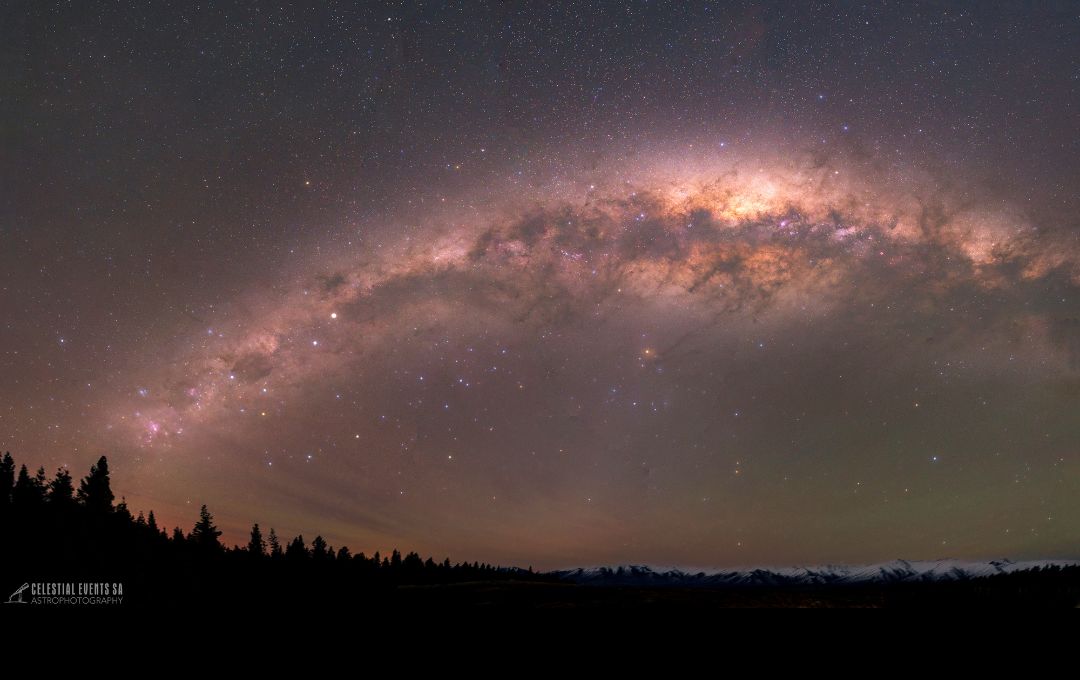
The winter months in South Africa offer the perfect time for stargazing. During this time, a high-pressure cell sits above the country preventing warm, moist air from rising and clouds from forming, meaning unobstructed views for weeks at a time. The associated drop in humidity also equates to less water vapour in the atmosphere, which would otherwise disrupt the starlight, manifesting in crystal clear skies that shine with enhanced vibrancy.
Not only are conditions ideal, but the Earth’s position during its endless circumnavigation of the Sun means that during this part of the year, the centre of the Milky Way arcs high overhead. Away from light polluted areas, the spiral arms of the galaxy are clearly visible as a snaking pathway of diffuse light. The light itself comes from billions of distant stars, too far away to be resolved by the naked eye, but whose combined light merges into a milky river flowing across the heavens.
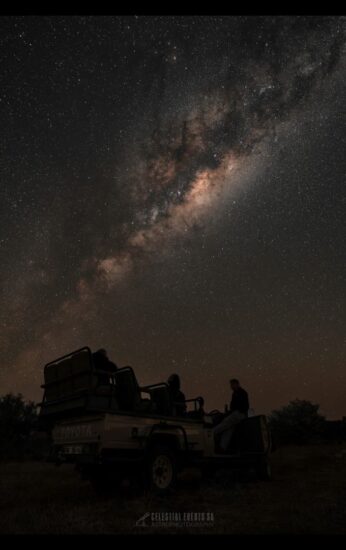
Ancient civilisations have long since marvelled at this sight, each culture attributing the phenomenon to reasonings based on their belief systems. Some Bushmen tribes saw the beacon of light as the bellies of a great herd of celestial springbok traversing the sky, whilst others considered it the ashes of a campfire scattered into the sky by a young girl trying to guide her father home after he failed to return from a hunting trip.
The name Milky Way has its origins in Greek mythology. Zeus fathered the great hero Hercules after an extra marital affair with a mortal woman. In an attempt to bestow more godly powers to his son, Zeus tried to suckle him at the breast of his wife, Hera, whilst she was sleeping on Mount Olympus. Unsurprisingly, Hera woke up and pulled Hercules away in disgust. The milk from her breast sprayed down from Mt Olympus, staining the sky below. The Romans built on this idea and adopted the phrase ‘Via Galactica’ meaning ‘The Way of Milk’, or ‘Milky Road’. In time, this became known as the Milky Way.
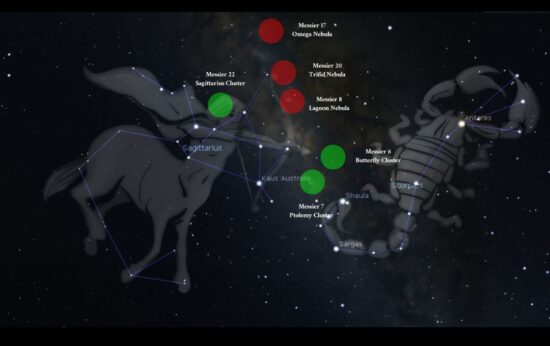
The brightest part of the Milky Way can be found at the convergence of the zodiacal constellations of Sagittarius and Scorpius. Our galaxy is shaped a bit like two fried eggs placed back-to-back. The yolk is known as the ‘Central Bulge’ and is made up of countless old stars, while the egg whites are the thin spiralling arms that encircle it. They are formed due to the movement of our galaxy which is spinning at a breakneck 220km/sec, throwing off dust and gas along its axis of rotation, and creating a disc of hot, vibrant, young stars. At the centre of it all lies the heart of our galaxy, a super-massive black hole dubbed Sagittarius A – the epicentre of the Milky Way.
Due to the sheer number of objects between us and the galactic core, the night sky between Sagittarius and Scorpius is a magnificent sight through binoculars. A simple sweep of this area resolves thousands upon thousands of stars that would otherwise be invisible to our primitive eyes. I cannot encourage you enough to explore this region while it is high in the sky and marvel at the sheer number of stars glistening in the darkness. Upon closer inspection, tight-knit groups can be seen, as well as hazy clouds silhouetted against the blackness.
Some of the best star clusters in the galaxy can be seen here. The Ptolemy Cluster (M7) and the Butterfly Cluster (M6) can both be found close to the stinger of the great celestial scorpion. These ‘open clusters’ are groups of baby stars, travelling through space together, just beginning their stellar journeys. At the opposite end of the spectrum lie the ‘Globular Clusters’, cosmic old age homes containing hundreds of thousands of related, ancient stars. The third brightest in the entire night sky, M22, can be found close to Sagittarius’s bow and is resolved as a cloudy spot in binoculars.
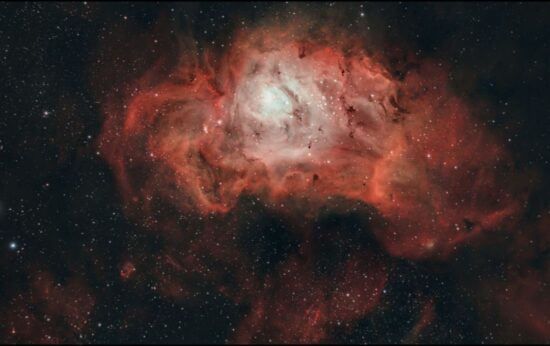
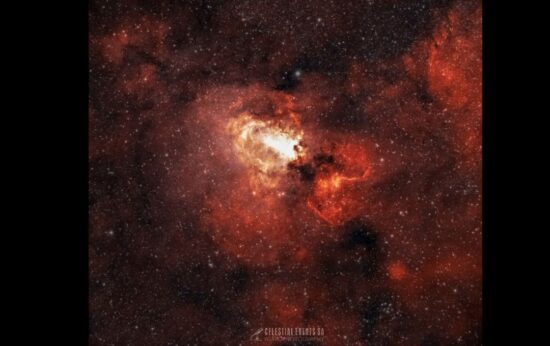
The real gems however are the emission nebulae; cosmic incubators within which new stars are being born. These great gas clouds are predominantly made up of hydrogen, and glow vivid shades of pink and red thanks the youthful energy of their offspring shrouded deep within. To fully appreciate these incredible objects, long exposure photography is needed, but even with ‘backyard’ equipment, their beauty is unparalleled. The Lagoon Nebula (M8), the Trifid Nebula (M20) and the Omega Nebula (M17) are just a few of the exquisite sights that populate the area around our galactic core.
The best way to find these objects is to use a star app. Many are free to download and ultimately all do the same thing. Which one is ‘best’ boils down to personal preference. The next time you are under dark skies, I encourage you to use your phone for something different, grab your bino’s, and take yourself on a tour of the centre of the galaxy that is guaranteed to leave you starstruck!
See Celestial Events SA advert for contact details