Space: a poignant description of the vast inky darkness within which our blue planet is suspended. There is nothing around us, in any direction, for tens of millions of lonely kilometres. Or is there …?
In reality, we share our stellar neighbourhood with billions of rocky particles, known as ‘meteoroids’. They are remnants of a long forgotten, tumultuous past that saw multiple young planets destroy themselves as they jostled for position around our parent star. Travelling hundreds of times faster than a speeding bullet, catastrophic impacts, particularly of the larger objects, have sculpted our solar system, over the course of billions of years … and they continue to do so to this day.
Very few larger fragments remain after 4,5 billion years, but day after day, and night after night, the Earth is pelted with ancient planetary debris. Thankfully, these potentially lethal projectiles are nullified by the protective shroud of our atmosphere, its elemental soup acting as the perfect baffle, causing such rapid deceleration, that all but the most stubborn interlopers are destroyed.

Once a piece of rock enters our atmosphere, it becomes a ‘meteor’. During the daylight hours, their demise is unseen in the scattered light of our sun-kissed atmosphere, but under the cloak of darkness, their extinction is far more dramatic. As the meteor hurtles groundward, it heats up due to friction and its energy causes the surrounding gas to glow, manifesting in a fiery streak along its path of entry. These beautiful phenomena, often accompanied by awe-struck ‘ooo’s’ and ‘aaah’s’ from lucky onlookers, gave rise to meteors also being known as ‘shooting stars’.
It is a humbling thought that our protective blanket is only effective to about 100kms above our heads. This is less than an hour’s car ride for most of us! Yet it protects us 24 hours a day, unyielding in its defensive duties – all the more reason then, to protect and nurture our precious atmosphere. However, it cannot protect us from everything.
A typical shooting star (or meteor) is created by particles ranging from the size of a grain of rice to a golf ball. Even something as small as 2mm can produce a visible streak under dark skies. But there are larger rocks lurking in the darkness of space, and every so often, one of these objects comes a-knocking.
Sometimes, meteors get perilously close to our home. Bolides are exceptionally bright meteors caused by larger objects and occasionally the friction of the lower atmosphere causes them to literally explode. The ensuing shockwave can have devastating consequences. In 2013, a 20m wide meteor, weighing over 12 000 tonnes, rocketed into the atmosphere over Chelyabinsk in Russia. It exploded 25kms above the surface of the Earth, damaging more than 7 000 buildings in a radius of over 100kms.
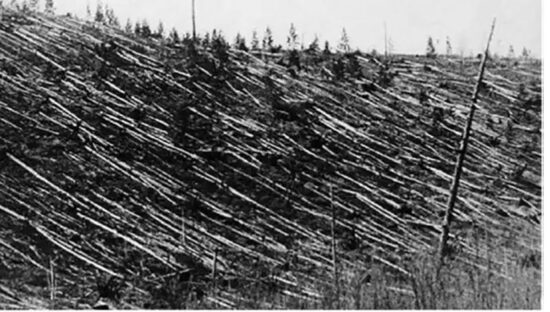
This was not a patch on the Tunguska meteor of 1908 however. Estimated to be 50m diameter, the meteor detonated a mere 5 – 10kms from Earth with the force of 15 megatons, a thousand times more powerful than an atomic bomb. It flattened 80 million trees over a 2 000 square kilometre area of forest, and broke windows in houses over 100kms away. Thankfully it happened in an unpopulated area but the consequences could have been much more dire!
Despite our atmosphere’s best effects, sometimes rocks do penetrate our planetary forcefield. If a meteor makes it to solid ground, it becomes known as a meteorite. Meteorites are rare, but offer scientists a unique opportunity to study the geology of our fledgling solar system. Today they are sought after by collectors, museums, and even jewellery makers. Many demand a high price for their history – thousands of US dollars per gram in some cases.
In ancient cultures, meteorites were revered items. Excavations of native American settlements and Egyptian tombs have discovered meteorites preserved in ceremonial fashion, while the Inuits made use of their iron content for cutting tools and spear tips. The Kabba Stone in the Grand Mosque in Mecca is said to be a meteorite sent to Earth to help Adam and Eve build their first alter. Whilst in ancient Zulu culture, powdered meteorite was used in conjunction with other ingredients to bestow the powers of animals to new born children.
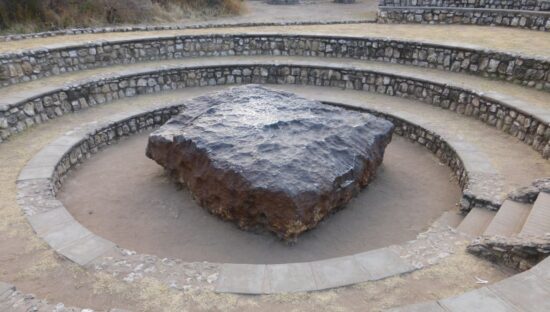
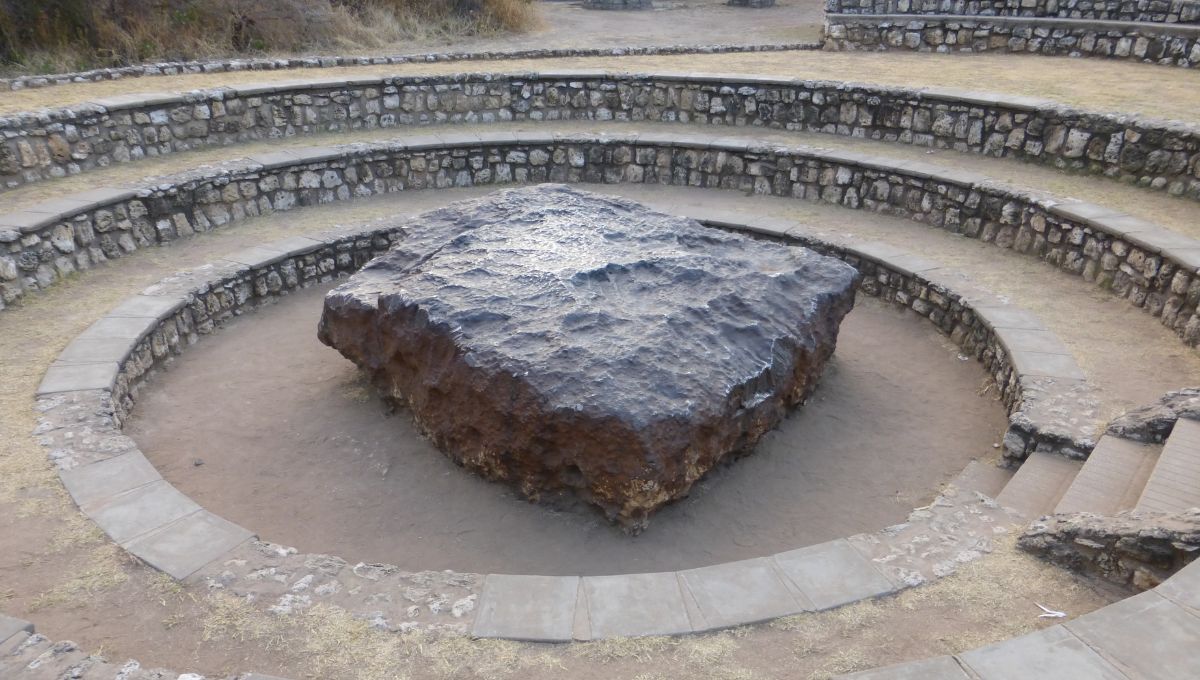
The largest meteorite ever discovered can be found here in southern Africa. The Hoba meteorite (named after the farm Hoba West) still resides exactly where it was discovered: in a field just outside of Grootfontein in Namibia. This incredible relic of our creation was discovered by a farmer ploughing his field in 1920 when the blades scraped against something metallic. Upon excavation, he unearthed a 66 tonne lump of iron that crashed into Earth some 80 000 year ago. Fittingly, the name ‘hoba’ comes from a local word meaning ‘gift’.
Closer to home, South Africa houses the oldest, and largest, impact crater on Earth. The Vredefort Dome in the Free state is thought to have been created over 2 billion years ago, and spans close to 300kms wide, although geological activity and weathering has eroded much of its grandeur. The Chicxulub crater in Mexico, that famously spelt disaster for the dinosaurs, is only 180kms by comparison.

Finding a meteorite is rare but not impossible. There are various traits one can look for, but most importantly, all meteorites, even stony ones, contain large quantities of iron and are thus magnetic. Most also have a ‘fusion crust’ – a baked layer of rock caused by the heat of passing through the atmosphere. If you happen across an unusually heavy and magnetic rock, it might be worth getting it checked out by the correct authorities – you never know, you may just have found a piece of creation: your very own ‘Rock Star’!