Previously the games were discussed in detail, all leading up to the competition that was held at The Hub on the 15 January 2024.
The competition was very well attended. The underlying ‘ethos’ of numiknow™ is to make numeracy fun, and fun was had by all at the competition. At the end of it, four individuals emerged as winners. In third place, Ouma Molobela and Delight Mahlakoane from Buffelshoek won R250.00 each, in second place Neo Malepe, from Sedawa, won R750.00, and the winner was Ribbens Shokane, from Sedawa, who won R 1 000.00.
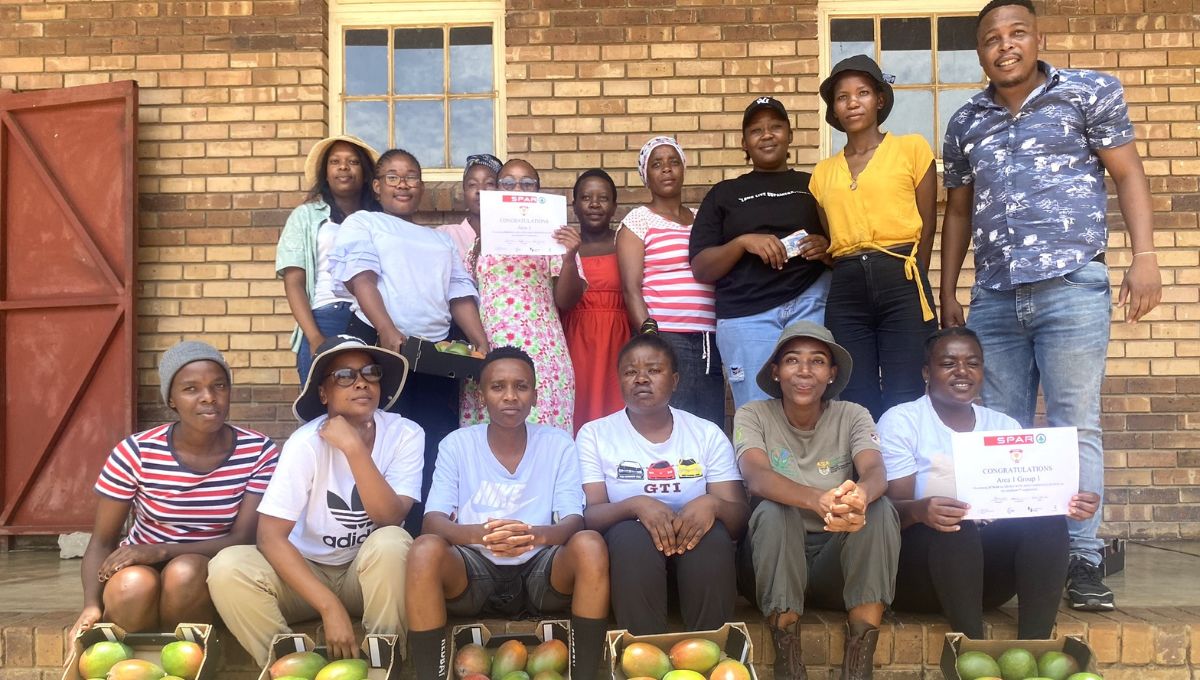
In the group competition, the best-performing group was Group 1 from Area 1 from Hlohlokwe. They won R750.00, and in the area competition the best performing area was Area 1 from Hlohlokwe. They won R 2 000.00.

Thanks to Spar, all the cash prizes were sponsored and Blydevallei and BBI provided boxes of packed mangoes for all winners.
The competition provided useful results to determine how participants’ mathematical proficiency developed. In summary, the performance and proficiency in the basic games of adda, mina and multa (addition, subtraction, and multiplication) had increased from 33% to 56%, a 23% improvement. This was expected as it is an elementary calculation of basic operations.
The performance in diva, perca, rata and fracta (division, percentages, ratios, and fractions) however achieved a mere 6%. This clearly showed that participants have very little understanding, if any, about the concept of division as is required to perform well in this group of exercises. The assessment instrument utilized resulted in a pass rate of 30%.
While some participants showed a noticeable improvement, others did not. It poses the question; what could the possible reasons be as to why the performance of some participants seemed to stay stagnant and what would be potential solutions to assist the participants on their learning journey?
After the competition, 85 participants who achieved below-average scores were interviewed to find out what possible causes could be established for their poor performance. The feedback from the interviews was categorized into three main problems.
The first and most prominent was a lack of motivation to practice and to improve. Respondents did not see how improving their mathematical proficiency could enhance their everyday lives. As a result, they did not go to any lengths to practice, even though they had all the help at their disposal.
The second most significant factor was their experience and perception of mathematics. Most had preconceived ideas that it would be too difficult for them to grasp or master, and therefore, gave up mentally before they even started to practice. Participants also stated that they took longer to learn new concepts, which disadvantaged them, as most games were under a time constraint so they could not complete the games well enough.
Thirdly, some participants have never understood certain mathematical concepts and still do not understand them.
It is important to take a step back to understand the funding of this numeracy project (and others). The project falls under the Department of Trade, Industry and Competition accessing the Social Employment Fund as part of the Social Economic Strategy. It is managed by the Industrial Development Corporation (IDC) supporting non-state entities to create work that serves the common good in communities. This is exactly what the whole numiknow™ concept does, by improving mathematical proficiency for the common good of all. Through this initiative participants effectively ‘work’ (on a nine-month project) for the state, providing services within communities whilst studying. For this, all participants are paid a stipend by the state, but they must commit to self-improvement (improving mathematical proficiency) and allocating some of their time to the community for the upliftment and better good thereof. Should the commitment falter, either as a lack of self-improvement or a disregard for the commitment to the community time ‘allocation’, or both, the participant will lose the funding received and their services/participation will be terminated.
Fast forward to the present day, and based on the problems that have arisen, the following interventions are currently being implemented to assist the participants on the mathematical proficiency learning journey.
Firstly, the value of mathematical proficiency in the workplace, as well as in their day-to-day lives, will be demonstrated. In addition, if the participants cannot develop and improve their mathematical proficiency, and set an example to other learners, then they are deemed not suitable for participation, and corrective actions manage that.
Secondly, to achieve better results, personal SMART goals for each participant will be set to work towards an 80% proficiency at the end of the project. The project has four months left, and participants will participate in four monthly assessments utilizing the assessment tool. Currently the average is 27% but through mentored steps over the next four months this will be steered towards achieving an 80% proficiency.
Thirdly, the ‘division barrier’ must be broken to increase the understanding of division and unlock the provided resources. Mastering division will positively influence the diva, perca, fracta and rata scores, and this in turn will greatly influence the average proficiency level for the better. This will be attempted through facilitator-intensive workshops with small groups. The first three of these workshops have had very positive results.
Practice will be critical for participants to see improvement in their results, and close contact be kept with all groups, to track their performance, provide further assistance as and when required, and celebrate their successes with them!
Next month’s issue will follow up and report on other numiknow™ initiatives to support the mathematical proficiency development in the schools in the project area.
To see a video of the competition go to https://fb.watch/qf3gseg8N7/