Summer is coming to South Africa, and it is almost time to say goodbye to the constellations that have watched over us for the past few months. The most noticeable departure is that of the great celestial scorpion which is currently nose-diving towards the western horizon after sunset, its curved tail standing ominously above the horizon, poised to strike. The centre of the Milky Way that runs through Scorpius and the neighbouring Sagittarius is also sinking, offering some wonderful photographic opportunities as its mighty arch begins to envelop the Drakensburg mountains.
All is not lost, however. As the Earth continues its endless cycle around the Sun, the summer constellations are beginning to come into view, bringing with them some of the most famous stars and objects in the night sky.
No object has received more attention, and is the centre of more cultural stories, than the fabled star cluster colloquially known as the Seven Sisters. Officially named ‘the Pleiades’ this vibrant group of young stars is unmistakable, twinkling close to the horns of the great bull, Taurus. Through binoculars or a small telescope, it is a remarkable object containing close to 500 blue/white stars that are just starting their stellar journeys. Its prominence has been noted by multiple civilisations in both hemispheres and its importance in cultural astronomy cannot be underestimated.
Africa
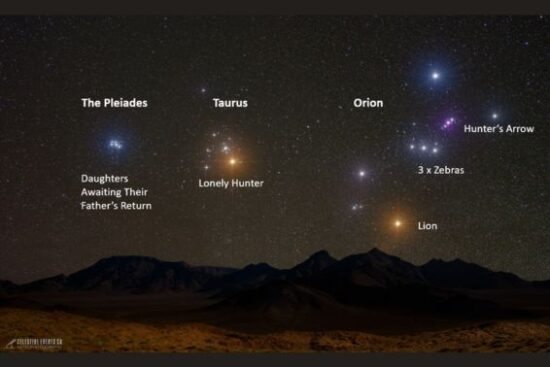
Early Bushmen tribes considered the glistening stars as a nest of ostrich eggs, since its nightly appearance coincided with the summer and the breeding season of these great flightless birds. This is one of many examples in African star lore, whereby stars and objects were named in accordance with the availability of important seasonal resources.
Another beautiful Bushmen story tells of a group of seven daughters who patiently await the return of their over-confident father from a hunting trip (represented by Aldebaran in Taurus). He had set out to hunt one of the three zebras of Orion’s Belt, but was so confident in his success, he took only one arrow. He duly missed his quarry, his wayward arrow symbolised by the sword of Orion but was unable to retrieve it due to the presence of the marauding lion (Betelgeuse) that was also hunting the zebra. To this day he remains cold and lonely, too ashamed to return to his hungry daughters.
All across sub-Saharan Africa, the Pleiades is known as the ‘digging stars’. Its arrival, in conjunction with the rising Sun in early spring, signified to people that the dry, harsh winter period was coming to an end and that it was time to prepare the fields in anticipation of the summer rains.
Greek

To the Greeks, the Pleiades represented the seven daughters of the Titan, Atlas. Atlas was very protective of his daughters, but after the Titans lost their war against the gods, he was sentenced to holding up the Earth as punishment for his involvement, leaving them unprotected. Orion became infatuated with them and chased them relentlessly across the land. In desperation, they complained to Zeus, who agreed to protect them by turning them into a flock of doves. They flew up into the night sky for safety, but the infatuated Orion followed them into the heavens and still pursues them to this day. The Greek word ‘Peleiades’ means ‘dove’ and this may be one explanation for its name.
Whereas the helical rising of the Pleiades foretold of the arrival of winter in Africa, it indicated the beginning of the northern hemisphere summer. Its appearance at dawn signified to the Greeks that better weather was approaching and thus marked the start of the sailing season. In Greek, the word ‘plein’ means ‘to sail’ and is also considered an origin of the name Pleiades.
Māori
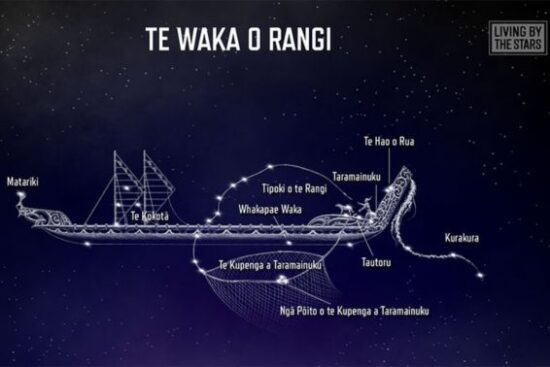
Perhaps no culture reveres the Seven Sisters as much as the Māori’s of New Zealand. Its conjunction with the sunrise marks the start of the Māori new year and was recently proclaimed a national holiday by the government. Thousands of people gather to watch it appear above the horizon along with Taurus and Orion, the three shapes forming a giant boat with a net that scoops up the souls of those who lost their life during the previous year. The souls are then transported into the heavens to become stars. It is a time to mourn lost loved ones, but also to give thanks for the previous year and pray for a bounteous new year.
Japan

The Pleiades are known as ‘subaru’ in Japan, which means ‘coming together’. The car manufacturer, Subaru, was formed when six companies merged, and the union was immortalised in their logo.
It is worth noting that whilst known as the Seven Sisters, only six stars are visible to the naked eye. This has not always been the case, however. Tens of thousands of years ago, seven stars were clearly visible but over time, the stars’ slow migration across the cosmos has brought two so close together that they have merged from our perspective. It is therefore odd that so many cultures, many of which were only established after this event, have stories pertaining to seven protagonists.
The Bushmen stories of this object are therefore considered by many archaeo-astronomers, to be the oldest of all the great cosmic narratives. They noted seven stars, and if Homo sapiens did indeed originate in Africa, is it quite conceivable that their descendants carried this knowledge with them, sowing this star lore seed to new civilisations and cultures across the globe.
See Celestial Events SA advert for contact details