For many of those who enjoy birding, but who struggle to break from their current introductory level to one more akin to intermediate, the transition may at times seem daunting to say the least. Improvement of field skills and mind-set are a large aspect of building ability and confidence.
Simple actions like practicing putting binoculars from chest to eyes as rapidly as possible or trying to stay focused while following a fluttering butterfly in the bins, offer physical improvement. They are rudimentary yet helpful ways to practice for birds in the field.
These second to half-second long exercises build muscle memory. This means that getting the best possible detail, in a quick flight view of a darting bird for example, suddenly falls within the realms of possibility as actions are swift and automated. The best practice of all is actively to get out birding and try it all on real birds.
In the field there are two major challenges, the first is the fact that views can be brief, especially for birds moving in flight, or while gleaning obliviously through canopies or belts of vegetation. The second is having birds at long range or at considerable distance. In these cases, while out in the field, hit the nail straight on the head.
Look out for distant dots in flight, get the binoculars up and focus. See if you can make out what there is to be made out. It is surprising what will be possible to even the un-trained eye. Aspects like bill shape, tail length, contrast between back and wings, head colour and more, all stand out from considerable distance.
These and almost all aspects of bird identification, have to do with the underlying principle of general relativity. Not Einstein’s gravitational epiphany that sparked the knowledge of today. No, rather in a birding context, it can be thought of as a two-step process of generally assessing how birds compare to one another, in relative terms.
If it is a dot in the distance, then how does it compare to what other dots should look like from this far?
For example, if the bird at distance looks to be about the size of an eagle, if it is spiralling widely in the air and has a bright white head and tail, it is an African Fish Eagle. No other eagle from that distance will have that combination of white extremities and dark body.
Another example might be of a Tawny-flanked Prinia darting into cover, across a narrow but well vegetated path 50 metres ahead. It looks like, well, all other LBJ’s, but has a long tail for its body which is rather small but plump at this distance. When it flew, it didn’t fly very strongly, in fact the tail seemed to dip a bit in between wing beats. This immediately gives a few details from which to mentally compare against small brown birds, without unusually long tails and with steady flight patterns.
General relativity doesn’t only apply to birds at distance but can apply in any birding context. The most basic way that birds can differ is in size. This word doesn’t just denote the objective size of a bird but also applies in much more subtle ways. Even classically small birds, like warblers or finches can appear large or small when compared to one another.
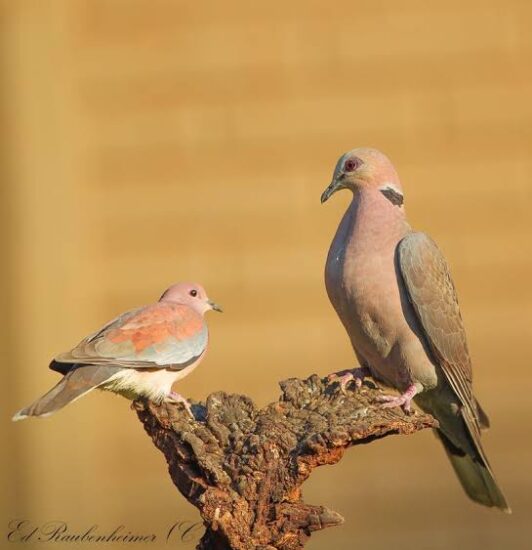
A good example is to think of the three most common garden-visiting doves in the country, namely Red-eyed, Ring-necked (old name Cape Turtle), and Laughing Dove. Red-eyed is comparatively the largest, while almost half in bulk and size is the Ring-necked, and finally the delicately built Laughing Dove. They are all doves no doubt, so they are all medium-size birds, but they differ in size when compared to one another.
Relativity between two similar species often comes down to comparatives in colour. In keeping with the current example of the doves, Laughing is undoubtedly the smallest but is also the most brightly coloured of the three. The body of this species is a mix of pleasing terracotta pink over much of its upper and underparts, with a sky-blue wing panel. Comparatively the Ring-necked is pallid grey all over. Finally, the Red-eyed on the other hand, has deep purple tones to the breast and belly, which stand out as darker when compared to the bland and slate-toned underparts of the Ring-necked Dove.
The relativity of colour can be extremely subtle, yet it is often an incredibly consistent character in many species. Colour is best used when directly comparing two birds against each other in the field, but this is not always possible or even required. Through birding and exposure, the judgement of colour of individuals of different species becomes more and more ingrained through experience. Simply being aware of variations such as rufous-brown, chocolate-brown, olive-brown or grey-brown, all begins hard-wiring the brain for picking these various tones up in the field.
When it comes to plumage and colouration of similar species, a large part of, or the entire body, may appear to be different. However, in many cases it may be a single region or feather group that differs with enough reliable consistency, to separate one bird from another. Knowledge of the different parts of a bird, those found on the diagrams in the first pages of the field guides book, is useful for being able to translate species descriptions. These descriptions outline what to look for when trying to identify the species they describe

An example of this, are the bold cream to white coloured wing bars seen on resting Square-tailed Nightjars. The bird is a nightjar no doubt, with the typical cryptic mottled mayhem it calls a plumage, but this one feature stands out. The presence of one or usually two prominent pale lines, indicates an easy way to separate this smaller-sized and more compact species from the other local nightjars.
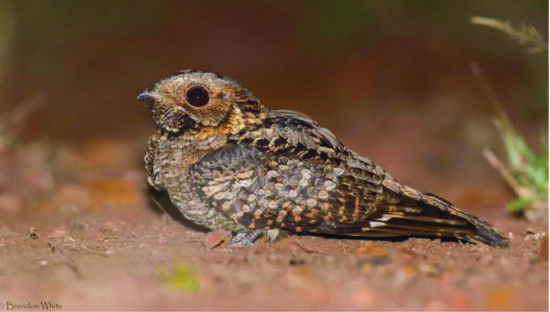
These other local species are represented by Fiery-necked, the rock-dwelling Freckled and the silent but migratory European Nightjar. Thus, knowledge of a comparatively unique feature, such as these wing bars, mean that Square-tailed generally looks like all other nightjars, but relatively, it has at least one consistent feature to readily separate it from the others.
Even the way birds fly can help separate one species from another. African Grey Hornbills for example have a slower more laboured “flap, flap, glide … flap, glide. … flap, flap, flap, glide” pattern. The similarly dimensioned Southern Red-billed Hornbill and the Southern Yellow-billed Hornbill, on the other hand, tend to flap rapidly, while climbing in height for several seconds before gliding down over tens of metres, then again, furious flapping, followed by a long glide.
In almost all cases in Southern Africa this is the extent at which most birds are identified, whether side by side, alone, in flight or offering brief glimpses. For most local birds, the number of aspects to be aware of, in terms of general relatively, are surprisingly few. Each species perhaps requires two or three features at most, to be mindful of. So once down to comparing between similar species, once at the family level or so, there are only a handful of things to look for to ascertain identity. Picture a small darkish bird, suddenly darting rapidly away and into the canopy of a tree ahead. The view is fleeting and all that could really be seen was its passerine nature, and small size. It generally could be a Warbler, or a Flycatcher, or by some weird impression, almost like a fast-flying Sparrow. As it is about to land, it opens its tail which reveals two bright white sides along the whole tail length, this makes it most likely, a Honeyguide. Getting closer, an obscured perched view shows it has a grey head, greenish back and looks comparatively like a Sparrow, these all add to confirm it as a Lesser Honeyguide.
Homework and self-study, in other words time spent pouring over books, apps or articles, are the key to the knowledge of each species secrets. That, or get out birding with those who are out often; will all ow you into the part that they have figured out, and the many shortcuts or other tell-tale features to look for. While out, it is useful to be keeping in mind the idea of generally getting to what a bird might be, and then relatively, how does it compare to others that are similar.
Even in terms of vocalisations, one song or call may be comparatively slower, faster, higher pitched, more melodic, more rasping, and so on, than others. As an illustration, a “tchuk” contact call from a Marsh Warbler is very similar to, but noticeably softer, more mellow, and more isolated, than the “tchuk” contact call of a Red-backed Shrike. The shrike emits a note which is harder, more punctuated, more mechanical, and often strung together. Yet another instance of a slight but noticeable difference to the attentive ear.
For the most challenging birds, which are represented by only a fraction of species here, there are several features to look out for simultaneously, to be able to seal the deal. Importantly, none of these stands on its own as a categorical way to separate, but rather it is the combination of several features, that create ‘the whole image’ of each species.
For example, in identifying Greater and Lesser Sand Plover, no one feature is the smoking gun.
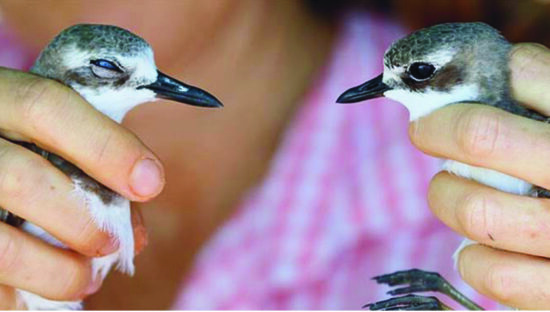
In this curious case, identification is secured by combining aspects seen in the field, under a variety of conditions like light, distance, and wind. Plumage and structural features like stature, bill length, bill tip sharpness, leg colour, wing bar and tail pattern, are all assessed to ascertain the overall impression each bird gives.
In the variety and continuum that nature represents, on some distant palm-strewn sandy shore, there can be birds that don’t fit easily. Can there be a small-billed Greater or one with blackish legs and can there be a large-billed Lesser or one with greenish legs – yes – but on average it is rare to have many of these features overlap in a single individual.
Thus, in the most challenging of groups, it is important to get a grip of all the features and not become reliant or being distracted by only looking for a single clincher.
It is imperative to stress, despite this layer of birding, existing for 95% of species encountered in this part of the world, simple, basic, and informed general relativity is all that is needed to reach a conclusion. This results in a small number of specific features to look for, when attempting to figure out any raptor, wader, warbler, cisticola, lark or distant dot.
This month, whether out in the field, relaxing in the garden, or actively in pursuit of a special target, use the idea of general relativity to your advantage. This concept not only helps those who are starting off in the hobby, but also veterans aiming at sharpening and honing their skills, and who are on the path to mastering all aspects that come with the turf in bird identification.