Dina and Ernst Marais drove into the Pafuri on a Sunday morning to do what all of us come here to do. By Friday, fellow tourists had found their bodies floating in the Levuvhu River at Crooks Corner – stabbed to death, their green Ford Ranger gone. Their killers remain free. The South African state, as best as can be established, was somewhere else entirely.
Kruger2Canyon News extends its condolences to the Marais family. This editorial was written in grief as much as in anger.
Before the details were even fully established, the calls started – journalists, content hunters, anyone looking for an angle, for proximity to someone else’s grief, for the clip nobody else had. It is the part of breaking news the industry rarely discusses openly, and it is what it is; there is however a difference between reporting a story and harvesting it, and not everyone who made contact this week appeared to understand the distinction.
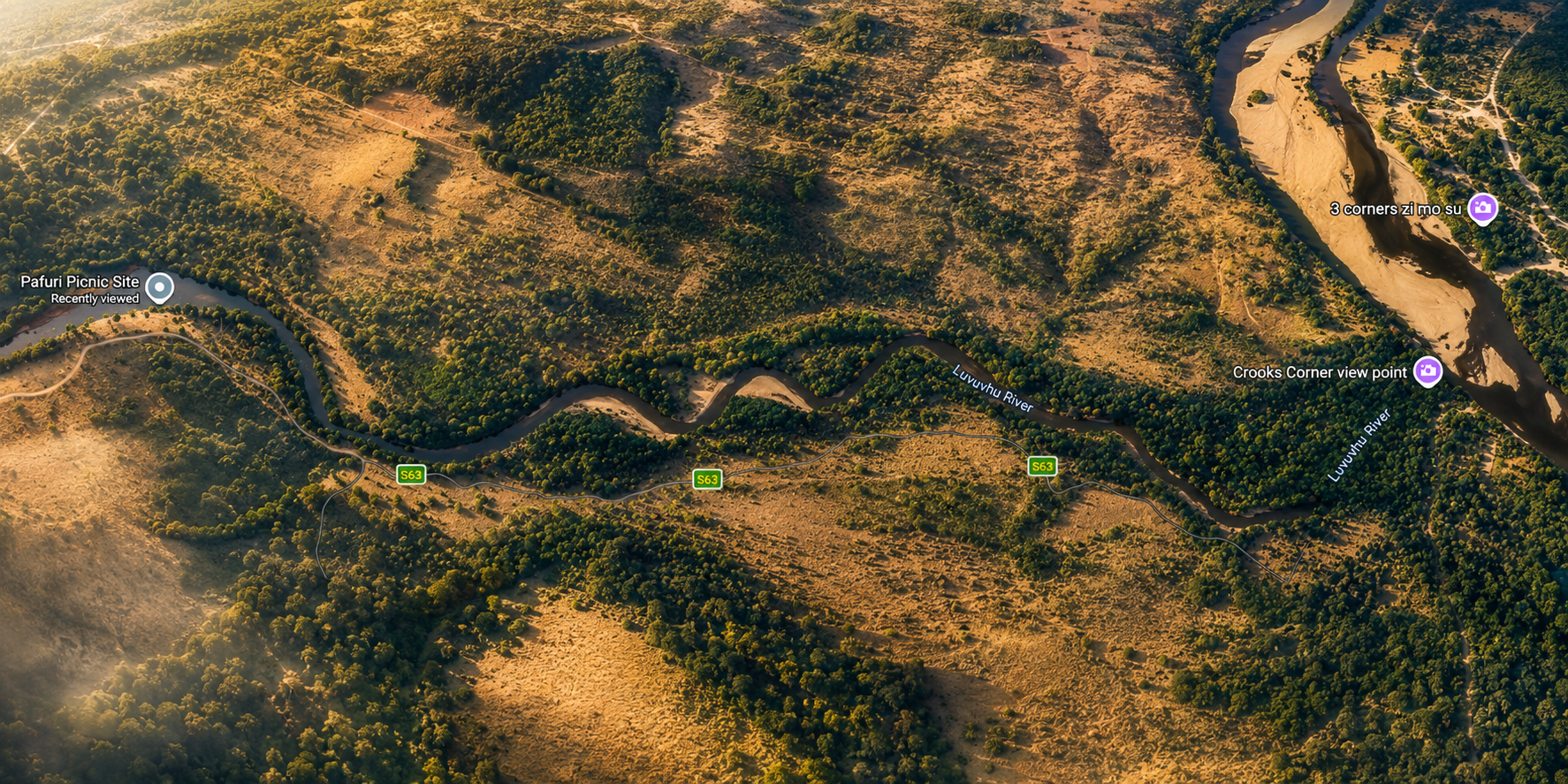
What we know is this: Dina and Ernst Marais arrived at the Pafuri section of the Kruger National Park on Sunday 17 May, travelling in a green Ford Ranger. They were last seen alive at the Pafuri picnic site on Wednesday morning. When they failed to return to camp, SANParks officials launched a search on Thursday evening – ground teams and a helicopter unit, running through the night. On Friday afternoon, their bodies were found floating in the Levuvhu River at Crooks Corner, stabbed to death, the bakkie gone. They were found not by rangers or SAPS but by fellow tourists who happened to be in the area. Tyre tracks at the scene lead towards Mozambique.
We are told this is the first incident of its kind in Kruger’s long history, which may be true, and which will be no consolation whatsoever to the people who loved them. What the family has confirmed, through SANParks, is this: Dina and Ernst followed every park rule. They would never have exited their vehicle where it was not permitted. They did nothing wrong.
They were murdered for a car. Hold that thought and turn it over until it reveals what it actually is: not an aberration, not bad luck, but the entirely predictable outcome of a country that has been hollowing out its own institutions for decades and is now living in the consequences.
Crooks Corner did not earn its name by accident, and anyone who has spent time in the northern Kruger knows exactly what that stretch of border represents – a confluence of three countries where, for well over a hundred years, the line on the map has been treated by a certain class of people as more suggestion than boundary, a place where fugitives went to become unfindable and contraband went to change hands. Poaching syndicates have operated through this corridor for years; SANParks knows it, the courts have processed the cases when the system has managed to get that far, and the records exist to prove it. What happened to Dina and Ernst may or may not be connected to those networks. What is beyond dispute is that this is not a stretch of border that anyone in authority can claim to have been unaware of.
Now consider this: SANParks deployed ground teams and a helicopter in a 24-hour search operation. That is not nothing, and it would be dishonest to pretend otherwise. But it produces a question that nobody in an official capacity has yet answered – how, with all of that on the ground and in the air, did two tourists find the bodies before any of them did? That question deserves a direct answer, not a press release. Until it gets one, the word “search” will continue to appear in inverted commas.
One detail from the official record tells you more than any ministerial statement has managed to. In the formal SAPS communication regarding this double murder – issued by Brigadier Hlulani Mashaba – the location was referred to as “Cross Corner.” It is called Crooks Corner. It has been called Crooks Corner for over a century. That is not a journalist’s transcription error. That is what the South African Police Service actually issued. If the people responsible for protecting a place do not know what it is called, it is reasonable to ask what else they do not know about it.
South Africa’s murder rate – 63 every single day, according to SAPS’s own 2025 crime statistics – is not a statistic in the conventional sense so much as it is a verdict on the social contract.
On the same Friday that Dina and Ernst Marais’s bodies were being recovered from the Levubu River, acting Police Minister Firoz Cachalia released the fourth-quarter crime statistics showing the national murder rate had decreased by 9.5%. Good news, on the day. The accumulated consequence of cadre deployment, institutional capture, and a political class that has refined the performance of governance into something almost indistinguishable from governance itself has left the actual machinery of the state corroded to the point where the criminals have long since done the arithmetic and decided they like the odds.
The official responses have been instructive. Minister Aucamp, to his credit, made multiple statements and confirmed SANParks would assist the family with transport, accommodation and repatriation costs. He also called it “an isolated incident” and urged tourists to keep visiting, warning that “criminals will have carte blanche if tourists stay away.” Minister of Tourism Patricia de Lille offered thoughts and prayers, noted that the tourism sector works closely with law enforcement, and said nothing structural. From the Limpopo provincial government, at the time of publication, nothing.
Anyone who raises their voice about any of this will be told they are playing politics, or fearmongering, or worse. Let that deflection be named for what it is. Black South Africans are being murdered at catastrophically higher rates than any other group in this country, and the communities carrying the full weight of gang violence, taxi wars and organised crime – communities that have been having this conversation for years without anyone in power treating it as urgent – deserve to have their experience acknowledged rather than instrumentalised every time a story like this one breaks through into the news cycle. This is not about who is being killed. It is about the fact that we keep being killed, across every community and every demographic, while the people collecting ministerial salaries issue statements and attend funerals and do nothing structural to change the conditions that keep producing them.
Condolences are what you offer when there is nothing left to do. We are nowhere near the nothing-left-to-do stage – we are at the we-have-been-asleep-at-the-wheel-for-decades stage, and condolences without consequence are an insult wearing a polite face.
None of it answers the questions that matter: where is the political will to actually secure that corridor, where is the investment in a detective service capable of closing cases, and where is the accountability for the officials – in SAPS, in the BMA – whose sustained failure to address what is already publicly known about this corridor built the conditions in which this murder became possible?
The Lowveld is not immune to what runs through it, and anyone who lives here knows that. We have been fortunate, or perhaps have simply not yet been unlucky enough in the specific way that produces international headlines. That calculation shifts every time the state declines to respond seriously to what is already documented about this region, and this week it shifted again in the worst possible way.
They were stabbed to death. Their bakkie was taken, their killers are still free, and the official statement from the South African Police Service couldn’t get the name of the place right. That is the country we are living in, and it will remain the country we are living in until enough people – not the forty social-media likes worth of people, but actual South Africans picking up actual phones and demanding actual answers from their ward councillors, their MPs, their representatives on the SANParks board – decide that a press release is not the same thing as accountability, and refuse to accept it as a substitute.
Kruger2Canyon News has reported this region for 25 years. We live here. We know this land. We are not going to stop saying this until someone in a position to act decides to listen.