Why alien invasive plant clearing matters
Alien invasive plant (AIP) clearing is often spoken about as a conservation issue, but in the Blyde River Catchment, it is also a serious water issue. Since early 2025, the Kruger to Canyons Biosphere NPC (K2C) and its partners have cleared 12 000 hectares of priority grasslands of alien invasive plants, including all the grasslands within the Blyde River Canyon Nature Reserve. This marks an important milestone in long-term work to restore natural landscapes and protect the catchments that supply water to the Lowveld.
Exotic trees such as blue gums, wattles and pines may seem familiar in the landscape from forestry, but when they spread into natural grasslands, they begin to change how those systems function. They outcompete indigenous grassland plants, reduce biodiversity and significantly reduce the water availability in the catchment.
Water security in the Lowveld
In the Upper Blyde Catchment, this matters far beyond the mountain slopes where the clearing takes place. This catchment ultimately feeds into the Blyde Dam, which provides water to agriculture, households and livelihoods across the Lowveld. If AIPs are left unchecked over the long term, they represent a direct threat to regional water security.
The amount of water used by alien trees is significant. It is estimated that one adult pine tree uses approximately 25 litres of water per day, while a single gum tree can use up to 250 litres per day. With thousands of trees spreading through large grassland areas, the impact quickly becomes substantial.
Based on current estimates, the 12 000 hectares of AIPs cleared by K2C is expected to release an additional 2 million cubic metres of water into the Blyde Dam each year through this intervention alone. To put this into perspective, that is equivalent to half of the total domestic water users’ allocation in Hoedspruit. That means this work is not only about distant mountain slopes or conservation targets – it is about water for farms, homes, businesses and communities. It is water for you and me.
Difficult work in difficult terrain
The work itself is also far more difficult than many people realise. Clearing AIPs in the Blyde Catchment is labour-intensive, technical and often physically demanding. Trained teams work as professional units, moving through rugged mountainous terrain with chainsaws and equipment. In some areas, teams camp in the field for extended periods and some even use ropes to access steep cliff faces where alien plants have taken root.
This makes clearing expensive and slow, but also essential. To secure long-term support for this work, K2C and its partners need to show not only that AIP clearing is important, but also what measurable difference it makes in this specific landscape.
Measuring the impact
One of the key questions K2C is working to answer is: exactly how much water is being returned to the system when AIPs are removed?
While current estimates of water gains from AIP clearing are based on strong research, much of this has historically been carried out in commercial plantation settings. Here trees are planted in neat, uniform rows and are easier to measure. In our mountains and grasslands, the situation is very different – AIPs do not spread evenly. They grow in patches, along drainage lines, up slopes and across difficult terrain, often more densely than in a plantation.
The Paired Catchment Experiment
To build more accurate, locally relevant evidence, K2C has established a Paired Catchment Experiment in the upper reaches of the Blyde River Canyon Nature Reserve, in partnership with the Nature for Water Facility, the South African Environmental Observation Network and The Nature Conservancy. This long-term study is designed to measure how water availability changes before and after AIPs are cleared.
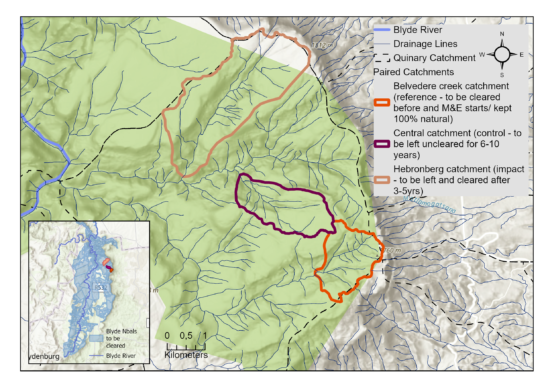
Three catchments have been selected because they are similar enough in terms of rainfall, altitude, size and landscape conditions to allow meaningful comparison. These include:
- an impact catchment, which is currently invaded by AIPs and will be cleared after three to four years of baseline monitoring;
- a control or comparison catchment, which is also invaded and will be left uncleared for the duration of the experiment; and
- a reference catchment, which was cleared by K2C in 2025 and now represents a rehabilitated (near natural) system.
Across these three catchments, the K2C Catchment and Conservation Team is continuously monitoring rainfall and streamflow, among other indicators. This will help the team understand how water availability changes over time, both before and after clearing.
The experiment uses telemetry equipment, radio repeaters and a mountain-top data station to send information to cloud storage every hour. This is especially important because the monitoring sites are located in remote valleys where there is no cellular signal. Instead of relying only on occasional field visits, the team can build a continuous record of what is happening in the catchments over many years.
Long-term evidence for long-term restoration
Catchment restoration work takes time, so the Paired Catchment Experiment is expected to run for six to eight years. Once the AIPs are cleared, follow-up treatments are needed, then enough time for the systems to recover and time to collect enough reliable data to understand what has changed.
This kind of patient monitoring is critical. It can help K2C and its partners make better decisions about where to focus future work, how to plan catchment management and how to strengthen proposals for future investment in water security. The evidence generated through this experiment will also support scientific modelling of future water gains linked to AIP clearing. This has value beyond our region, for restoration programmes elsewhere in South Africa dealing with similar problems resulting from alien invasive plants threatening water, biodiversity and livelihoods.
Clearing and restoring catchments is difficult, costly and long-term work. It takes patient fieldwork, follow-up treatment and years of monitoring to understand the full impact. Through this project, K2C is helping to build the local evidence needed to show that restoring catchments is not only conservation work, but a practical investment in the Lowveld’s future water security.
Lauren Booth
Kruger to Canyons Biosphere