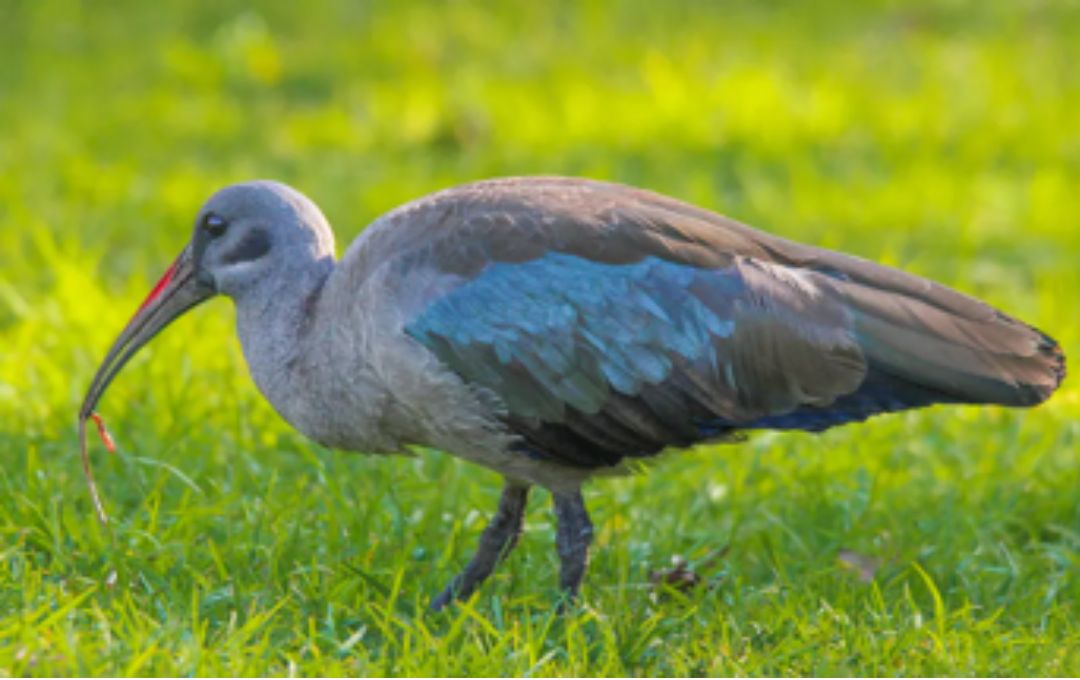
Hadeda ibises (Bostrychia hagedash) are one of the most familiar species of birds across sub-Saharan Africa. They are large, long-legged birds with long, thin beaks for probing invertebrates out of soil, and though they appear dull brown at a glance, they actually have beautiful iridescent feathers on their wings. But they are best known for their loud, laughing calls, which often ring out early in the morning, winning them the title of “African alarm clocks”.
They can be found across much of sub-Saharan Africa, with a range extending from the Cape all the way to Kenya, Ethiopia and Sudan. In South Africa, they were historically confined to north-eastern regions of the country. But in the past century they have experienced a significant range expansion, now inhabiting many a golf course and garden from Johannesburg to Cape Town.

Various ibises and shorebirds (like sandpipers) are able to use the “sixth sense” of remote touch. This allows them to detect vibrations in soil and water and use this information to locate invisible buried prey items. When they hunt for soft-bodied prey (such as earthworms), these vibrations result from the movement of prey in the soil. The birds can sense these vibrations using a special sensory organ in their beaks, called a bill-tip organ, which evolved during the time of the dinosaurs.
Recently published research from my PhD at the FitzPatrick Institute of African Ornithology shows that hadedas have this sixth sense too – something that had been assumed based on the anatomy of their beaks but never tested. In addition, my co-authors and I discovered an added twist to their sixth sense – their ability to use it is closely tied to the amount of water in the soil. This has likely played a role in hadedas’ range expansion and has global implications for key groups of wading birds.

Testing hadedas’ ‘sixth sense’
Based on the birds’ beak anatomy, my co-authors and I knew it was likely that hadedas used remote touch while foraging. To confirm this, we used a series of sensory assays – a type of experiment testing how different sensory cues (such as sound or smell) affect how quickly an animal can detect a stimulus.
We tested hadedas housed in free-flight aviaries at a bird sanctuary. We presented them with trays filled with soil, in which we buried several worms. We knew the birds couldn’t see the buried worms, but we also needed to make sure they weren’t using hearing or scent to find them. We masked any sounds the worms made by playing white noise from a speaker next to the trays. To ensure the hadedas couldn’t smell the worms, we mixed crushed worms into the soil.
Neither of these affected how quickly hadedas found their prey. So, we concluded that they weren’t using hearing or scent to locate the worms in our experiments.

To test whether hadedas were able to use remote touch, we gave them either live worms (which moved around and produced vibrations) or dead worms (which did not produce vibrations). The birds were able to find the moving worms significantly faster than the dead ones, indicating that they are able to sense vibrations, and use them to find prey in the absence of all other sensory information.
Why soil water matters for remote touch
The mechanical waves (vibrations) that the bird’s sense are transmitted better in liquids than in gases, so we predicted that hadedas would be more successful at detecting vibrations (and finding prey) in wetter substrates. Once we had established that hadedas could use remote touch, we tested how adding different amounts of water to the soil affected how quickly they located their prey, as this could be a factor that affects where they are able to forage.
When they were using remote touch, the birds located the worms significantly faster in wetter soils, supporting our prediction. If they were given dead worms (no vibrations), adding water to the soil had no effect on their prey capture rate, so it wasn’t simply because the wetter soils were easier to dig around in. If the soil was too dry, hadedas lost their ability to sense living worms faster than dead ones. This indicates that they could not use remote touch in dry soils, and were instead having to rely on random probing to find prey.
In the wild, this would mean taking twice as long to find the same amount of prey, or ending the day with less than half the amount of prey as they would have if they could use remote-touch.

Effects of remote touch and soil water on hadedas
Our findings shed new light on the range expansion of hadedas in South Africa. Previous studies have shown that their range expansion matches with increased areas of artificial irrigation – particularly around farms and large suburban areas. Our research suggests that one of the driving factors is that hadedas need soil with enough water to be able to sense their prey. This could in part explain why they aren’t found in more arid areas of the country.
Their dependence on moist soil could have significant effects on their population in periods of prolonged drought. Dry soil would mean that birds like hadedas would struggle to find prey. The predicted trends in sub-Saharan Africa indicate that droughts and heatwaves will become more frequent and last longer as a result of climate change. Thus, even common garden birds like hadedas may be threatened in decades to come.
The bigger picture: a global warning?
Although hadedas need water in soils to use remote touch, they actually tend to forage in drier soils than most other remote touch foraging bird species. Their bill-tip organ anatomy indicates hadedas have more sensitive bill-tip organs than ibises that forage in wetter substrates.
Coupled with our new findings, this likely means that other remote touch probing birds would be even more vulnerable to decreases in substrate saturation. Several species, such as the spoon-billed sandpiper, are already critically endangered.
Our results therefore suggest that it’s important to consider birds’ sensory requirements from their habitats, particularly regarding levels of water in the substrates waders forage in.

So, while the hadedas’ raucous calls may be annoying at times, it’s a sombre thought that Africans could lose the sound of our natural alarm clocks. We hope that our study will highlight this overlooked aspect of wading birds’ ecology, and that we don’t oversleep this particular alarm call from nature.
Carla Jacquelyn du Toit currently receives funding from The Royal Society (UK). The work presented in this article was funded by GENUS DSI-NRF Centre of Excellence in Palaeosciences (South Africa). During the time of this work, she was a doctoral student at the FitzPatrick Institute of African Ornithology (University of Cape Town).
University of Cambridge provides funding as a member of The Conversation UK.
This article is republished from The Conversation under a Creative Commons license.