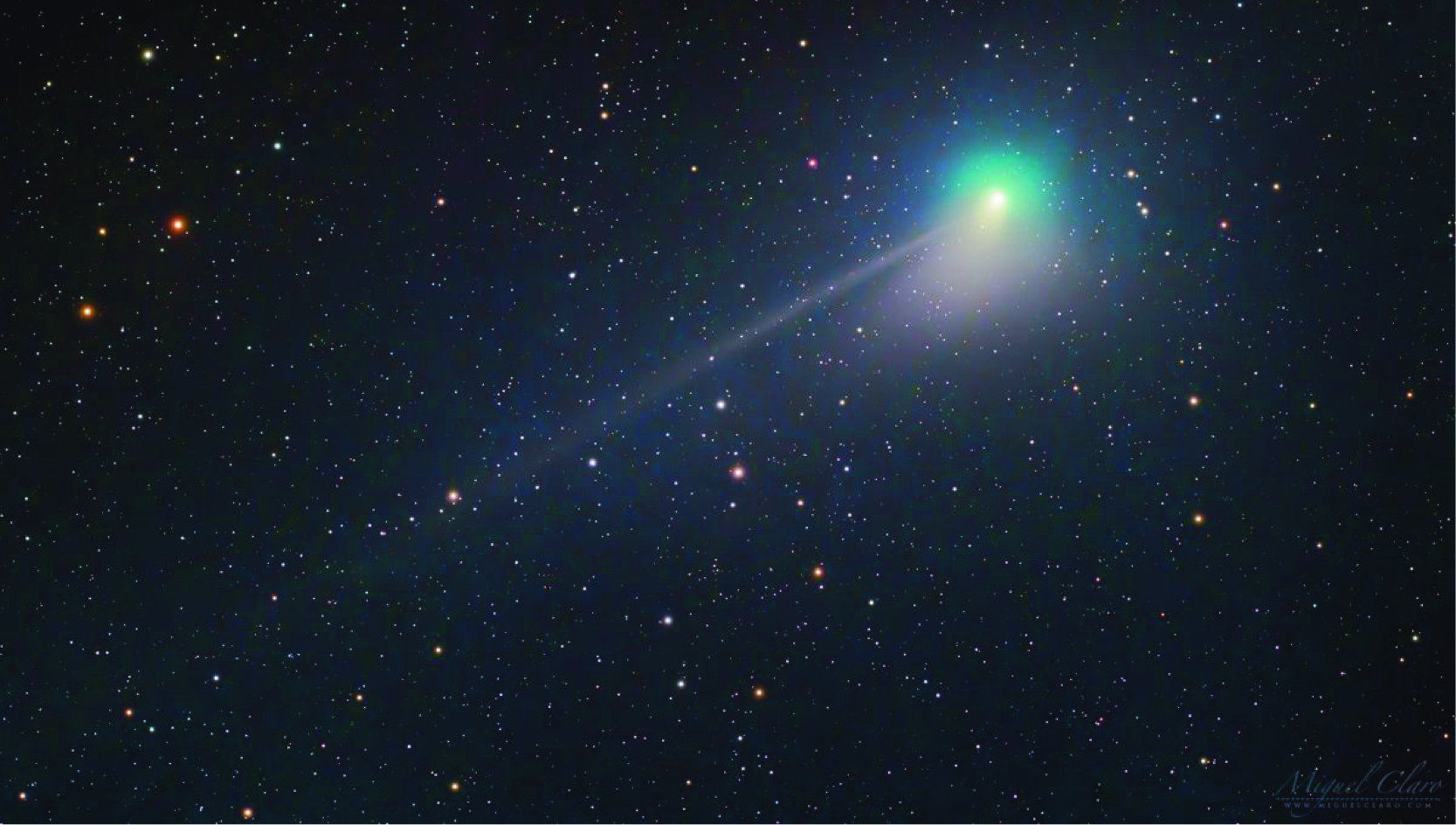
Last month saw the return of a celestial visitor that was last viewed by our distant ancestors around 50 000 years ago!
The green comet, otherwise known as Comet C/2022 E3, made headlines through January and early February as it returned to Earth after its massive hiatus from the far reaches of our solar system.
It was first detected in March 2022 by eagle-eyed astronomers as they were scanning the heavens. Most comets are only discovered at the last minute, since they are so small in comparison to other stellar bodies and need to be relatively close to us to be seen. A year ago, the green comet was a whopping 650 million kilometres from Earth (about the same distance as Jupiter), and gave off 25 000 times less light than the dimmest stars visible to the naked eye.
Since then, it has travelled much closer to us on its elongated, parabolic orbit around the Sun, and reached its closest approach to Earth on the 1st of February, whilst in the northern hemisphere constellation of Camelopardis. Close is a relative term however, since the comet was still 42 million km from Earth! This is not much closer than Venus gets during its closest approach to us.
Unfortunately this put it out of range from our location in South Africa, and we had to wait another week or so before it moved into Auriga, the Charioteer, and on to the zodiacal constellation of Taurus, passing quite close to Mars in the sky.
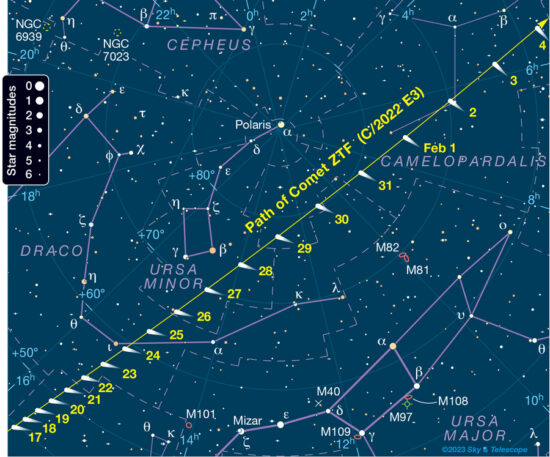
The comet was fading from view as it entered its return trajectory, speeding away from the Sun at thousands of kms per second. There is a good chance that it’s orbit will take it outside the influence of the Sun’s gravity and it may never return, so I hope that you had a chance to view this one in a (multiple) lifetime stellar beauty.
Although below naked eye visibility, the comet was visible as a faint fuzzy star in binoculars, and long exposure photography could easily pick up the green glow. Those with designated star tracker mounts and astrophotographic equipment were able to get some incredible photos of this verdant celestial visitor. Unfortunately, I was away and did not manage to capture its viridescent wonder, but many amateur photographers around the world were able to do so.
Comets are remnant of the solar nebula, the disc of excess material that was spun off by the Sun in its early years, that went on to form all the planets and other objects in the solar system. Most comet nuclei reside in either the Kuiper Belt, or the Oort Cloud, rings of stellar outcasts way beyond the orbit of Neptune. Asteroids are lumps of rock, whereas comets are chunks of frozen dust and gases like carbon dioxide, carbon monoxide, methane and ammonia, as well as water ice.
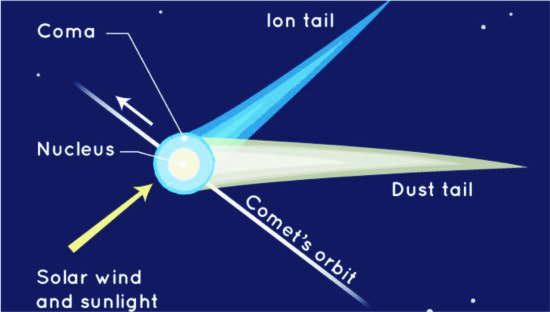
As they approach the Sun, they begin to warm up and melt, forming a gassy envelope around the nucleus. This ‘coma’ is what gives a comet its hazy appearance, the gases glowing with a ghostly green hue as they react to the solar winds. The dust, now freed from their icy prison forms a tail behind the comet as it rockets through the solar system. These dust trails remain suspended in space and every year, the Earth periodically passes through the debris fields, the particles colliding with our atmosphere causing meteor showers. A secondary tail known as the ‘ion tail’ is also visible, caused by the solar radiation stripping off electrons of particles within the coma.

Halley’s comet is responsible for 2 showers each year, the Eta Orionids and Eta Aquarids, but traditionally, the best shower of the year is the Perseids, which peaks in the second week of August, with up to 120 meteors an hour. This is quite a spectacle and is a chance for some dramatic long exposure photography. Unfortunately, this currently coincides with a bright moon phase, and many of the shooting stars are hidden from view, but as the years roll by, this will change and we will enjoy the full force of this remarkable show once more. Meteor showers are named after the area of space (and thus the prominent constellation) that the majority of meteors seem to emanate from, and is known as the ‘radiant’.
I hope some of you managed to enjoy this spectacle and do not despair, there will be more! Many comets are only discovered months before they are first seen, so it may not be long until we get to witness another flyby from a celestial outcast!
See Celestial Events SA advert for contact details