On April 14, 2023, the European Space Agency (ESA) launched JUICE. The space industry loves a good acronym and this is no exception. JUICE stands for Jupiter Icy Moon Explorer and is another huge step towards scouring our solar system for signs of life. In 8 years’ time, JUICE will reach its final destination and settle into orbit around the largest of our solar system’s planets – Jupiter. Over the coming years, JUICE will orbit Jupiter and its 4 largest moons, known as the Galilean moons, examining them with a plethora of scientific instruments. Its goal is not too dissimilar to Star Trek’s famous Starship Enterprise, “… to explore strange new worlds … to seek out new life and civilisations … to boldly go where no man has gone before”.
Whilst finding new civilisations may be a bit of a stretch, its mission can be summarised as exploring and assessing Jupiter’s moons for the presence of current or past life, as well as understanding their interactions with their host planet, and each other. But what is it about these bodies that has inspired this latest mission?

History
Jupiter is home to 92 recognised moons, but the 4 largest have been known to science for over 400 years. Io, Europa, Ganymede, and Callisto, were first discovered by the great Italian astronomer Galilieo in the 1600’s, with a telescope no more powerful than a pair of modern day 8x birding binoculars!
Not only were they the first moons discovered orbiting another planet, but their legacy proved vital in reshaping our understanding of the cosmos. Prior to this, the world still followed the ancient view that the Earth was the centre of everything, and that all other bodies orbited it. Galileo’s observations provided some of the first empirical evidence that not everything was bound to Earth. This, along with various other discoveries, paved the way for the heliocentric model of the solar system – that the primary orbit of all the known planets was the Sun, and not Earth. Despite the magnitude of this revelation, it caused great tension between the scientific community and the church, the latter being firmly ensconced in the geocentric theory that placed the Earth at the centre of all things. For his work, Galileo was labelled as a heretic and placed under house arrest for the remaining 10 years of his life, and the church only relented to validate the heliocentric theory in the 1820’s!
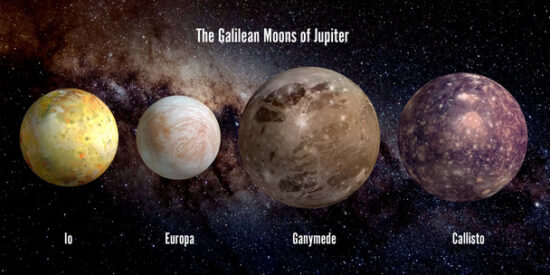
The Galilean Moons
These 4 celestial bodies are some of the most interesting objects in our solar system, with each being unique in its own right.
Io
Io is the closest moon to Jupiter, and boasts a multicolour surface dashed with a cacophony of pinks, yellows and purples. Its visual beauty is born from the gravitational interactions between it, Jupiter and the other moons. Their mass tugs at this defenceless satellite, wrenching its interior to and fro, causing massive geothermal unrest. Great volcanos spew toxic plumes of elements, 100’s of kilometres into the atmosphere, and great fissures in its surface allow lava to ooze forth sulphurous compounds that coat and stain Io’s surface, in a patchwork quilt of chthonian origin.
Europa

Europa may be the most scientifically significant body in the solar system. Radar imaging has confirmed that beneath its fractured, icy surface, resides a liquid salt water ocean, encircling the whole moon, estimated to be some 150 kms in depth. Within these watery depths, lies a primordial soup of carbon and hydrogen based compounds that form the building blocks of life here on Earth. The ocean is warmed by hydrothermal vents, caused by the tidal pull of Jupiter on its core, much like we see in our own ocean depths. On Earth, these vents are home to blossoming ecosystems, filled with organisms that have adapted to live in the hot, sunless, toxic environments with great success. Whilst no direct evidence exists yet, Europa is seen by many astrobiologists as one of the most likely bodies capable of supporting life.
Ganymede

Ganymede is the largest moon in the solar system, dwarfing Mercury and three quarters the size of Mars. Like Europa, Ganymede is thought to harbour a deep subsurface ocean. What makes Ganymede unique however, is its magnetic field, the only known moon to be encapsulated in this invisible energy field. It has auroras just like the poles on Earth, and a thin atmosphere that contains some oxygen.
Callisto
Callisto is a lunar relict. Its surface is pitted with craters almost to the point of saturation and is thought to be unchanged since its creation over 4,5 billion years ago. Being further from Jupiter than its aforementioned brethren, its interior is not thought to be heated in the same manner, but subterranean oceans have not been ruled out. While the chances of life on Callisto are slim, its ancient surface offers a unique opportunity to study the history of the solar system.
So, what of JUICE? JUICE will use gravity assists from the Earth, our Moon and Venus to slingshot itself towards its final destination at thousands of kilometres per hour! Its mission will focus in studying Jupiter’s largest moon Ganymede, examining its surface in exquisite detail, understanding its alien magnetic field, and searching for confirmation of the presence of salt water below its crust. It is hoped that its findings will unlock some of the secrets of the Jovian system and pave the way for future exploration.
Enter NASA’s Europa Clipper. Some may wonder why JUICE will not be spending more time looking at Europa, considering its biological potential. Europa has been earmarked for exploration for years, and next year NASA will launch the Europa Clipper, whose primary objective is to study this fascinating, frosty body. Despite launching a year later, Clipper will arrive before JUICE and its scientific payload will already be hard at work searching for superficial evidence of life in its icy depths.
What either of these scientific marvels will find remains a mystery, and as mankind’s expansion into the unknown of the solar system continues, what secrets they unearth could turn out to be some of the most monumental discoveries ever made.
Unfortunately, we will have to wait nearly a decade for any fruits of these great endeavours to be plucked, but as the years roll by, the anticipation will rise. And maybe, just maybe, we will finally be able to answer one of the great questions of the universe. Are we truly alone?
See Celestial Events SA advert for contact details