As winter sets in, and the days shorten as if on purpose, the stars adorn clear skies and frosty early mornings grace our small quadrant of the Lowveld. Despite the competitive scarcity of birds compared to the hot and humid midsummer, there are a still the plethora of residents for both local and travelling birders to appreciate. Despite the regularity of these species, many remain tricky to pick up for all but the most seasoned of ‘avifans’.
One of the most challenging aspects, even for those who are confident birders visually, is the ability to distinguish species according to the sounds they make. There are many factors which play a role, which all affect the ability to pick up clarity, or regularity, with many things sounding very similar and others being completely unknown sounds.
This state of affairs can persist for many years and the ability to define sounds from one another is often coveted towards those who can do it well. The main reason for this is that sounds that birds make are often incredibly varied, they are often erratic and uttered only briefly or with long intermission. Bird song, in many ways is a different language, much like when beginning to identify birds visually. In the beginning stages of practicing, many species went past too quickly to see well enough.
Over time though, as more and more accumulated experience occurred for each species, the easier and easier they became to recognize. In order to improve on the ability to bring sound recognition into one’s regular birding, there are a number of individual concepts or principles which can help in the understanding of what learning bird sound entails. These are simple tips aimed to offer advice, rather than being dictatorial, they are presented as thoughts. The first, is that mastering of bird sound takes a long time of conscious effort and experience, so don’t worry if there are unknown sounds. How one becomes better is by adding to their individual known sounds rather than assessing how many gaps they have.
If today one sound is known and tomorrow two sounds are known then that is learning, in this example, and within two weeks perhaps up to 10 species could be permanently locked in. One of the most daunting things when beginning to truly think about calls and songs, is that many species of bird can often be heard calling at the same time, even when well outside the classic dawn or evening chorus times, from a number of directions and at a range of distances.
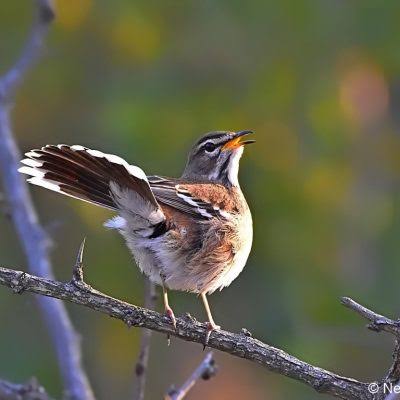
A Symphony of Sounds
One way to think of this, at times chaos, is to think of the medley of sound as an orchestra or a symphony playing in a grand hall. Some instruments, in other words some species, will be bold and obvious.
This is largely due to the rhythm or nature of their vocalisations, they are so distinct that they can be easily learnt and assimilated. After some experience these are readily identified even when at some distance. Other sounds will be less distinct or more difficult and thus are simply labelled as unknown, or erroneous, or simply blur into any mash of others that are equally indeterminate.
When out birding and attempting to assess what is calling, it is good to try and target the loud obvious instruments first. The trumpets, the trombone, the cymbals or piano, the drums or the violin. Species like black-collared barbet, African fish eagle, African green pigeon, common greenshank, yellow-fronted and yellow-rumped tinkerbirds are good examples of bold brassy species, with easily recognizable tunes.
For beginner birders, being able to know these sounds in-and-out, is one of the most pleasurable aspects of being out birding. At an intermediate level, by slowly increasing the number of species locked in through learning by listening, more subtle species start to be picked up. Comparative instruments like the clarinet, the cello, the flute and others represent the sounds of species like yellow-bellied greenbul, cardinal woodpecker, blue waxbill, African firefinch, tawny-flanked prinia and wood sandpiper. These sounds, despite being less obvious, are often regularly heard and are often repeated a number of times by their stand-out owners.
Finally at the advanced or intricate layer of a symphony, lie abstract objects like the oboe, the viola, the castanets. These, subtle, difficult to clearly distinguish instruments, can equate to birds like marsh warbler, brimstone canary, red-backed shrike and more.
While starting out, it is important to glean and learn from others. In many cases, one or two new additions of easy and mid-layer instruments, or birds, could potentially be added with each outing initially. In many cases, species seen in areas of regular birding are the same, and thus once one species is heard at a site, there is a good chance it will be heard again, in the same area, at another time. So keeping tuned in is important. One way to practice this concept is to try and always be aware of the two most prominent bird sounds that can be heard at any and all times, just in case someone were to ask you.
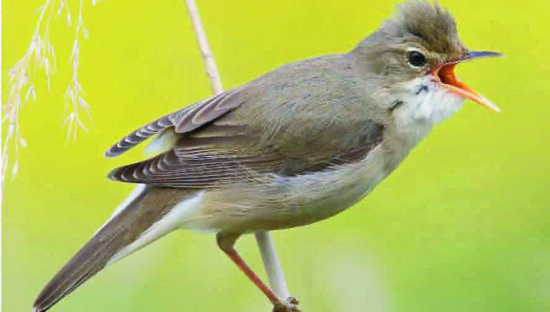
Song vs Call
To add more fuel to the flames, most species of bird make a number of different sounds, in most cases up to ten different types of vocalization cam be produced. However it is very important to differentiate the song of a species from the variety of calls that it makes.
Song is often the most diagnostic, regular, recognizable and most readily used sound for identification, but its primary purpose is actually to attract mates and ward off potential intruders. Songs are not just given during the mating season but, in fact, are produced throughout the year, each species with its own unique song. Calls on the other hand refer to all the other, often short clicks, buzzing, high-pitched notes, trills, ‘tchacks’, and other noises that birds make. There are a number of different types of calls, contact calls, alarm calls, excitement calls, flight calls and more.
When starting, the most imperative to learn is the song, this is the first part of recording for each bird within the apps. Calls, on the other hand, are the different sound that appear later in the recordings. Not all songs are melodic, some are raucous and grating, or hooting or croaking or screeching to name a few, but once learnt, most birds picked up correctly will be by their songs. Focusing on learning the song initially and augment additionally with the calls through time is a good way to leap into this challenge.
In many, but not all cases, the recognition of calls starts to happen at an intermediate and higher level, bettered through the experience and home study. Many species however have distinctive calls which can clinch or really help support other features in the identification between similar species in the field.
Training the Ear
With our modern society of cars, trucks, sirens, airplanes and other distractions, for much of our lives we learn to tune sounds out. When attempting to separate and focus on bird song, the rare need arises to be able to really focus on our hearing. Initial attempts involve actively having to stop, keep quiet and still, and try to absorb. Despite its simplicity, to really hear properly, at all levels, this habit of attentive listening is tip-top essential.
Once stopped for a single sound, one is often confronted by what seem to be continually different sounds. It is difficult to separate one from another and all are coming from any direction. Even trying to use an app can be confusing, as often in the field, birds utter sounds that are not quite like the individuals in recordings. In order to better achieve the ability to tune in, there are number of exercises suggested for those wishing to improve on their skill.
The first is not to be afraid of attempting to listen far away, as far in the distance as possible, a practice best done in relatively quiet surrounds. Often sounds can be picked up much further than expected and much to the surprise of those involved.
Listening to classical music, even a little tiny bit, is useful. If that is a completely alien experience, just one or two songs a week while considering what is below should do it. Listening to birds is in many ways similar to the variation experienced in this genre.
While listening, concentration on changes in pitch, tone, rhythm, softness and loudness as a few examples, can add huge value when applied to birding. Whether notes and phrases are thin or volumous, delicate or bold, repetitive or varied, higher or lower pitched, faster or slower than others, as a few examples, all help as sticking points when looking at those species with more complex songs.
Once picking up on sounds, separating one from another and having basic confidence with a small baseline of ten species or more is a great place to start. One way to practice is to always be on the listen out for the two most prominent bird sounds no matter where one is, whether in the wilderness or traffic. Just the most obvious two sounds, as much as humanly possible. Another good technique is to listen out for those two top bird calls or more, while walking and talking with someone else. The ability to listen even through one’s own speech often seems like magic.
Homework?!
Learning the songs and calls of birds, especially here in a subtropical nation, where there can easily be over a hundred available in a single morning, can be extremely daunting and when starting from the beginning, almost impossible. For those that have hiked the world’s highest peaks, consistent effort is an essential requirement. Putting one foot in front of the other consistently, gets them to the top. Bird songs and calls are essentially a new language which requires decoding, and as such does take time to truly master. However, through a little, but regular effort, this can yield quick and highly rewarding and intrinsically pleasing results.
One important aspect to try and retain things learnt today do that tomorrow they can be added to. If principles are not added to, it is easy to reach a road block. One way to try this to observe birds in an area and then practice their calls using an app or recordings, and then return to try pick up on the sounds they make. Another way, is just after visually confirming a species, move away and play the sound for oneself, then listen again, and perhaps that species can be heard nearby.
Getting into and really familiar with the sounds that birds make by using incredible tools like Robert’s and Guy Gibbon’s material, as well as more recent mecca like Xeno-Canto.org and the Merlin app, is an essential way to be able to grow, if you are not lucky enough to have mentors or others willing to help. If planning a trip, make a list of species and play their sounds while traveling down to tune in. Even in the garden, if there are house sparrows as an example, make a note and play the sound, it is interesting how often some species are around us which are picked up by sound alone. Homework really helps to solidify or prepare, and is a vital element of birding for those that hope to improve rapidly and with confidence.
Keep Listening For Some Time
Finally, some birds make sounds consistently, others may have bouts where they sing for several minutes then stop in between, when others still, call only once in a while. When listening to an unfamiliar sound, it can really help to stand very still and be patient, waiting for several minutes at least for the sound to be repeated for more clarity.
Often the impatient urge to move on can hinder the ability just to absorb new sounds. More importantly, if a bird is seen, it is often brushed past, but if singing, there is a trick to be had here by taking some time to observe. If seeing a Cape robin-chat singing for example, one can listen to the sound for an extended period, making a note of variations, consistencies and any other aspect that makes it unique.
Reading the information provided while playing the sound on an app, when listening to a known species, helps immensely. In many cases these can be mulled over, practiced and maybe even absorbed in real time while a bird is calling. This resonates best over a number of experiences with each species, eventually new birds and their sounds fall into the “easy” bin along with those that are already there.
Overall, the attempt to learn to identify birds by the sounds they produce is an admirable quest, and a journey in its own right. It is important to be patient with progress and to build on previous learning, bird by bird and sound by sound. Always be alert, listening and aware while asking advice, if needed, and using resources to their full potential.
This month, while out in the field, take note of any birds seen calling and log them to check later, better yet, if traveling, make a list and try pick them up by ear when there. With a little practice, adding a few species per week or month to one’s knowledge is a highly pleasing and attainable goal, which adds a great sense of satisfaction when in the pursuit of birds.