Each and every night, our planet is bathed in starlight; an eternal vigil held by the countless members of our galactic community. But it is easy to forget that our Sun is just one of many… The Milky Way is thought to contain up to 400 billion stars, yet within the cosmic web of our Universe, there are as many as 200 sextillion stars. This is an incomprehensible number, the equivalent of 10 times the number of cups of water in all the oceans on Earth!
Despite their unfathomable numbers, stars have lives. Just like us, they are born, mature into their adult years, and ultimately succumb to Father Time. But have you ever wondered how these innumerable building blocks of our Universe blink into existence?
Stars are born from giant molecular clouds containing mostly hydrogen, the first and simplest element on the periodic table, interspersed with a dappling of other more complex elements. Most of the hydrogen in space was created in the aftermath of the Big Bang 13,8 billion years ago. These great clouds can be seen with the naked eye under dark skies. One only has to glimpse the great swathes of dust lanes slicing through the Milky Way to see them. These snaking channels of darkness are not patches of empty space. They are in fact ancient, inert clouds of dust and gas silhouetted against our galaxy’s spiral arms.
Space is cold – very cold – hovering at only a few degrees above absolute zero, and when atoms are cold, they do not move. Left untouched, these gas clouds simply remain suspended in the frigid expanse of the cosmos; but if something agitates them – such as the gravity of a passing star, or the shockwave of a nearby supernova, magic starts to happen…
The atoms of hydrogen start moving and bump into each other, forming molecules. Over time, these molecules grow in size and mass, imparting a gravitational influence on the area around them, attracting more matter towards them. The object now begins to grow exponentially, gravity sculpting it into a rapidly rotating sphere, forming the core of a developing proto star.
Under the intense pressure of their own gravity, the atoms in the core are crushed together, and should the force be great enough, hydrogen atoms combine to form helium atoms in a process known as nucleosynthesis. This nuclear fusion produces heat and light and marks the moment a true star is born.
The runaway fusion in the core of a star is the fuel that will last it throughout its life. Its lifespan will ultimately be dictated by its mass, or the size of its engine. Larger stars burn through their fuel in only a few million years, whilst smaller stars are more economical, sipping at their fuel-load, extending their lives into potentially trillions of years. But these small stars are not to be scoffed at! Our Sun, categorised as a yellow dwarf, will likely reach the ripe old age of between 8-10 billion years before exhausting its fuel reserves; yet its fusing 600 million tons of hydrogen into helium every second (no, that is not a typo … every second)!
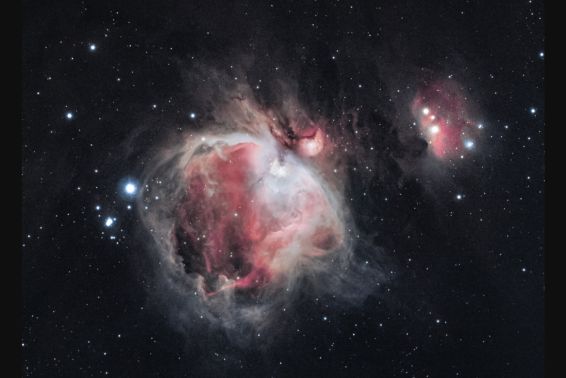
Whilst still in its gaseous incubator, the intense radiation produced by a young star ionises, or ‘excites’, the surrounding hydrogen gas, causing it to glow. These areas of active star formation are known as emission nebulae (from the Greek word for ‘cloud’), and manifest as some of the most beautiful structures in the cosmos. Many are visible to the naked eye, binoculars, and telescopes, but are best appreciated in long exposure photography which is able to pick up the delicate pinkish-red hues given off by the excited hydrogen.
Here in the southern hemisphere, we are privy to see many of the most prevalent emission nebulae in the sky, and over the years, I have been able to capture some of these cosmic birthplaces in all their glory. It is a humbling experience to witness creation on a such a vast scale and offers a great sense of perspective into the insignificance of our lives.
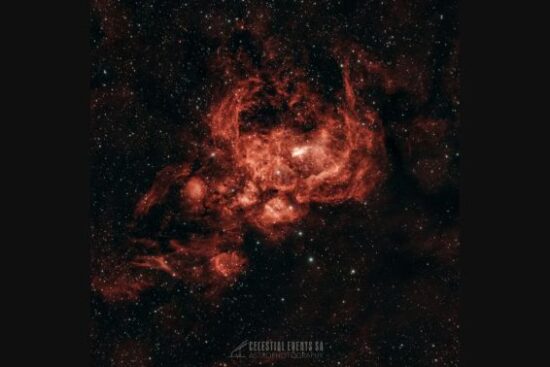
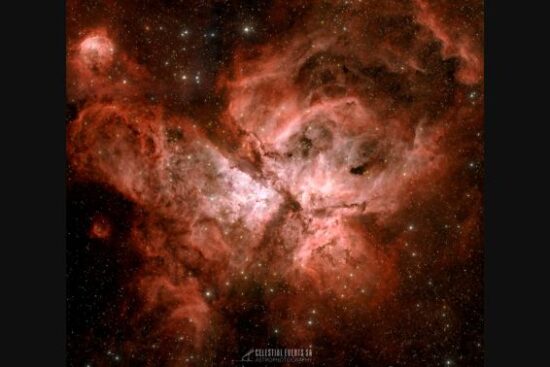
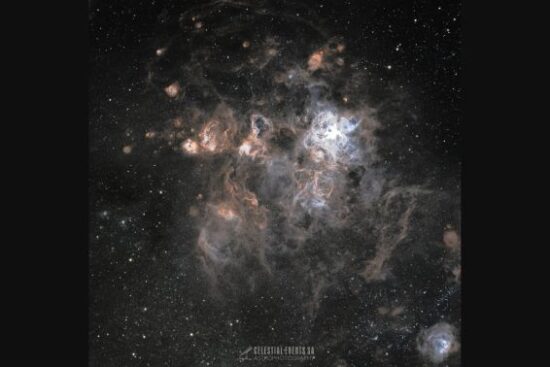
As the winter constellations sink towards the western horizon, we begin to say farewell to the Lagoon and Eagle nebulae (home to the famous ‘Pillars of Creation’) in Sagittarius as well as the aptly named Lobster nebula in Scorpius. However, they will soon be replaced by some of the most exquisite sights in the summer skies. In the coming months, we will welcome the Great Orion Nebula (the closest emission nebula to Earth), the mighty Carina Nebula, and the spectacular Tarantula nebula which resides in the neighbouring dwarf galaxy known as the Large Magellanic Cloud. This gaseous behemoth is so large, that if it was the same distance from us as the Orion nebula, it would occupy the same amount of sky as 75 full moons, and be bright enough to cast shadows on Earth.
Stars are the largest single entities that we know, some spanning billions of kilometres in diameter, yet they are forged from the simplest element known to science. Their development is slow, but their influence on the Universe is legion. Their presence in our heavens has allowed us to predict weather patterns and develop the language of time. They have helped us to figure out our place in the Universe, and their catastrophic deaths seed the cosmos with the raw materials to create new stars, planets and even the elements we ourselves are made from.
Next time you look up in the wonder at the stellar tapestry above your head, take a moment to appreciate not only their intrinsic beauty, but also the origin and cosmic importance of these twinkling wonders.
See Celestial Events SA advert for contact details