As the sun rises over the southern Kalahari, casting a soft orange glow over the endless stretches of an iconic expanse, a sense of excitement and adventure takes hold. I am on the Lowveld Trails Company’s (LTC) recently launched ‘Kalahari Primitive Trail’ experience.
In the distance, haunting calls of a black-backed jackal echoes through an otherwise silent landscape, sending a primal reminder down our spines. We are merely a product of this ecosystem. This is the Kalahari Primitive Trail, an immersive and thrilling experience that takes one on a journey into the heart of one of the most extreme and captivating environments on Earth.
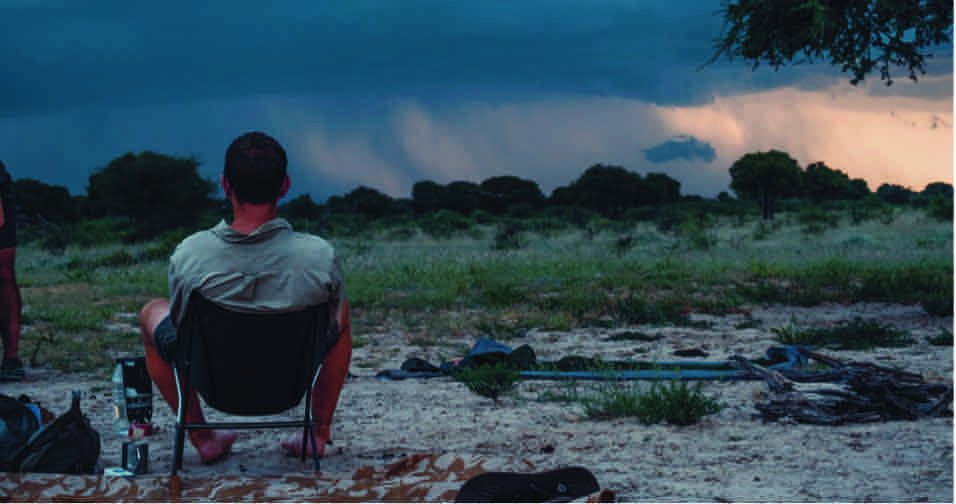
The trails are led by expert Trails Guides, and participants spend a minimum of three self-sufficient nights in the wild. By carrying all your food and equipment on your back, you enter a world only accessible to a privileged few. Groups set their own pace and explore according to their interests and capabilities. There are no demarcated campsites or routes. Each night is spent at a pristine location under the stars (no tents), with participants sharing the responsibility of ‘watch duty’.

In the distance, a herd of gemsbok gracefully moves across our path as the calls of southern pied babblers fill the air. Their frantic energy adds to the sense of adventure and excitement that surrounds us. The deep red sands of the Kalahari shift beneath our feet as we follow the oversized tracks of two black maned lions.
To say that the landscape is flat would be an understatement. Of the nine kilometres we would cover that day, our total elevation gained was a modest six meters. At least four of those were spent moving out of Kgatlewa Pan, a large circular depression with a flat bottom. These endorheic pans are a characteristic feature of the southern Kalahari. Their centres are covered with short grass and their white calcrete edges are dominated by dwarf, non-fragrant shrubs. Springbok, gemsbok and blue wildebeest are ever present, but as long as seasonal surface water persists, these scattered pans put on a brilliant wildlife spectacle. The rapidly evaporating pools of rainwater that collect in the pans attract animals such as eland, red hartebeest, zebra, buffalo, black rhino, white rhino and a range of predators such as African wild dog, cheetah, leopard and the infamous Kalahari black maned lion.
During some of our nights spent out on these pans, we have also had the pleasure of interacting with bat-eared fox and brown hyena. Such is the backdrop of the ‘Kalahari Primitive Trail’, an experience that was launched by Lowveld Trails Company at the beginning of April this year.
“Our new destination is not just about offering an adventurous experience, but also about helping participants to connect with nature, find meaning, and enhance their overall well-being,” said Wayne te Brake, one LTC’s founders. “We believe that unsupported time spent in the wilderness is a powerful tool for promoting mental and physical strength, and our new destination has been specifically selected to provide visitors with an opportunity to experience these benefits first-hand.”
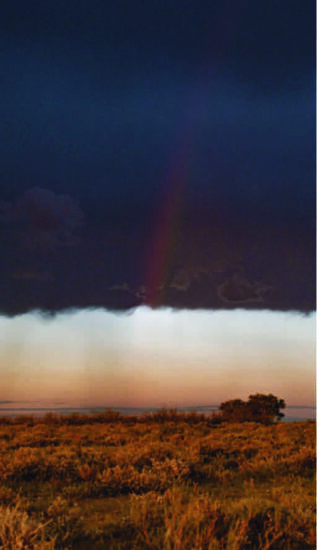
The Kalahari Primitive Trail takes place in a remote part of North-West Province. Here, the vegetation community is classified as Molopo Bushveld, named after the Molopo River, which is the northern boundary of the reserve, and the international boundary between South Africa and Botswana. Only eight tree species occur here, of which the mighty camel thorn, Vachellia erioloba, and the shady shepard’s tree, Boscia albitrunca (locally known as Motopi), are two of the most common. It should therefore not be surprising that the Kalahari has the lowest tree species to area ratio in southern Africa. Nevertheless, this particular vegetation community has a stronger grass component than other parts of the Kalahari.
There has been no evidence of permanent flowing water in the southern Kalahari for the past 12 000 years. In fact, the region couldn’t be settled permanently before the 1940’s, at which stage the technology became available to extract water from below the 200-meter-deep sand sheets.
Nevertheless, the Molopo River holds seasonal water that would historically (before boundary fences and farming) have created a meandering lifeline and corridor into the otherwise dry eastern Kalahari Bushveld Region. It is along this course that larger, more water dependent mammals such as rhino, elephant and Cape buffalo would have seasonally migrated into the area where the reserve exists today. Evidence of their historic distribution and the fact that the vegetation community can still support them, have been the motivating factors for their reintroduction into this, the largest privately owned reserve in South Africa (95 000 ha).
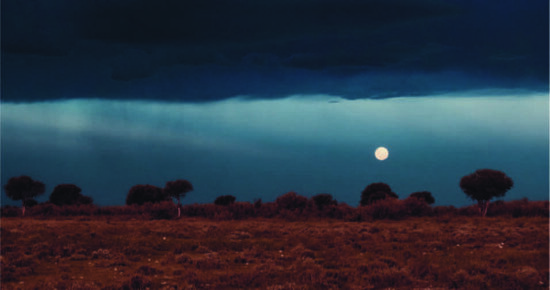
One of the most attractive things about the area is that it holds strong intrinsic wilderness qualities such as isolation, quietude and a strong ‘sense-of-place’. At night, the silence is deafening, and there is no sign of light pollution along the flat, panoramic horizon. “We believe that the intrinsic wilderness qualities of the area make it an exceptional destination for anyone who has grown bored of areas where man and his own works dominate the landscape,” said Brenden Pienaar, another LTC’s founders. It is evident that this area is unique, raw, and remote offering an unparalleled sense of freedom.
The Kalahari is a land of extremes, with hot summer days and cold winter nights. That is why the Kalahari Primitive Trail season is limited to only sixteen trail departures during the ‘Goldilocks’ months – April and May. The short trail season also aligns with LTC’s ‘leave-no-trace’ policy, which allows the environment to recover from an already negligible and nomadic impact. Their expert Trails Guides promote a culture of consideration and care for the environment and the self. “We’ve put a lot of effort into creating a unique experience that allows visitors to fully immerse themselves in nature and challenge themselves in new ways,” said Leighton Barnard the Senior Trails Guide.
Based on the quality of their Trails Guides, the backdrop of a globally iconic landscape and limited seasonal supply, LTC’s ‘Kalahari Primitive Trail’ experience may well have positioned itself as the country’s first premium primitive trail. It is an opportunity to disconnect from the modern world and rewild yourself in the land of great thirst, where every step brings the promise of discovery and the unexpected.
Bookings for April and May 2024 opens on 1 June 2023. Contact reservations@lowveldtrails.co.za to book your spot on this adventure.