As the nights grow warmer, new regions of the heavens drift into view, offering us a chance to meet some of our closest and most spectacular galactic neighbours.
Today, most of us accept without question that we share the universe with trillions of galaxies. But not long ago, that idea was unimaginable. When many of our grandparents were born, the Milky Way was thought to be the entire universe. Science and technology have since leapt forward at astonishing speed, peeling back the darkness and revealing a vast, star-studded cosmos beyond anything early astronomers could have dreamed of.
Less than a century ago, in 1924, Edwin Hubble turned his telescope toward a hazy patch of light known then as the Andromeda Nebula. Using methods developed by the brilliant Henrietta Leavitt, he discovered that this cloud was far too distant to belong to the Milky Way. It had to be a separate galaxy altogether. His revelation on 30th December 1924 changed everything – expanding our universe from a single island of stars to a sea of countless others.
A hundred years later, we’ve catalogued and photographed thousands of galaxies – and some of the most breathtaking are visible even through binoculars or small telescopes. Here are five worth hunting down this summer.
The Andromeda Galaxy (2.5 million light years away)
A faint, misty smudge to the naked eye in the constellation Andromeda, this is the closest major galaxy to our own – and the most distant object visible without optical aid. Andromeda is a grand spiral, home to over a trillion stars, and it dwarfs the Milky Way in both size and splendour. Through binoculars, you can pick out its bright central core. With a telescope – or a long-exposure photograph – its graceful arms unfurl across the sky, spanning six times the width of a full moon. Our two galaxies are linked by gravity and destined to collide in about four billion years, merging in a slow, swirling dance that will end in a single, giant elliptical galaxy.
The Magellanic Clouds (170,000 – 190,000 light years away)
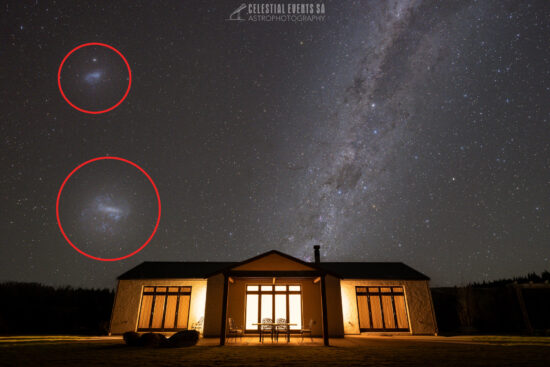
The southern skies boast two galaxies easily visible to the naked eye – the Large and Small Magellanic Clouds. Named after the explorer Ferdinand Magellan, who documented them in 1520, they have long inspired stories in southern Africa. Some saw them as smoke from the pipes of celestial hunters; others as the fading embers of campfires where the hunters cooked their prey. Modern astronomy has revealed them to be dwarf galaxies orbiting our own. In time, the massive gravity of our own galaxy may pull them so close that the Milky Way absorbs them completely.
The Silver Coin Galaxy (10 million light years away)
In the constellation Sculptor lies one of the brightest galaxies visible from Earth – the Silver Coin. Seen edge-on, it appears as a soft white streak across the dark, like a coin glinting in the night. Its brilliance is the legacy of a cosmic collision some 200 million years ago, which ignited a frenzy of star formation. Though we view it from the side, the Silver Coin is thought to be roughly the same size and shape as our Milky Way.
The Triangulum Galaxy (2,8 million light years away)
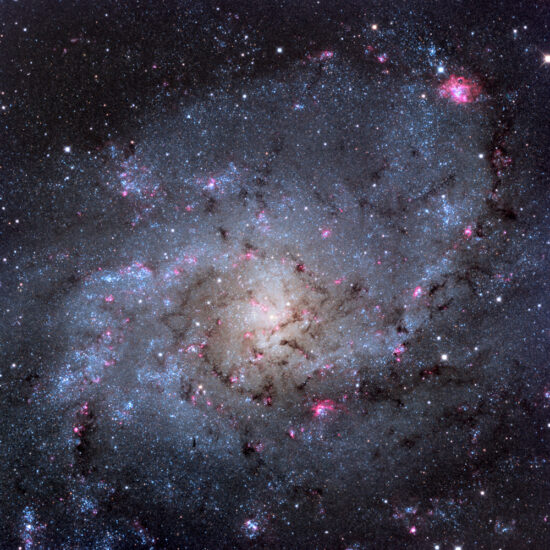
Though often overshadowed by its famous neighbour Andromeda, the Triangulum Galaxy is another member of our local group. Under exceptionally dark skies, it can be glimpsed without aid – a faint spiral nearly three million light years away. Through a small telescope, its delicate arms begin to emerge, revealing a galaxy about half the size of our own.
Galaxies aren’t easy quarry for backyard astronomers, but these five offer a glimpse into the vastness that surrounds us. Each faint blur you see in the eyepiece holds tens – even hundreds – of billions of suns, each likely with its own family of worlds and moons, and who knows what else…
So next time you look up, take a moment to remember – every faint smudge, every patch of light, is a vast island of suns. The night sky isn’t empty; it’s overflowing with galaxies, each holding untold stories written in starlight.