
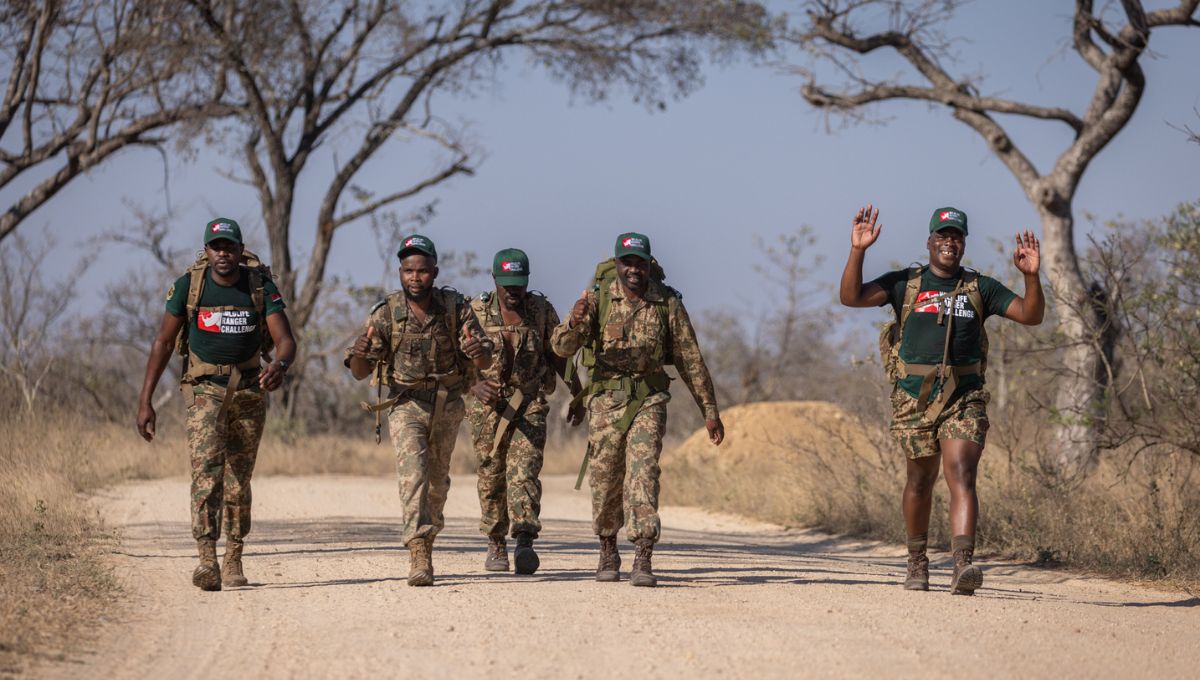
Wildlife rangers operate on the very frontline of conservation across Africa, routinely making personal sacrifices to put their lives on the line to protect the continent’s wildlife and habitats.
Wildlife rangers are not just law enforcement officers, they are teachers, community support workers, mediators, researchers and so much more. Unfortunately, resources are not keeping pace with the scale of the challenges they face every minute of every day.
For the fourth year running, the Wildlife Ranger Challenge (WRC) sets out to redress this, by raising critical funding to cover operational costs, including salaries and equipment, for over 10 000 rangers. These rangers protect threatened wildlife, and some of the continent’s most vulnerable areas, while also protecting communities and securing wildlife/human coexistence.
The WRC is the world’s largest celebration of solidarity, support and fundraising for the ranger profession. Initiated by NGO Tusk Trust in response to the Covid-19 pandemic in 2020 (the goal was to keep wildlife rangers employed through the crisis), the WRC has grown into an annual celebration of connection and camaraderie for the ranger profession. It also connects rangers and supporters. The global campaign #ForWildlifeRangers has created a united front for conservation, driving donations to secure vital funding and connecting virtual race participants around the world to run in tandem with Africa’s biodiversity guardians.
Together with the Game Rangers of Association of Africa (GRAA), and with the support of the Scheinberg Relief Fund, the WRC highlights the role of rangers and the work they do, often in hazardous conditions, and with low pay and few benefits. It brings together over 100 ranger teams across more than 20 African countries, who run the WRC in support of one another.
Prior to World Ranger Day on Monday 31st July 2023, the teams of rangers across Africa started gearing up for this the fourth annual Wildlife Ranger Challenge. This multi-million fundraising initiative features a series of fitness challenges and culminates with a 21km (half-marathon) race.
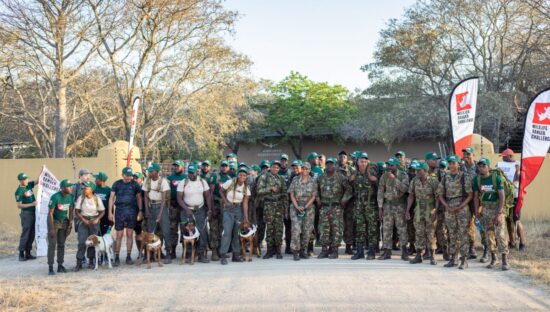
This year, the Southern African Wildlife College (SAWC), who has entered a ranger team from the inaugural WRC in 2020, hosted seven official teams on race day, five of them from the Kruger National Park. The teams were the Kruger National Park (KNP) Special Rangers, KNP Marula South, KNP Marula North, KNP Xanatsene South, KNP Xanatsene North, Southern African Wildlife College and the Black Mambas.
Setting off at 06h30, the SAWC’s airwing and its K9 team ensured the safety of the participating teams, as did the support vehicles. Each team comprised four runners, with the men in the team carrying 22 kg and the woman 10 kg of previously weighed rice, in their backpacks. Joining them in solidarity were four unofficial teams running without backpacks. These included a Community Team representing the Kruger Park Running Club, a Southern African Wildlife College staff team, a Sabi Sand Wildtuin team, and a team comprising the Braveheart course leader with three of the course participants. The route took the runners around the college campus located just south of the Kruger Park’s Orpen Gate.
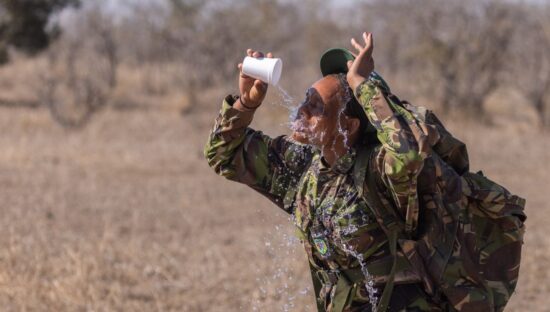
Under tough conditions and in the blistering heat, the first official team that came in as a collective was the team from the Southern African Wildlife College comprising Clive Ngomane, Tebogo Malapane, Excellent Ubisi and Precious Malapane.
More about the organisations involved
The SAWC was established in 1996 and is based near the Kruger National Park in South Africa. It is a regional non-profit, public benefit organization, aimed at promoting thought, leadership, and empowering people to manage and conserve some of the world’s most biologically diverse areas. It uses an applied learning methodology to deliver conservation education, training, and skills development programs both on site and across the region. The college provides tomorrow’s conservation leaders and practitioners, including natural resource managers, field rangers, guides, wildlife monitors and the community, with the skills needed to become partners in the drive to conserving our natural heritage responsibly and inclusively.
For more than 30 years, Tusk has worked to accelerate the impact of African-driven conservation. Since its formation, Tusk has boosted an impressive range of successful conservation projects across more than 20 countries. These initiatives have increased vital protection for more than 40 different threatened species, and have also contributed to poverty reduction through sustainable development and education amongst rural communities living alongside wildlife. Tusk partners with the most effective local organisations, investing in their in-depth knowledge and expertise. By supporting and nurturing their conservation programmes, Tusk helps to accelerate growth from an innovative idea to a scalable solution. The charity, which has Prince William as its Royal Patron, has invested over $100m into African conservation since its founding in 1990.
Founded in 1970, the GRAA is a non-profit organisation and the oldest, largest, and most representative ranger association in Africa. As an organisational partner of the WRC, the GRAA plays a critical role in building networks of wildlife rangers, advocating for their interests, and providing expert guidance on ranger-related issues.
The Scheinberg Relief Fund is the founding donor of the Wildlife Ranger Challenge. It was established by businessman and philanthropist Mark Scheinberg, and his family, in response to the Covid-19 pandemic. Its mission is to provide meaningful difference with strategic, high impact relief for individuals and communities in locations where the family has a personal or business presence. The fund works closely with a network of trusted partners in key locations across the globe, to identify local organisations, social benefit projects, charities, and communities on the ground that have limited visibility.
For more information go to https://wildliferangerchallenge.org/ – you can also see a google map for areas where all the rangers across Africa are running, and for any other information, contact Jeanné Poultney on email jpoultney@sawc.org.za


