
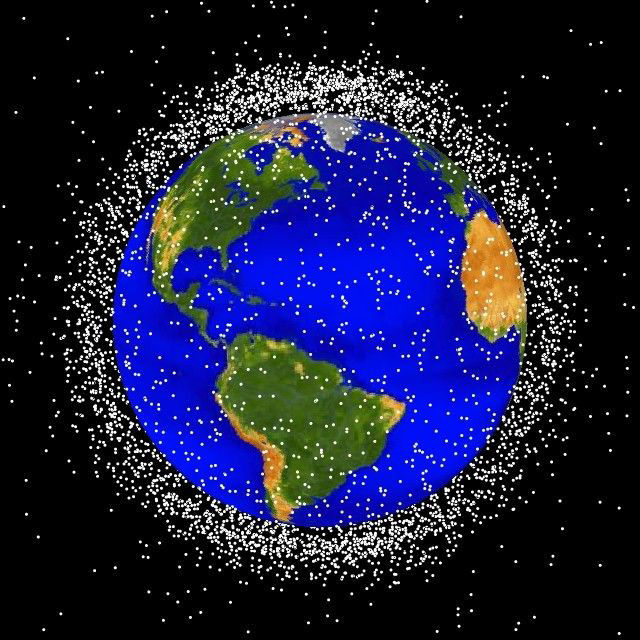
Traditionally, conservation concerns and practices have focused on terrestrial issues. We are all well aware of the plight of many species, great and small, due to human activities such as pollution, urbanisation, industry and a general lack of ethical consideration. However, as our technology evolves, the human race’s influence is expanding well beyond the classic biosphere of the Earth.
The first satellite, Sputnik 1, left the Earth’s atmosphere on 4th of October 1957. In the 70 years since it launch, mankind has slowly added to this once monumental achievement, by populating Earth’s orbit with thousands of satellites, their uses as varied as their form. Currently, there are in excess of 9 000 satellites circling the Earth, performing all manner of tasks from monitoring weather and climatic conditions, facilitating communications, to aiding in navigational systems.
Some of the most famous examples, many of which are visible from Earth as pin-pricks of light moving across the sky, include old rocket boosters, the Iridium Constellation (responsible for satellite phone communications), the Hubble, and other space telescopes, the International Space Station, and of course, the ever-growing number of SpaceX ‘Starlink’ satellites, intended to provide worldwide internet coverage.
While it is an unavoidable reality of modern day life, the continuing launches and growing number of man-made objects in low Earth orbit comes at a price. Not only do they play havoc with research telescopes and cameras, but satellites do not live forever, and once defunct, they can become a liability for current and future space ventures.
Objects in low Earth orbit are circling our planet at around 30 000 km/h. That is close to ten times faster than a typical bullet! At this speed, even a tiny object can become a lethal projectile, capable of causing catastrophic damage to anything in its path. As our orbit becomes more congested, the risk becomes more palpable, and incidents are on the inevitable increase.
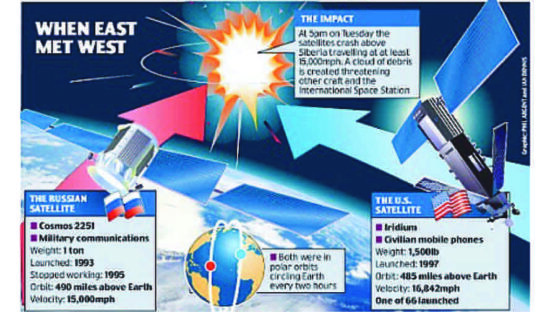
In 2009, two communication satellites, one from the United Staes and one from Russia, accidently collided with each other travelling at an otherworldly 42 000 km/h! The impact destroyed both bodies, turning the two objects into a mass of over 2 000 fragments of potentially lethal debris.
In 2021, the Russians tested the capabilities of their anti-satellite defence system by destroying an old satellite with a guided missile. The test was successful, but its aftermath created a debris field of hundreds of thousands of hypervelocity projectiles, orbiting the planet every 90 minutes! A few months later, the International Space Station was forced to take evasive action to avoid this debris cloud, with authorities ordering the onboard astronauts to shelter in their docked spaceship, in case the hull was damaged and a quick escape was necessary.
Only days ago, the ISS had to fire its thrusters in order to change its position to avoid a rogue satellite in a decaying orbit. Since 1999, thirty two evasive manoeuvres have had to be performed in response to potential collisions. As the number of orbital objects increases, the likelihood of a catastrophic event also multiples.
Perhaps the deadliest scenario is known as the Kessler Syndrome. This hypothesises the very real probability, that multiple collisions set off a chain reaction of events, that will ultimately render vast swathes of Earth’s orbit unusable. Any of you that have watched the movie ‘Gravity’, will have witnessed the worst case scenario, as their shuttle is completely destroyed by space junk hurtling along their orbit like a barrage of supersonic artillery shells.
In lieu of this threat, the United States Department of Defence tracks over 27 000 items over four inches in size, keeping a careful eye on their trajectories! Currently, there are estimated to be in excess of 100 million objects over one millimetre in size racing around the globe every 90 minutes or so! Whilst this size may sound insignificant, this is more than capable than chipping the reinforced window of a space shuttle or space station. Remember the words of Dalai Lama … “If you think you are too small to make a difference, try sleeping with a mosquito”.
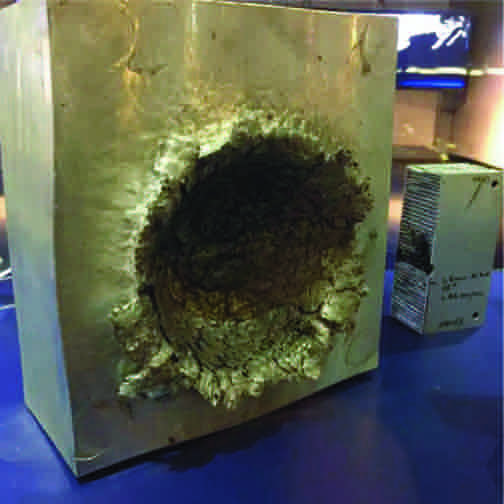
The following photograph is a simulation of a what happens to a block of aluminium when hit at orbital speed by an object the size of a pea!
The problem then is simple. If we do not make a effort to alleviate and caution against this new world threat, vast tracts of our orbit will become unusable. Unfortunately, mankind’s history in utilising resources sustainably is not good, and as we continue to cast our net of influence wider into the surrounding neighbourhood, it is imperative that we protect it. Some of these objects will slowly fall towards our upper atmosphere and burn up, but this can take years, and is hardly a proactive measure. There is hope however, that we have learned from our previous mistakes, and that we can pre-empt these problems before they become too great to alleviate.
Such is severity of this issue, NASA and many other organisations, governments and scientists have called for an international treaty, to protect the sanctity of the space above our planet in order to safeguard future space missions, and continue to enjoy the current benefits we receive from today’s satellites, be they related to health, communications, security, information or the economy. Whether or not an official accord will be reached remains to be seen, but it is heartening to know that proposals are being made and hopefully step will being taken.
In addition to these bureaucratic proposals, various companies are experimenting with innovative new technologies to combat the current problem. JAXA, the Japanese Space Agency, is testing a space whip that is designed to grab objects from orbit. Other proposals include nets, magnets and even harpoons, as well as small crafts that can grab pieces and relocate them to safer or decaying orbits.

If we have learned anything from the past few centuries, it is that humans make a mess, and just because space is large and uninhabited, it is no reason for nonchalance. Out of sight should not be out of mind, and for the first time in our history, the conservation of space can be implemented before the situation becomes dire. Space is our next frontier, and respecting the narrow band above our atmosphere is vital for our future technology, endeavours and exploration.
See Celestial Events SA advert for contact details


