Since the dawn of mankind, we have wondered if we are alone. According to scientific estimates, the Universe contains more than a septillion planets (that’s 1 followed by 24 zeros!!). Surely, somewhere in this seemingly infinite darkness, other life might exist.
If this claim is indeed true, why have we not encountered evidence? Where are the aliens, the UFO’s, the radio signals or visitations from curious interstellar travellers? But we have only been searching for less than a century and have explored maybe 10 celestial bodies in our immediate celestial neighbourhood. This is the equivalent of scooping a cup of water from the ocean and being surprised to not find a fish!
In the past few weeks, news has arisen that could constitute the first plausible evidence of biosignatures on another world. Before we delve into the specifics, it should be noted that this is not necessarily the ‘smoking gun’ we are searching for, but perhaps more of a lukewarm prehistoric spear.
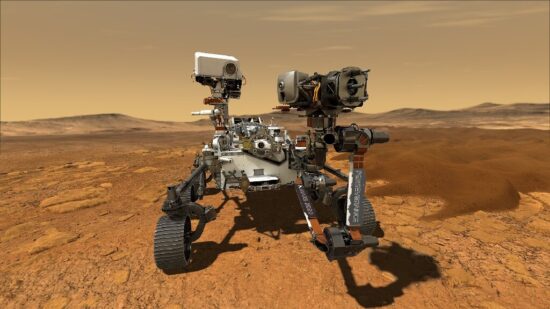
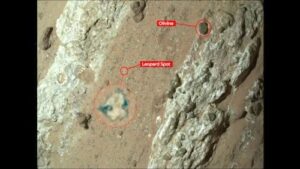
Similar deposits can be found on Earth and are the result of biological activity. Tiny microbes can cluster on rocks and feed on elements like iron and manganese. As they do, they leave behind chemical by-products that stain the rock. Over time, these stains fossilise, preserving a kind of chemical fingerprint of biological activity. The Martian leopard spots might represent exactly that – not the microbes themselves, but their primordial signatures.
It should be noted that there are non-biological explanations for these markings, but these should be accompanied by additional evidence, none of which seem to be present in these Martian rocks. Of course, the only way to know for sure is for the samples to be returned to Earth and scrutinised. ‘Percy’ has been depositing capsules of rocks and soil to be collected and returned during future missions, but with the recently proposed budget cuts to NASA, these sample-return missions are now looking less likely.
Interest in the potential biological history of Mars has been around for decades. We are convinced that Mars once had a substantial atmosphere with liquid water on its surface. Over millennia, this protective cloak has been stripped away by the unrelenting solar wind, leaving an environment incapable of housing liquid water on its surface. But radar imaging suggests the presence of underground aquifers, and water ice abounds in the colder polar regions. In fact, Mars hosts enough ice, that if melted, would cover the entire planet in an ocean 50 metres deep.
Equally compelling is the discovery of methane emissions in its atmosphere. Methane gas is quickly destroyed by UV light from the Sun, so some process must be continually restocking it on Mars. On Earth, methane is produced either as a byproduct of anaerobic microbial life, or geological activity. Whilst the latter is far more plausible, there is still the chance that primitive organisms survive under the Martian surface, away from the damaging solar radiation, particularly since some studies have suggested that the methane peaks during the warmer summer months.
Carl Sagan, the late, great, American astronomer once poignantly stated that “… the Universe is a pretty big place, so if it is just us, it’s an awful waste of space…” Maybe, just maybe, these innocuous markings are in fact the chemical fingerprints left by ancient microbes – silent messages from a world that once teemed with biological possibilities.
While Mars’s ‘leopard spots’ are not yet indisputable proof of life, their discovery keeps alive the hope that we are edging closer to answering the most profound questions ever posed: are we alone in the Universe?
See Celestial Events SA advert for contact details.