The SELATI Martial Eagle project was launched in July and we are raising funds to acquire and set up specialized camera recording equipment to monitor a breeding pair in real-time and also to protect their nesting site on Selati Game Reserve.
It is believed that this will be the first time a pair of breeding Martial eagles will be recorded in a non-invasive way.
The current nest on the 28,000Ha Selati Game Reserve, situated in the Limpopo Province of South Africa, offers an excellent opportunity to document and research the breeding biology of this, Africa’s largest eagle.
This Martial Eagle pair has successfully bred on Selati for several years and the purpose of placing a real-time camera at the nest is to document their breeding biology including, behaviour, incubation, chick development and fledging, prey selection, and post-fledging dependence on the nest. Incidental nest observations have been recorded previously but thorough documentation of a breeding cycle from nest reconstruction to post-fledging has not been undertaken anywhere.
A significant advantage of the technology to be used to collect images is that there will be no disturbance at the nest during the breeding/fledging period. All images are collected by the camera controlled by a Raspberry Pi computer programmed to send the images remotely by Wi-Fi. This camera will be powered by a solar-charged battery which will not need to be visited for the duration of the breeding event. The nest is vulnerable to predation even though it is 24m up in a Knob-thorn tree. It will be necessary to protect the solar panels, battery, and computer equipment from possible damage by inquisitive elephants, rhinoceros, buffalo, lions, and the chick from leopards. To prevent this, a perimeter electric fence around the tree is envisaged.
Christiaan Brink, Raptor and Large Terrestrial Bird Project Manager at BirdLife South Africa said, “BirdLife South Africa welcomes the Selati Wilderness Foundation’s plans to install a live-streaming camera on a Martial Eagle nest on their reserve. This project will help create awareness for the conservation plight of one of Africa’s most iconic eagles.
“The Martial Eagle population is declining rapidly throughout its range in Africa and is now classified as endangered”.
Given the recent up-listing of Martial Eagles to Endangered, there is an urgent need for well-informed and effective conservation action. The proposed camera can assist in this by providing the opportunity to gain new insights into the breeding biology and general ecology of this species.”
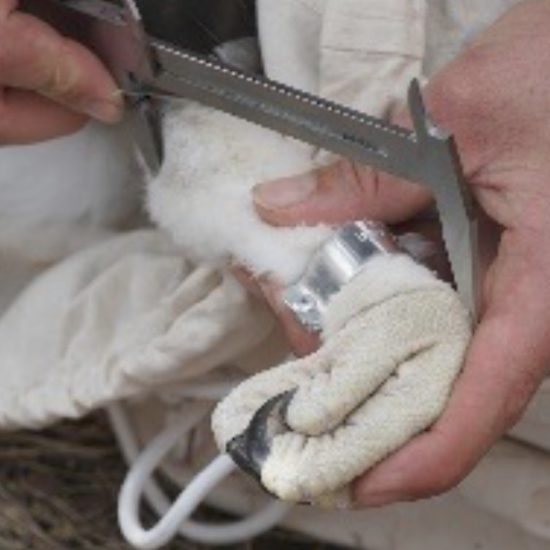
The Martial Eagle, Polemaetus bellicosus, is a large powerful eagle (78-83 cm) and weighing 3.3 to 4.7 kg with the females being considerably larger than the males. Martial Eagles can easily be identified by their dark backs, throat neck and head, contrasting with the white underbelly which is spotted. The largest eagle in Africa, they occur throughout sub-Saharan Africa excluding the lowland forests of West Africa. Although they may be encountered anywhere in South Africa they are more frequently found in protected areas, especially the Transvaal Lowveld and the Kgalagadi Transfrontier Park. Outside protected areas, their territory sizes can vary between 300 and 1000 sq. km. while In Kenya there have been territories as large as 130km sq recorded. Although research by Tarboton and Allan in 1984 suggested that there might be about 1000 mature individuals in Gauteng ( formerly Transvaal) with 137 pairs in the Kruger National Park, the current numbers are considerably less.
A 2012 survey by Murn et.al. (2012), estimated a breeding population of 110 mature individuals in the Kruger National Park based on an aerial survey of nests, a decrease of at least 50%.
The Swaziland population has dropped from 40 mature pairs in 2011 to 14 mature individuals in 2008, this decrease is attributed to habitat and land-use change as well as persecution. Martial Eagles have disappeared from much of their former range and are now categorized as “endangered” in southern Africa.
The images collected will be analysed and interpreted by specialists. In addition, the environmental students visiting the Eco-training centre on the Selati reserve will be able to study the images during their training. The results of the research will be made available through the Selati Wilderness Foundation NPC social media sites.
For more information on how you can donate, contact Lindsey Jones076 314 6842