How Farm Watch’s Unified Force Held Hoedspruit Together
Hoedspruit has always lived in a delicate balance with water. The rivers that sustain our farms, wildlife and livelihoods can, in a heartbeat, become forces of destruction. Over the past two weeks, that balance tipped violently.
From Thursday, 8 January, relentless rains pounded the Lowveld. By the second weekend, the Blyde, Zandspruit, Klaserie and Oliphants rivers had burst their banks, roads disappeared beneath swirling brown water, bridges failed, and entire pockets of our region were cut off from the outside world.
For many, it was the worst flooding since 2012. And yet, in the chaos, something remarkable happened. Hoedspruit did not descend into panic. It organised. It mobilised. It responded.
At the centre of that response stood Farm Watch – our crime-fighting and security body, but also a fully-fledged community disaster response unit. Tested under extreme pressure, Farm Watch’s newly unified structure proved its worth not on paper, but in mud, rain, darkness and danger.
This is the story of how a volunteer organisation became the backbone of Hoedspruit’s flood response – when time, weather and circumstance gave no second chances
From Safety to Survival: A System Built for Crisis
Just over two years ago, Hoedspruit’s two principal safety organisations – Farm Watch and Town Watch – merged under one umbrella: Farm Watch. The intention was simple but ambitious: remove duplication, streamline communication, and create a single, powerful safety structure serving the town and rural surrounds alike.
Few could have imagined that within months, this new system would face its greatest trial – not in the form of crime, but nature.
The floods of January 2026 became the first true stress-test of Farm Watch’s unified model. And it passed with flying colours. What distinguished Hoedspruit from many other flood-affected towns was not luck, nor geography – but readiness.
While rainfall warnings were being issued elsewhere, Farm Watch volunteers were already monitoring river levels along the R527, at low bridges near Driehoek, the Blyde River crossings, farm access routes stretching towards Moria, The Oaks and the Air Force Base perimeter, and the R40 from Bushbuckridge to Phalaborwa. No access route was left to chance.
“This wasn’t coincidence,” one senior Farm Watch volunteer said later. “We remembered 2012. We didn’t wait for confirmation that it was serious – we assumed it would be.”
Before the Rivers Broke Their Banks
Looking back at the first night of the floods, one of the most important interventions came even before the rivers rose.
The Water Users Association (Water Gebruikers Vereniging Afrik.) which includes all the farmers linked to the pipeline system, had already raised the alarm. Johan Malan shared critical information about the volume of rain that was on the way and the risks that lay ahead. With his input, farmers acted proactively. Runoff channels were cleared. Dam outlets were opened. Infrastructure was prepared. And that early work mattered. It is the main reason why so many drifts (drainage lines), bridges and dam walls held. Because when one dam wall fails, it rarely fails alone – it breaks in a chain reaction. This time, that chain reaction was avoided.
Zandspuit Bridge: The First Major Test
By Tuesday afternoon, the situation was already deteriorating. At around two o’clock in the afternoon, the Zandspuit bridge began overflowing. The decision was made to close it immediately. That, it soon became clear, was only the beginning.
“By that evening the water was already nearly 1.6 metres deep – up to chest height.”
In the meantime, the Klaserie River started coming down with force. The next morning, rescue teams went in at the Klaserie Dam to evacuate people trapped with caravans, vehicles under water, and families stranded overnight in small houses and tents. Vehicles were switched off, placed in neutral, and towed through to prevent engines from ingesting water. Dozens of recoveries followed.
Zandspuit soon became a focal point, not because of the bridge itself, but because of the deteriorating condition of the R40 from Phalaborwa and Acornhoek. It was a matter of extreme urgency that something be done.
The call went out. Machines and equipment arrived courtesy of Mareul Aitchison, Johan Joubert, Fred Barnard and Koos Boshoff. A 20-ton excavator lifted tons of reeds that had jammed against the bridge and blocked the flow. Tar washed away on one side was repaired with gravel. Throughout this operation Sanral was there in support. When the bridge was reopened later that day (around 18:00), it stayed open – because the community had responded. That intervention prevented the bridge from being flooded again.


R40: Vehicles Washed Away
But even as the Zandspuit stabilised, the crisis shifted. On Wednesday evening, between seven and eight o’clock, reports came in that four vehicles had been washed off the R40 between Mica and Griekie. In some places, 170mm of rain had fallen in just two hours. Rescue teams reached people clinging to vehicle roofs. Ropes and harnesses were used in an extended, highly dangerous operation. Everyone was brought out safely. There were no fatalities.
Lodge on the Oliphants River: The Air Rescue
Then came the call from a lodge on the banks of the Oliphants River. Before midday, concerns were raised. Initially, the situation was not yet life-threatening. But by 21:00 that evening, Deidré Carter of Limpopo Agri requested urgent evacuation.
This is where the Air Force stepped in. Farm Watch received the call and relayed the message to the Air Force, who took the situation on immediately. Authorisation was given and the helicopter was airborne.
“Those pilots – they were incredible and fearless. We owe them.”
Flying at barely 100 feet, in very poor visibility, with low cloud and rain, the helicopter extracted 15 people from the lodge and dropped them at an accessible pickup point. For some families, those hours were agonising.
One family member later said she believed her parents had already been swept away downstream – they had not. Again, there was no loss of life.

Elsewhere: The Disaster Widens
On Essex Road, an elderly woman was swept away while trying to cross the floodwaters. Farm workers saw it happen, alerted Farm Watch, and she was rescued further downstream. She was admitted to Hoedspruit Private Hospital with a serious leg injury and is now recovering well.
By then, more than a hundred drifts (drainage lines) and bridges across the region had been washed away.
Even now, as this edition is released, the full extent of the damage is still being assessed. Roads remain closed. Infrastructure inspections are ongoing. Engineers are still determining which bridges can be repaired and which must be rebuilt from scratch. What is already clear, however, is that the final cost – in money, time and disruption – will run into many tens, if not hundreds, of millions of Rands.
If this flood has taught us anything, it is this: Proper planning prevents poor performance.
The early warnings from the Water Users Association, the pre-emptive clearing of runoff channels, and the rapid closure of vulnerable bridges were critical. But equally important was something far broader: Farm Watch is not a structure built only for floods. It is a permanent, standing system designed to react to any crisis, at any time.
Its patrols, reaction units, communications network and command structure exist every day – whether the threat is crime, fire, medical emergency or flood. In January, that permanent readiness meant the town did not have to invent a response in the middle of a disaster. It already had one.
Phalaborwa was without power and water for days. Shops were emptied. Fresh produce vanished from shelves. Water infrastructure was destroyed. Helicopters and boats ferried in personnel to restore services. In the reserves, a different crisis unfolded.
Roads were impassable. Lodges and staff were cut off. People isolated for ten days began trying to reach town for food and water – only to become stuck again. Every day, 15 to 20 vehicles were being winched out of the mud by Farm watch volunteers.

When Radios Saved a Life
Communications became critical. Contact Communications and Herotel kept networks alive throughout the crisis.
On Mariepskop, entire sections of road – 40 metres wide and 30 metres deep – had vanished. With Eskom unable to access the site, diesel had to be flown in by helicopter to keep the repeaters operating.
“If the radios had failed,” one responder said quietly, “that child would not be here today.”
Without the radios, lives would almost certainly have been lost. That was proven one night on an estate near Hoedspruit. At half past eight, a radio call came through: a child was not breathing. A father was performing CPR in a ditch, somewhere off an unmarked road, with no cell phone signal! Search teams fanned out. One vehicle found them – stranded where the road had collapsed. The three-year-old was taken immediately to medics, placed on oxygen, and rushed by ambulance to Hoedspruit Private Hospital. Three days later, the child was discharged. Fully recovered.
The Helicopters That Never Stopped
And overhead, the helicopters kept flying. From first light to dark, pilots ferried tourists out, food in, anti-poaching teams supplied, and isolated lodges sustained. Donovan de Wet, Gerry McDonald and Jana Meyer. Three names that appear again and again in this crisis.
Spar and Pick n Pay parcels were packed and distributed daily. Many flights were sponsored. Many pilots flew without certainty of payment. But everyone understood the same rule: Money later. Lives first.
In the beginning, tourists were flown out to dry ground. Later, food and medicine were flown in. Anti-poaching teams, carrying only two or three days’ supplies, were resupplied to keep the reserves protected. This was not a single operation. It was hundreds of coordinated acts of quiet courage.
Eyes on the Rivers, Boots in the Mud
As the rains intensified, Farm Watch activated every layer of its structure. Patrol units moved into disaster surveillance. Stopper groups erected rapid roadblocks. Reaction Unit members deployed into washed-out zones. And when cell phone networks failed, Farm Watch’s radio system became the town’s nervous system.
Volunteers pulled vehicles from flooded roads. Guided motorists away from deadly currents. Ferried food to marooned families. Cleared fallen trees. Drained flooded homes. Hauled bakkies from mud with tractors and bulldozers. This was not improvisation. It was a trained system in motion.
What Made Farm Watch Work
Farm Watch succeeded because it is built on seven interlocking pillars: Membership and Community Integration, Patrol Groups, Stopper Groups, Reaction Unit, Intelligence Unit, Camera Monitoring Network and Farm Watch Support Unit.
Overlay this with specialist groups – air support pilots, canine handlers, fire units, responder support teams – and you begin to understand why Farm Watch could step into roles usually reserved for formal disaster agencies.
But note this carefully: they did not replace government support or intervention. They bridged the gap before government could arrive.
A Town Held Together by Volunteers
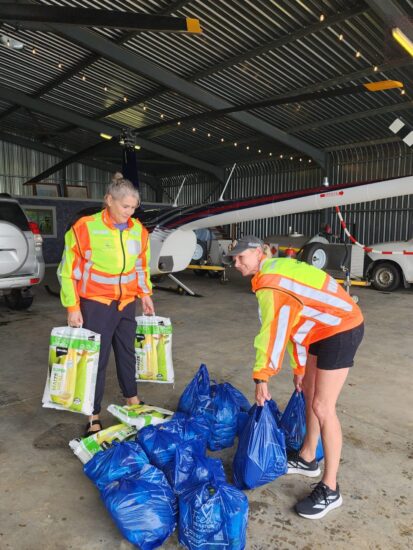
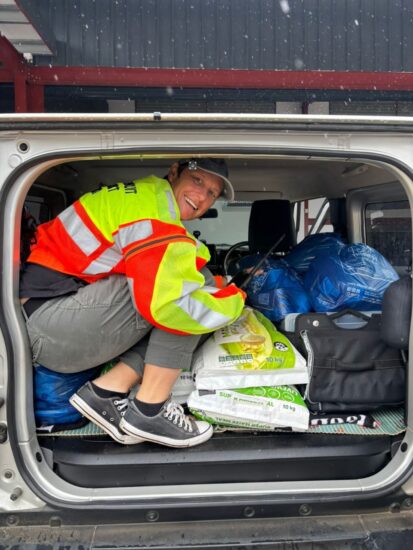
Every person involved through Farm Watch was unpaid. Every kilometre driven was fuel and time “donated” by every volunteer themselves. Heavy vehicles were immediately mobilised with only fuel sponsored. Every hour worked by the volunteers was taken from families, sleep and comfort. And yet there were no complaints. Amazingly only smiles and resolve.
At 03:00, ankle-deep in mud, one exhausted volunteer said:
“If this was your house, you’d want someone here too.”
After the Flood: Why Farm Watch Now Needs Us
Hoedspruit Farm Watch stood for us when the rivers rose. Now, they need us to stand for them. The floods placed extraordinary demands on this voluntary organisation. Vehicles were damaged. Equipment strained. Fuel reserves depleted. Medical kits emptied. Radios worn down. Protective gear destroyed. Some equipment lost.
Farm Watch receives no state funding. It survives on volunteers, membership and community support. And yet it is this very organisation that saved lives, possibly yours, prevented serious injuries, preserved infrastructure, maintained order during chaos, and delivered humanitarian relief when formal systems were overwhelmed.
“We cannot allow such a structure to weaken after proving its value so powerfully.”
How You Can Help
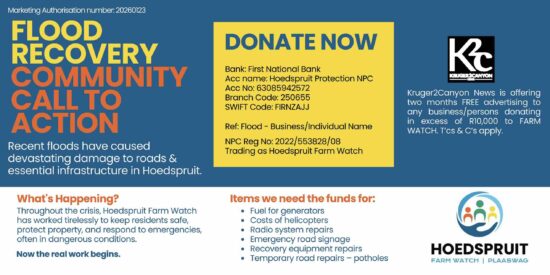
There are many ways to help – but right now, after this massive operation, financial support is critical.
- Donate Financially. Here are indications of some costs that have had to be covered:
- R1,000 restocks first-aid and rescue kits
- R2,500 refuels a TLB (a tractor-loader-backhoe)
- R5,000 services critical radio and recovery equipment
- R10,000 covers one helicopter flight
- Volunteer Your Time or Skills
Patrollers, camera monitors, medics, mechanics, cooks, pilots, tractor owners, administrators.
- Contribute Equipment or Services
Recovery gear, radios, generators, lighting, fuel, protective clothing, IT support.
- Become a Member
Ongoing monthly support is the backbone of Farm Watch’s sustainability. Farm Watch is not only a safety organisation. It is Hoedspruit’s emergency spine. Without it, this town would not have coped the way it did.
So, let’s make this a community effort. Everyone join. Everyone benefits. Everyone helps hold the line when the rivers rise.
“We are forever indebted to Farm Watch. Thank you!”