
Honeybees have complex social structures and behaviours. The colony is comprised of three distinct castes of bees: each responsible for performing specific functions within the colony. First, there is the queen bee, she is larger than the other bees and her sole function is to lay eggs for the colony. Next, we have the worker bees, which are all female. The worker bees form the bulk of the colony, are equipped with a stinger, and perform several different tasks within the hive. These tasks include packing nectar and pollen into the cells, cleaning, feeding the brood, building the wax combs, guarding the hive, water collection, and foraging for pollen and nectar. Lastly, there are the drones, which are the males and are stingless. Their sole focus is to mate with the queen during her nuptial/mating flights
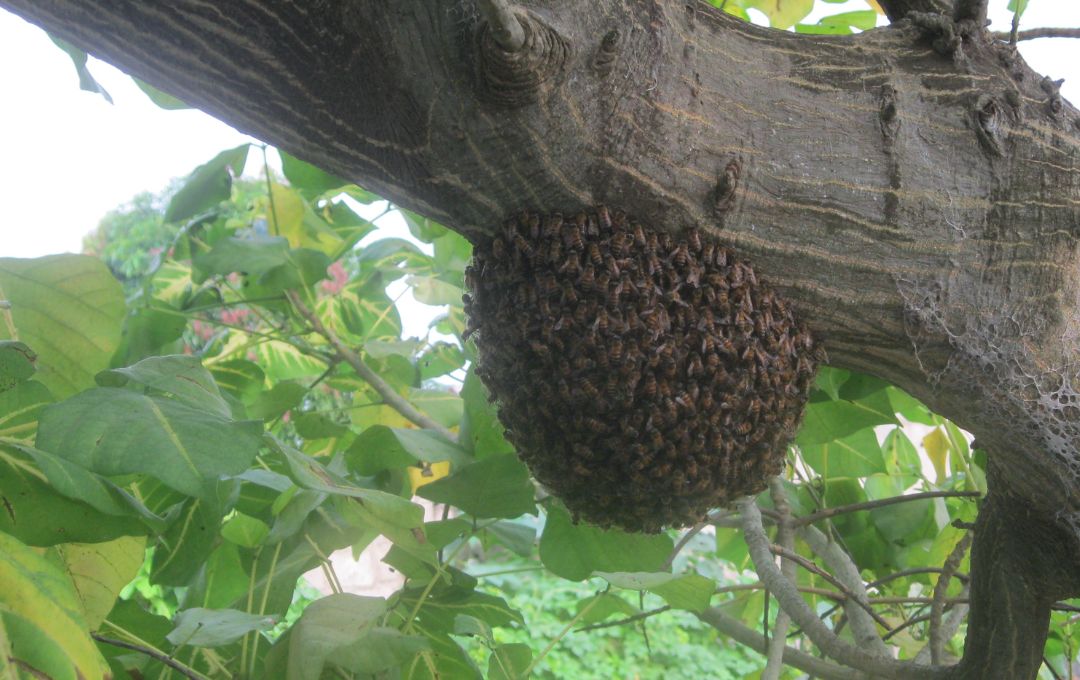
September is the start of the main swarming season in South Africa. Swarming behaviour is part of the natural reproductive cycle of honeybee colonies. When a colony becomes overcrowded the original queen will depart the hive with the intention of establishing a new colony elsewhere. As many as two thirds of the worker bees may leave with her. They will usually exit the hive as a ‘cloud of bees ‘.
They will then typically go and settle in a tree or on a fence post fairly close to the original colony, forming a protective clump around the queen. At this point scout bees will fly off in search of a suitable location to establish the new colony. Once they find a potential location they return to the swarm and perform a ‘waggle dance’ in an attempt to convince other scout bees to investigate the new location. By performing the ‘waggle dance’ the scouts are able to communicate to the other bees both the direction and distance to the new hive location.
Swarming bees are usually not aggressive or defensive as they don’t have a hive to protect. If you do find a swarm that has settled on your property, just give them space and keep pets away and they should move off after a few days. If you have concerns that they may establish a hive close to your home, then call a beekeeper that can safely capture and relocate the swarm.
Bee safety
African honeybees are generally speaking, considered more defensive than other honeybee species. It is important to note however that some colonies may be more, or less aggressive than others. Below are a few helpful pointers regarding bee safety and awareness.
When partaking in outdoors activities such as hiking or fishing, pay close attention to your surroundings and listen for any distinct buzzing sounds. Stay away from any bee hives that you may encounter. Avoid applying strongly scented perfumes and wear light coloured clothing.
Be careful when using machinery such as chainsaws, weed-eaters, tractors, generators and lawnmowers. The noise, vibrations and smells produced by these pieces of equipment are well known to aggravate bees
If you un-expectedly disturb a colony immediately distance yourself from the hive, do not swat at any bees that maybe flying around you. The movement can aggravate the bees and crushed bees emit a pheromone that will attract other bees.
If you are attacked, quickly run away; try to protect the sensitive areas around your eyes, mouth, nose and ears by pulling your shirt or jacket over your head. If possible, run to the nearest shelter such as a building or car. If there is no shelter available running through thick bush may help to disorientate and disengage at least some of the attacking bees. Do not jump into water, the bees will hover above the water and wait for you to surface.
Bees have a barbed stinger and when they sting the stinger, a venom sac and a nerve ganglion are left behind, embedded in the skin. It is important to remove the stinger as soon as possible, as venom will continue to enter the wound for a period after the sting. Avoid using tweezers or your fingers to remove the stinger. Rather make use of a straight edge such as a credit card, blunt knife or your fingernail to scrap the stinger out. If you are allergic to bee stings consult with your doctor immediately, and they will be able to advise you on any first aid measures you can implement.
For more information on venomous animals, awareness training and talks, as well as a professional 24hrs problem snake rescue service, contact the author at Wildlife Safety Solutions: 073 934 6156; info@wildlifesafetysolutions.co.za; www.wildlifesafetysolutions.co.za, FB Wildlife Safety Solutions, Instagram wildlife_safety_solutions


